
Cutting karmic family ties is the process of consciously releasing unhealthy energetic and emotional attachments inherited from your family to reclaim your personal power and peace. These ties, often called karmic cords in spiritual traditions, form through intense family dynamics and persist through emotional loops like shame, guilt, and blame. Releasing them does not mean abandoning your family. It means stopping the unconscious repetition of inherited pain. The result is emotional freedom, clearer boundaries, and the beginning of genuine generational healing.
What are karmic family ties and how do they affect you?
Karmic family ties are energetic attachments formed through unresolved emotional patterns shared between family members across time. They differ from ordinary family bonds because they carry a charge. Every interaction that ended in shame, blame, sacrifice, or unspoken grief adds weight to the cord. The physical relationship may look normal from the outside while the energetic drain continues underneath.
Active karmic loops show up as feeling another person’s emotions in your own body, recurring dreams about a family member, or repeating the same betrayal pattern in different relationships. These are not coincidences. They are signals that unresolved energy is still running in the background of your life. Shame, blame, hope, and sacrifice are the four most common emotional threads that keep ancestral attachments alive.
The distinction between a physical relationship and an energetic attachment matters enormously here. You can speak to your mother every week and still be energetically enmeshed with her unprocessed grief. You can be estranged from a sibling for a decade and still carry their emotional weight in your nervous system. The cord is internal, not geographical.
Pro Tip: Keep a simple journal for two weeks and note when you feel a sudden mood shift that has no obvious cause. Tracking these moments often reveals the emotional loops tied to specific family members.
Signs that karmic bonds are still active include:
- Feeling inexplicable guilt when you succeed or feel happy
- Chronic physical tension in the chest or stomach during family contact
- Repeating relationship dynamics that mirror a parent’s patterns
- Difficulty knowing where your emotions end and a family member’s begin
- Dreams that replay old family conflicts without resolution
What do you need before you try to break karmic bonds?
Emotional regulation is the most critical prerequisite for this work. Without a stable nervous system, every piece of feedback during the process feels like rejection, and the healing stalls. You cannot release an attachment while you are still in a reactive state. The body reads the attempt as threat, not liberation.
Before beginning any cord cutting practice, work through these steps in order:
- Assess your emotional baseline. Can you sit with discomfort for ten minutes without acting on it? If not, nervous system regulation practices like breathwork or somatic grounding come first.
- Clarify your intention. Are you seeking to release the energetic pattern, or are you hoping to punish the other person? The former heals. The latter reinforces the cord.
- Decide on contact levels. Healing from estrangement does not always require reconciliation. Set boundaries ranging from reduced contact to no contact based on your safety and genuine needs, not guilt.
- Identify your grief. Cutting ties with a family pattern means grieving the family you needed but did not have. Skipping this step leaves the wound open.
- Seek professional support. A therapist trained in trauma or a spiritual counselor with experience in ancestral healing provides the external anchor you need. This work is too layered to do entirely alone.
Guilt is the most common emotional pitfall at this stage. Feeling guilty does not mean you are doing something wrong. It usually means you were conditioned to prioritize the family system over your own wellbeing. Recognizing that distinction is not a small thing. It is the foundation everything else rests on.
How to cut karmic family ties: a step-by-step practice
Cutting karmic ties is a multi-stage practice, not a single event. It involves acknowledging emotional loops, visualization, energy reclamation, and ongoing boundary maintenance. Each stage builds on the last.
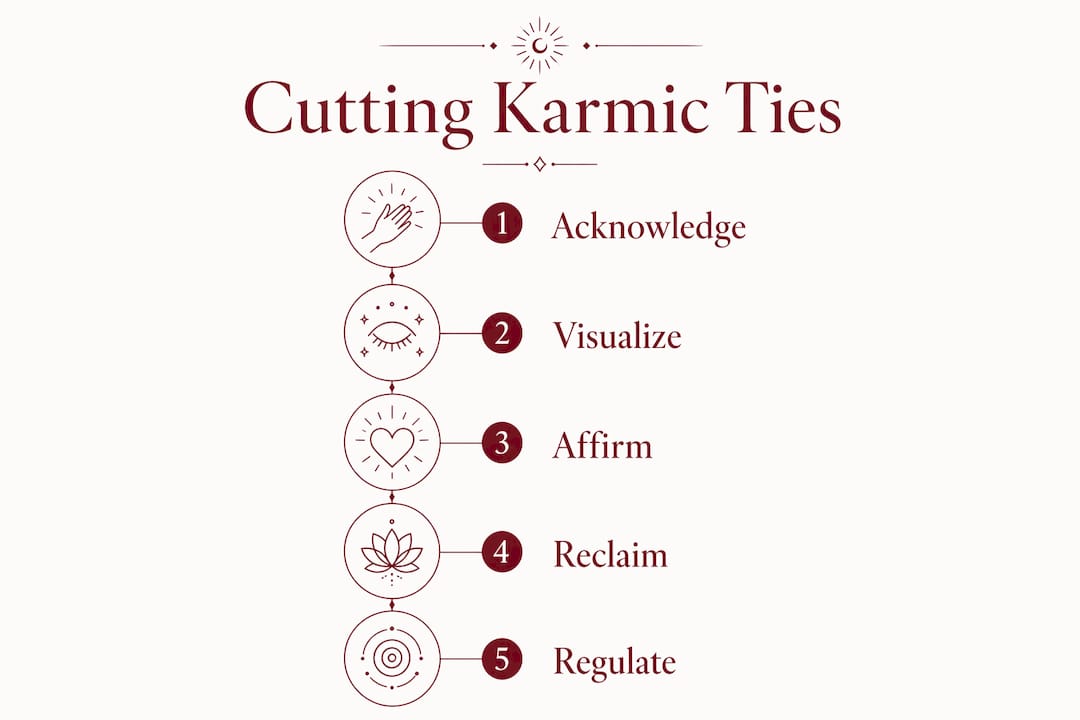
Step 1: Acknowledge the specific loop
Name the exact pattern you are releasing. “I carry my mother’s shame about money” is specific. “My family is toxic” is not. Specificity gives the practice direction and prevents the mind from generalizing the work into vague resentment.
Step 2: Visualize the energetic cord
Sit quietly and bring the family member to mind. Notice where in your body you feel the connection. Many people feel it in the solar plexus or heart. Visualize the cord as a physical object: its color, thickness, and texture. This is not imagination for its own sake. It is a way of making the unconscious attachment conscious so it can be addressed.

Step 3: Use affirmations to release the attachment
Speak your intention clearly. Phrases like “I release the pattern of inherited shame” or “I return your pain to you with love and reclaim my own energy” work because they combine acknowledgment with boundary. Avoid affirmations that deny the reality of what happened. Honest release is more effective than spiritual bypassing.
Step 4: Reclaim your energy
After releasing, actively call your energy back. Visualize it returning to your body as light or warmth. This step is often skipped, and skipping it leaves people feeling empty rather than free. Energy reclamation is what transforms the practice from loss into restoration.
Step 5: Regulate your nervous system afterward
Emotional release creates a temporary vulnerability. Use grounding techniques immediately after: walk barefoot outside, drink warm water, or place your hands on your heart and breathe slowly. This signals safety to your body and prevents the nervous system from interpreting the release as trauma.
Pro Tip: Perform this practice at the same time each week for at least four consecutive weeks. Karmic patterns are layered, and one session rarely addresses all of them.
The table below shows how each stage maps to its purpose and the tool that supports it.
| Stage | Purpose | Supporting tool |
|---|---|---|
| Acknowledge the loop | Make the pattern conscious | Journaling or therapy |
| Visualize the cord | Locate the attachment in the body | Guided meditation |
| Affirm and release | Set conscious intention to let go | Written or spoken affirmations |
| Reclaim energy | Restore personal vitality | Visualization or ritual |
| Nervous system regulation | Anchor the body after release | Breathwork or grounding |
Maintaining boundaries after the practice is not optional. Cord regrowth happens when guilt is left unaddressed or when the internal emotional work is skipped in favor of ritual action alone. The practice and the boundary must work together.
What are common misconceptions about releasing family karma?
The most damaging misconception is that cutting karmic ties requires ending the physical relationship. The cord cutting process is internal and energetic. You can maintain contact with a family member while completely releasing the energetic drain they once caused. The relationship changes because you change, not because you disappear.
Guilt during this process is conditioning, not conscience. Recognizing the difference is the turning point.
A second misconception is that family karma is permanent fate. It is not. Family karma is unfinished business, a set of inherited illusions and unresolved patterns that persist until someone in the lineage chooses a different path. You are not punished by your ancestors. You are carrying what they could not resolve. That is a very different thing, and it means the pattern can end with you.
Common pitfalls to avoid:
- Rushing through the visualization stage because it feels uncomfortable
- Treating one session as complete resolution when the pattern is decades old
- Confusing emotional numbness after a session with genuine release
- Expecting the family member to change because you did the internal work
- Using spiritual practice to avoid the psychological work of grief and boundary setting
The healing process requires gradual emotional regulation, not a single breakthrough moment. Patience with the timeline is not weakness. It is accuracy about how deep these patterns run.
How to maintain emotional freedom after cutting karmic ties
Sustaining the healing requires active, ongoing effort. Descendants unconsciously repay ancestral burdens until someone in the lineage consciously acknowledges the past and chooses not to perpetuate it. That choice must be renewed, not just made once.
Practices that support lasting freedom include:
- Daily grounding. Five minutes of conscious breathing or physical contact with the earth prevents energetic drift back into old patterns.
- Identity rebuilding. Actively develop preferences, values, and relationships that are yours alone, not inherited defaults. Ask regularly: “Is this mine, or did I absorb it?”
- Mindful acknowledgment of the past. Acknowledge what happened in your family without denying it or being consumed by it. Acknowledgment is not approval. It is clarity.
- Reconnecting with ancestral strengths. Not everything inherited is harmful. Reconnecting with ancestral roots for healing means reclaiming the wisdom and resilience in your lineage alongside releasing the pain.
- Adjusted contact boundaries. If you maintain contact with family members, revisit your boundaries regularly. What worked six months ago may need updating as you grow.
Generational healing does not require the whole family to participate. One person doing this work shifts the pattern for the entire lineage. That is not a metaphor. Systems-based healing, including approaches like Family Constellation work, shows that acknowledging ancestral burden rather than rejecting the family system produces the most durable resolution.
Key Takeaways
Cutting karmic family ties requires acknowledging specific emotional loops, releasing energetic attachments through conscious practice, and maintaining boundaries to prevent the patterns from returning.
| Point | Details |
|---|---|
| Karmic ties are energetic, not just relational | Shame, guilt, and blame loops persist even when physical contact is limited or absent. |
| Emotional regulation comes first | A stable nervous system is required before cord cutting practice can produce genuine release. |
| Cord cutting does not require estrangement | The process is internal; physical relationships can continue while energetic patterns are released. |
| Guilt is conditioning, not conscience | Feeling guilty during this work signals inherited conditioning, not moral wrongdoing. |
| Generational healing starts with one person | One individual doing this work consciously shifts inherited patterns for the entire family lineage. |
What I have learned from watching people do this work
The people who struggle most with releasing family karma are not the ones with the most painful histories. They are the ones who want the process to be faster than it is. They complete one visualization session and feel lighter, then wonder why the old pattern resurfaces two weeks later. The answer is always the same: the cord was thicker than one session could address.
What actually works is treating this as a practice, not an event. The same way you would not expect one therapy session to resolve years of conditioning, one cord cutting ritual does not dissolve decades of karmic inheritance. The people I have seen make real, lasting progress are the ones who combine internal emotional work with consistent spiritual practice and genuine boundary setting. They do not choose one or the other.
The forgiveness question comes up constantly, and I want to address it directly. Forgiveness is not a prerequisite for cutting karmic ties. Release is. You can release a pattern without forgiving the person who perpetuated it. Forgiveness may come later, or it may not. What matters is that you stop carrying the weight. That is the work. The rest follows in its own time.
Professional support is not a sign that the work is too hard for you. It is a sign that you understand the depth of what you are doing. Whether that support comes from a therapist, a spiritual counselor, or a practitioner with deep ancestral healing experience, having a skilled guide shortens the timeline and prevents the common pitfall of spiritual bypassing.
— Psychic
Motherodessa’s spiritual healing services for karmic release
Motherodessa has spent over 40 years working with clients navigating exactly this kind of deep, layered healing. Her approach, rooted in West African spiritual traditions, treats every situation as unique. No two rituals are the same because no two karmic histories are the same.

For those ready to go deeper, the Spiritual Healing & Clarity collection offers rituals designed specifically for releasing energetic burdens and restoring personal power. The Debt Clearing & Release Ritual addresses karmic debts carried across generations, while the Protection & Banishing Ritual supports the boundary work that follows cord cutting. Each service is conducted with complete confidentiality and full personalization to your specific situation.
FAQ
What does it mean to cut karmic family ties?
Cutting karmic family ties means consciously releasing the energetic and emotional patterns inherited from your family that continue to drain your energy or repeat as harmful cycles. It is an internal process, not necessarily a physical separation from family members.
Do I have to stop speaking to my family to release karmic bonds?
No. Cord cutting is an energetic process, and physical contact does not prevent the release of harmful patterns. Many people maintain family relationships while completely transforming the energetic dynamic.
How long does it take to break karmic bonds?
There is no fixed timeline. Karmic patterns are layered and often require repeated practice over weeks or months. Emotional regulation skills and professional support significantly speed the process.
Why do I feel guilty when I try to let go of family ties?
Guilt during this process stems from conditioning, not moral failure. It is the internalized voice of a family system that taught you to prioritize its needs over your own wellbeing.
Can cutting karmic ties heal future generations?
Yes. Acknowledging ancestral patterns and consciously choosing not to repeat them shifts the inherited burden for the entire lineage. One person doing this work changes what gets passed forward.