
A recurring family tragedy signals a curse or unresolved ancestral trauma when specific patterns of misfortune repeat across two or more generations. This is not about isolated bad luck. When mental health breakdowns, financial collapse, broken marriages, or early deaths appear in your grandparents, your parents, and now your own life, that repetition is the signal. Derek Prince Ministries documents seven distinct manifestations of generational curses. Psychology Today and Catholic Exchange both confirm that these patterns carry real psychological weight. Understanding why recurring family tragedy signals a curse is the first step toward changing the story your family keeps living.
What are the common signs that a family curse is present?
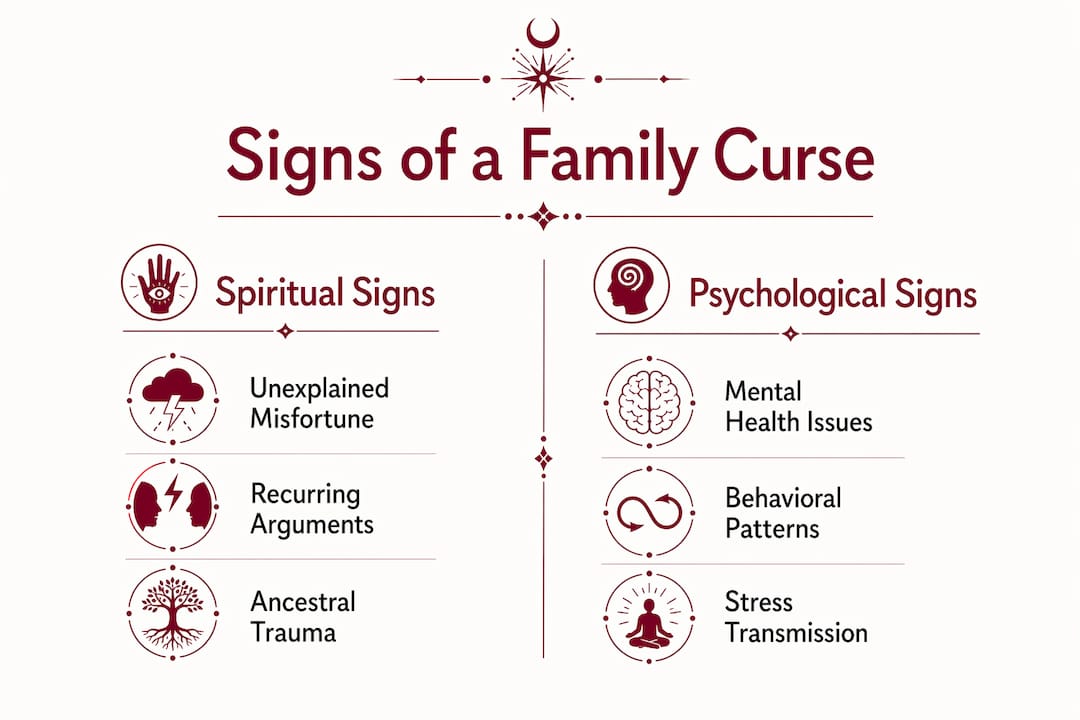
Generational curses manifest through seven specific repeating patterns: mental health breakdowns, chronic hereditary sickness, repeated miscarriages, broken marriages, financial insufficiency, accident proneness, and unnatural deaths across two or more generations. One occurrence is a tragedy. The same tragedy in your grandmother, your mother, and your sister is a pattern that demands attention.
Beyond the spiritual markers, legal and psychological experts flag a second layer of warning signs. Sudden mood changes, financial irregularities, withdrawal from responsibilities, and statements of hopelessness often precede a family tragedy. These behavioral signals are frequently dismissed as personality quirks. That dismissal is exactly how the pattern continues.
What appears to be ordinary stress can be an early warning of systemic tragedy requiring immediate intervention. The difference between a family that breaks the cycle and one that does not is often whether anyone recognized these signs early enough to act.
- Repeated mental health crises across generations
- Chronic illness patterns with no clear medical explanation
- Multiple miscarriages or infant losses in the family line
- Marriages that end in abandonment, betrayal, or violence
- Persistent financial failure despite consistent effort
- Unusual frequency of accidents or sudden deaths
- Social withdrawal and emotional exhaustion in multiple family members
Pro Tip: Noticing three or more of these signs across two or more generations is a far stronger indicator of a generational curse or ancestral trauma than any single incident on its own.
How do spiritual beliefs and psychology both explain recurring family misfortune?
Spiritual and psychological frameworks reach the same conclusion from different directions. Both say the pattern is real, both say it is inherited, and both say it can be changed.
| Framework | Core Explanation | Key Mechanism | Example |
|---|---|---|---|
| Spiritual (Derek Prince Ministries) | Generational sin opens the family line to curse effects | Spiritual warfare and unbroken covenants | Repeated financial ruin tied to ancestral vows of poverty |
| Spiritual (Methodist Message) | Generational sin effects can be broken through repentance and inner healing | Cooperation with the Holy Spirit | Healing broken marriage patterns through spiritual restoration |
| Psychological (Catholic Exchange) | Trauma passes through family systems via learned behavior | Transactional cascade | Children of combat veterans showing heightened emotional vulnerability |
| Psychological (Psychology Today) | Family therapy addresses core systemic conflicts | Improved communication and restored trust | Adolescents breaking cycles of conflict through structured therapy |
The spiritual view holds that a curse is an external force that entered the family line through sin, trauma, or broken covenant. The psychological view calls the same phenomenon intergenerational trauma, where destructive behaviors and emotional wounds are modeled and absorbed by each new generation. The practical difference between these two views is smaller than it appears. Both require active intervention. Neither resolves on its own.
What makes the psychological concept of transactional cascade particularly useful is its specificity. Studies of children of combat veterans show that vulnerability is transmitted through the family environment, not through fate. That finding matters because it proves the pattern is real and measurable, and it proves the pattern can be interrupted.
Why do recurring family arguments point to something deeper?
Recurring family conflicts are rarely about what they appear to be about. Unresolved patterns cause re-emergent conflict, meaning the same fight resurfaces because the underlying wound was never addressed. A family that argues constantly about money is often not arguing about money. They are expressing inherited anxiety, shame, or fear that was never named or healed.
Harbour Family Counselling identifies surface conflicts as defensive mechanisms masking deeper ancestral trauma. The argument about who forgot to call becomes a proxy for decades of emotional abandonment. The fight about finances replays a grandparent’s shame about poverty. Until the root is addressed, the argument will keep returning in slightly different forms.

This is one of the clearest signs that a family is dealing with a generational curse rather than ordinary disagreement. Ordinary disagreements get resolved. Cursed patterns return. Understanding family curses across generations helps explain why the same emotional wounds keep surfacing in new relationships and new contexts.
Pro Tip: Addressing only the surface conflict, without exploring the ancestral or systemic wound beneath it, will not break the pattern. The argument will return within weeks or months in a new form.
How can families break the cycle of recurring tragedy?
Breaking the cycle requires a structured, multi-layered approach. No single conversation or ceremony resolves decades of inherited trauma. Effective healing demands sustained, multi-month commitments to integrated family and individual therapies rather than isolated interventions.
Psychotherapist Shane Tull emphasizes that early support for caregivers can prevent escalation to tragedy in family systems. Overwhelmed parents, particularly mothers, are often the first point of collapse in a generational pattern. Supporting them proactively changes the trajectory for the entire family.
- Map the pattern. Write out the recurring tragedies, illnesses, or conflicts across at least three generations. Look for the specific type of misfortune that repeats.
- Name the behavioral signs. Identify mood changes, withdrawal, financial irregularities, or hopelessness in current family members. These are active warning signs, not personality traits.
- Seek family therapy. Psychology Today confirms that family therapy improves communication, restores trust, and resolves systemic conflicts. Commit to at least several months, not a single session.
- Add spiritual support. Spiritual intervention, whether through prayer, ceremony, or inner healing work, addresses the dimension of the pattern that therapy alone may not reach.
- Support caregivers first. The person carrying the most weight in the family system is often the most at risk. Prioritize their support before the system collapses further.
- Reconnect with ancestral roots. Healing ancestral wounds through intentional practice restores a sense of identity and breaks the isolation that keeps patterns hidden.
The goal is not to erase family history. The goal is to stop history from writing the future.
What are the biggest myths about family curses?
The most damaging myth about a family curse is that it is a fixed sentence. Catholic Exchange is direct: family history influences but does not determine the future. The freedom to change is foundational to overcoming generational patterns.
| Myth | Reality |
|---|---|
| A curse is an arbitrary punishment from outside forces | Curses often reflect systemic trauma or unresolved ancestral behavior passed through the family |
| Individuals are helpless victims of their family history | Personal choices and active intervention can interrupt the pattern at any generation |
| Breaking a curse requires one dramatic event or ritual | Sustainable change requires sustained therapy, spiritual work, and behavioral shifts over time |
| Only spiritually weak families experience generational curses | Trauma and inherited dysfunction affect families across every background and belief system |
| If the pattern hasn’t broken yet, it never will | Patterns break when the right combination of awareness, support, and action is applied |
The concept of transactional cascade from Catholic Exchange is particularly clarifying here. It shows that what looks like fate is actually a chain of learned behaviors and emotional responses. Each link in that chain was created by a person. Each link can be broken by a person. That reframe shifts the question from “are we cursed?” to “what do we need to heal?”
Tragedy in family history does not make healing impossible. It makes healing necessary.
Key Takeaways
Recurring family tragedy signals a curse or generational trauma when the same patterns of misfortune, conflict, and breakdown repeat across multiple generations, and both spiritual and psychological frameworks confirm these patterns can be interrupted through sustained, integrated healing.
| Point | Details |
|---|---|
| Pattern recognition is the first step | Seven specific manifestations, including broken marriages and financial failure, indicate a generational curse when they repeat across generations. |
| Both spiritual and psychological views align | Derek Prince Ministries and Catholic Exchange both confirm that inherited patterns are real and require active intervention to break. |
| Recurring conflicts mask deeper wounds | Surface arguments that keep returning signal unresolved ancestral trauma, not ordinary disagreement. |
| Healing requires sustained commitment | Multi-month family therapy combined with spiritual support produces lasting change; isolated interventions do not. |
| Family history is not fate | Catholic Exchange confirms that influence is not inevitability. Personal choices and awareness can break the cycle at any generation. |
What 40 years of working with families has taught me about curses
The families who come to me carrying the heaviest burdens are rarely the ones who have experienced the most dramatic tragedies. They are the ones who have stopped asking why. They have accepted the pattern as their identity. That acceptance is the most dangerous part of a generational curse.
What I have seen consistently is that the moment a family names the pattern, something shifts. Not because naming it removes it, but because it stops being invisible. An invisible pattern controls you. A visible pattern can be worked with. The spiritual dimension of this work matters enormously because ancestral wounds often carry a weight that purely clinical approaches do not fully reach. Ceremony, ritual, and intentional spiritual practice create a different kind of release.
The families who heal are not the ones who found the fastest solution. They are the ones who committed to the long work. They combined therapy with spiritual support. They supported their most vulnerable members instead of isolating them. They stopped treating the symptoms and started addressing the root.
Recurring tragedies are not a life sentence. They are a call. The question is whether your generation will be the one that answers it.
— Psychic
Spiritual healing for families ready to break the pattern
Motherodessa has spent over 40 years helping families identify and address the spiritual roots of recurring misfortune. Her approach is rooted in West African healing traditions and is fully personalized. No two families carry the same curse, and no two ceremonies are the same.

Motherodessa’s spiritual healing services cover protection, ancestral clearing, financial blockages, and health restoration. For families dealing with repeated financial collapse, the Debt Clearing & Release Ritual addresses the spiritual layer of financial patterns that therapy alone cannot reach. For families facing repeated illness or loss, the Health & Healing Ritual works directly on the ancestral wound. Every service is private, personalized, and grounded in decades of real results.
FAQ
What does it mean when tragedy keeps repeating in a family?
Repeated tragedy across two or more generations signals a generational curse or unresolved ancestral trauma. Derek Prince Ministries documents seven specific manifestations, including mental health breakdowns, broken marriages, and financial failure, as the clearest indicators.
Is our family cursed or just unlucky?
A curse differs from bad luck by its specificity and repetition. When the same type of misfortune, such as financial ruin or early death, appears in your grandparents, parents, and your own generation, that pattern points to a curse or inherited trauma rather than random chance.
Can psychology explain a family curse?
Catholic Exchange confirms that psychological research supports the concept of intergenerational trauma through a mechanism called transactional cascade. Learned behaviors and emotional wounds pass through family systems, producing the same outcomes in each generation without supernatural cause.
How long does it take to break a generational curse?
Psychology Today confirms that effective healing requires sustained, multi-month commitments to integrated family and individual therapy. There is no single session or ceremony that resolves decades of inherited patterns. Consistent effort over time produces lasting change.
Can one person in a family break the cycle for everyone?
One person’s healing does not automatically heal the entire family, but it does interrupt the pattern for that individual and can influence the family system. Catholic Exchange confirms that personal choices and awareness can break the cycle at any generation, regardless of what others in the family choose.