
If the same targeted problems keep surfacing across multiple generations, such as addiction, repeated divorce, unexplained illness, or financial collapse, and they resist ordinary help, that pattern can point to a generational spiritual stronghold or a deeply entrenched family cycle. The cause is usually mixed: spiritual, learned, and biological factors overlap more often than any single explanation admits. Start by mapping three generations of your family history, then pursue both a spiritual assessment and professional care rather than choosing one path over the other.
TL;DR:
- Repeated family issues like addiction, illness, or relationship breakdowns that do not respond to therapy or change in circumstances may indicate a spiritual stronghold rather than inherited traits.
- An accurate family timeline covering three generations helps identify targeted patterns, which can signal either spiritual curses or inherited predispositions.
- Persistent problems that worsen during spiritual practices or resistance to counseling suggest a spiritual root, while issues that respond to therapy or environmental changes are likely learned behaviors or biological.
- Investigating occult involvement, family oaths, or unresolved rituals is crucial for spiritual assessment, but sensitivity is necessary to avoid reopening old wounds.
- Combining spiritual ceremonies with ongoing therapy and honest family communication offers the most effective long-term strategy to break recurring patterns.
Table of Contents
- Common Signs of a Generational Curse Across Family Lines
- Spiritual Stronghold or Inherited Pattern? How to Tell the Difference
- Points of Entry: Family History Details Worth Investigating
- When to See a Therapist, Doctor, or Deliverance Minister
- A Step-by-Step Plan to Start Breaking the Pattern
- What Mother Odessa’s Approach Adds to a Combined Plan
- Historical Family Trauma and Its Lasting Psychological Toll
- Cultural and Religious Perspectives on Generational Curses
- How Different Traditions Identify a Generational Curse
- Why Family Secrecy Keeps Curses and Patterns Alive
- Long-Term Healing Strategies That Outlast the First Ceremony
- Naming the Pattern Comes First
- How Mother Odessa Can Help You Address a Suspected Generational Curse
- Sources
- FAQ
Common Signs of a Generational Curse Across Family Lines
Most families carry some repeated struggle. What separates an ordinary rough patch from a real generational curse sign is repetition with a specific target, one issue showing up in similar form across multiple generations, regardless of varying circumstances.
Deliverance-focused counseling resources and ministry guides consistently flag a similar cluster of patterns when they describe signs of demonic oppression tied to generational curses:
- Addictions and compulsive behaviors that repeat in form, alcohol in one generation, substance dependency in the next, pornography or gambling in another.
- Chronic, unexplained illnesses or a family history of premature or untimely deaths that doctors can’t fully account for.
- Relationship wreckage that follows a script: repeated divorce, cycles of abuse, or sudden emotional cutoff between parents and children.
- Financial collapse or business failure that recurs despite real effort, education, and opportunity.
- Frequent accidents or a string of life breakdowns that seem to target the same areas of life.
- Persistent emotional patterns like chronic depression, unexplained rage, or a constant sense of inner condemnation that doesn’t lift with circumstances.
Pro Tip: Write down every recurring issue you can name for three generations before you try to interpret any of it. Patterns are far easier to spot on paper than in memory.
One detail deliverance practitioners point to often: these patterns tend to intensify rather than fade during genuine spiritual growth, prayer, fasting, or active ministry work. Some interpret that intensification as evidence of a spiritual stronghold pushing back rather than simple coincidence.
Spiritual Stronghold or Inherited Pattern? How to Tell the Difference
Not every repeated family problem is spiritual in origin. Epigenetics research shows that trauma and stress can leave chemical marks on gene expression that get passed to children, raising vulnerability to anxiety, addiction, or depression without guaranteeing the outcome. Predisposition is not destiny.
Behavior gets transmitted the ordinary way too: children model what they watch. A father who manages conflict with silence teaches that pattern by example, no supernatural component required. Attachment styles, coping strategies, and even financial habits often pass down through observation alone.
So how do you tell the difference? Ask whether the pattern holds steady across completely different environments and whether it responds at all to counseling, medication, or changed circumstances.
“Many so-called curses are inherited patterns and predispositions rather than supernatural sentences, and awareness plus consistent intervention can genuinely alter the trajectory,” according to Psychology Today’s analysis of ancestral patterns.
If a pattern persists no matter where someone lives, who they marry, or how much therapy they get, and it actively worsens around prayer or deliverance work, that combination is what most practitioners treat as a spiritual indicator rather than a purely learned one.
Points of Entry: Family History Details Worth Investigating
Spiritual practitioners across traditions look for specific historical markers when tracing where a curse may have entered a family line:
- Occult involvement. Witchcraft, divination, ritual objects, or family altars used for anything beyond decoration.
- Covenants and oaths. Secret vows, sexual soul ties, or cultural rites that function as binding spiritual agreements, even generations later.
- Inherited objects or places. Heirlooms, land, or homes tied to a known ritual history or unresolved tragedy.
- Family interviews. Ask older relatives gently, without accusation, and write down what you learn to build your timeline.
Handle these conversations with care. Guides on identifying family curses recommend treating occult history inquiries with sensitivity, since digging into old family secrets can reopen wounds that need as much compassion as curiosity.
When to See a Therapist, Doctor, or Deliverance Minister
Some situations need immediate professional attention before any spiritual work makes sense. Active self-harm, substance dependency, or ongoing abuse call for a doctor or licensed therapist first, always.
Once safety is handled, the paths split by function, not competition:
- A therapist helps you process trauma, build coping skills, and treat diagnosable conditions with evidence-based methods.
- A pastor or deliverance minister addresses the spiritual dimension: prayer, discernment, and ceremony aimed at severing a suspected stronghold.
- A medical provider rules out biological causes behind chronic illness before anyone assumes a spiritual explanation.
Pro Tip: Bring your three-generation timeline to both appointments. A therapist and a spiritual practitioner working from the same document catch different things, and neither has to guess at your history.
Focus on the Family’s pastoral guidance recommends exactly this combined approach: therapy and spiritual care working in parallel rather than treated as competing options.
A Step-by-Step Plan to Start Breaking the Pattern
Breaking a generational pattern rarely happens in one dramatic moment. It happens through a sequence of concrete, trackable actions.
- Build the timeline. Write out three generations, parents, grandparents, great-grandparents, and mark every repeating issue: health, money, relationships, spiritual events.
- Book two intake appointments. Schedule a therapy consultation and request a spiritual diagnostic reading within the same month.
- Address physical objects. If you’ve identified an inherited item tied to ritual history, don’t destroy it impulsively, get guidance on removing or cleansing it safely first.
- Set accountability. Choose one mentor, pastor, or therapist who checks in on your progress, not just your intentions.
- Track milestones at 30, 90, and 180 days. Note what’s changed, what hasn’t, and where each type of intervention seems to be making a difference.
Counselors and deliverance ministers alike point to the three-generation written timeline as a low-cost, high-value tool precisely because it turns a vague family feeling into something you can actually work with. Naming a pattern on paper is itself a therapeutic act. It shifts you from feeling controlled by history to actively studying it.
What Mother Odessa’s Approach Adds to a Combined Plan
This approach involves West African–rooted spiritual healing that treats generational patterns as something to interrupt through personalized ceremony rather than generic ritual. Her practice sits alongside counseling and pastoral care, not in place of it.
Two services map directly onto the process described above:
- The Generational Curse Breaking Ceremony addresses a suspected spiritual stronghold once you’ve already identified a recurring pattern through your family timeline.
- The Full Spiritual Diagnostic Reading helps clarify whether what you’re seeing has a spiritual root before you commit to a specific ceremony.
Every working is personally conducted and reported back to the client, with privacy maintained throughout and no templated approach applied to two different family histories.
Historical Family Trauma and Its Lasting Psychological Toll
Trauma doesn’t stay contained to the person who lived through it. A grandparent’s war experience, forced migration, or abuse history can shape parenting style, communication habits, and even a family’s baseline stress response for decades afterward.
Children raised by a traumatized parent often absorb hypervigilance or emotional withdrawal as normal, then pass that same nervous-system pattern to their own kids without ever naming what happened. Nobody sat down and taught it. It transmitted through daily interaction, tone of voice, and what got left unsaid at the dinner table.
This is where spiritual and clinical explanations actually converge more than people expect. A family might describe a recurring depression or rage pattern as a curse, while a trauma-informed therapist describes the same pattern as an inherited stress response. Both descriptions can be pointing at the same underlying reality from different angles.
The psychological cost compounds when nobody in the family ever processes the original event. Grief that goes unspoken in one generation tends to surface as anxiety, control issues, or emotional numbness two generations later, often in people who never even knew the original story. That’s part of why a family-tree mapping exercise matters so much: it’s frequently the first time anyone has laid the full history out where the connections are visible.
Cultural and Religious Perspectives on Generational Curses
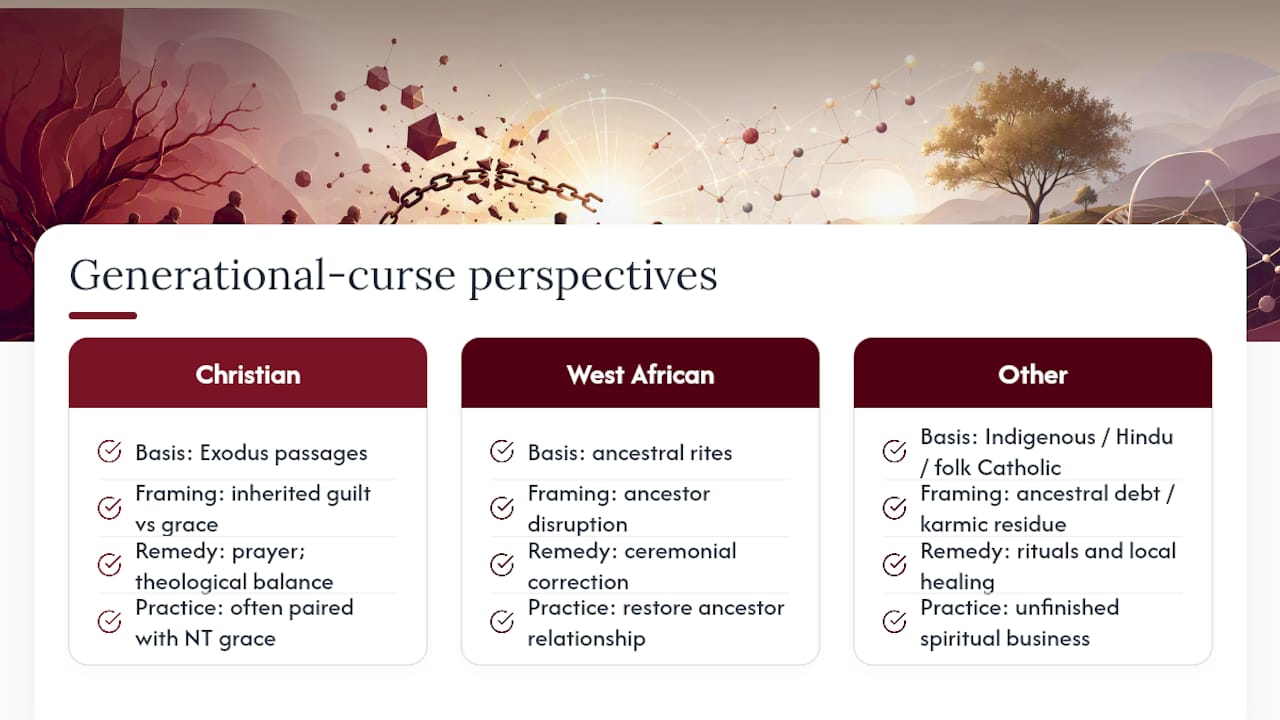
Christian traditions most often anchor the concept in Exodus 20:5 and Exodus 34:7, passages describing how iniquity can affect descendants to the third and fourth generation. Many pastors pair that framing with New Testament passages, including sections of Romans, that emphasize freedom through grace rather than permanent inherited guilt, a balance Focus on the Family walks through in detail.
West African spiritual traditions approach the same territory differently, often framing generational trouble in terms of ancestral disruption, unresolved rites, or broken covenants that need active ceremonial correction rather than pure theological interpretation. The emphasis falls on restoring right relationship with ancestors and spirit through specific ritual action.
Other traditions, from various Indigenous practices to certain strands of Hinduism and folk Catholicism, describe comparable ideas using their own vocabulary: ancestral debt, karmic residue, or unfinished spiritual business. The mechanisms described vary, but the underlying observation repeats across cultures: unresolved family history has consequences that outlast the people who lived it.
None of these frameworks are mutually exclusive in practice. Plenty of families draw on more than one tradition at once, praying within their own faith while also seeking a ceremonial or ancestral healing approach that speaks to their cultural background.
How Different Traditions Identify a Generational Curse
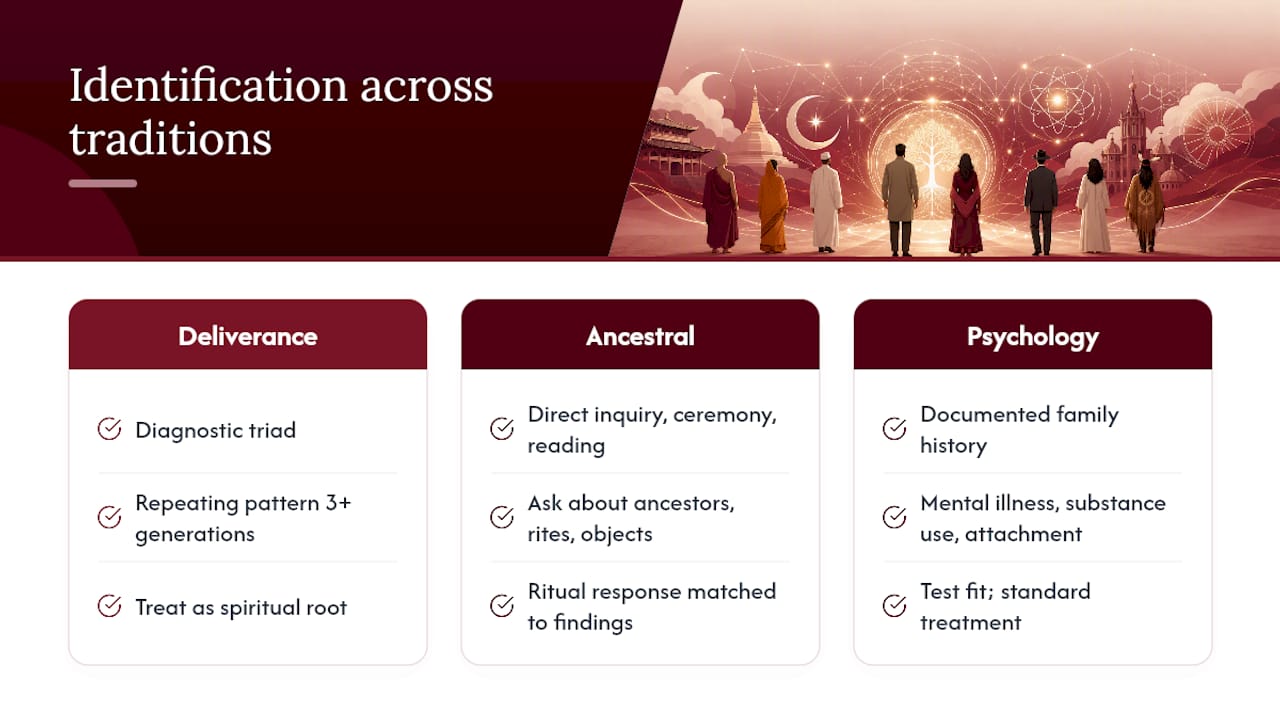
Deliverance ministries typically rely on a diagnostic triad: a repeating, targeted pattern across three or more generations, persistence despite major life changes like relocation or new relationships, and intensification during active spiritual practice such as prayer or fasting. When all three line up, practitioners treat that as strong evidence of a spiritual root.
West African ancestral healing traditions often work through direct inquiry, ceremony, and reading rather than a checklist. A practitioner may ask about specific ancestors, unresolved rites, or objects passed down, then design a ritual response matched to what surfaces. The process stays personalized because no two family histories carry the same details.
Clinical psychology approaches the identification question from a completely different angle, looking at documented family history of mental illness, substance use disorders, and attachment disruption, then testing whether the client’s current struggles fit a recognizable inherited pattern that responds to standard treatment.
What’s notable is how often these three methods land on the same families and the same clusters of issues, just described in three different vocabularies. That convergence is part of why a combined approach makes practical sense instead of forcing a choice between them.
Why Family Secrecy Keeps Curses and Patterns Alive
Silence is one of the most effective ways a destructive pattern survives. When a family refuses to discuss an ancestor’s addiction, an old affair, or a ritual history, later generations lose the information they’d need to even recognize a repeating pattern when it shows up in their own lives.
Secrecy also blocks the diagnostic tools that actually work. A three-generation timeline is only as useful as the information relatives are willing to share, and shame around addiction, mental illness, or occult involvement routinely keeps that information locked away for decades.
There’s a quieter cost too. Kids raised in families where certain topics are permanently off limits often learn that secrecy itself is the coping strategy, then they apply the same silence to their own struggles as adults. The specific problem changes. The pattern of hiding it doesn’t.
Breaking that cycle usually starts with one person choosing to ask questions out loud, gently, without blame, and writing down what they learn even when the answers are incomplete. That single shift in communication can matter more than any individual ritual or therapy session, because it’s what makes every other intervention possible in the first place.
Long-Term Healing Strategies That Outlast the First Ceremony
A single deliverance session, therapy breakthrough, or ceremony rarely finishes the work on its own. Lasting change usually depends on what happens in the months and years afterward.
Combining spiritual deliverance work with ongoing clinical therapy reduces the risk of overlooking a treatable mental health or medical condition hiding behind what looks like spiritual oppression, an approach Focus on the Family frames as both safer and more thorough than relying on either path alone.
Practical rituals and culturally rooted ancestral healing carry weight beyond the symbolic. Ceremony creates structure, marks a clear before-and-after, and builds social accountability, three things that support real behavior change over time, not just in the moment the ritual happens.
Sustaining that change tends to require ongoing check-ins with a mentor or counselor, periodic revisiting of the family timeline as new information surfaces, and honest conversation with the next generation so the pattern doesn’t simply go quiet for a decade before resurfacing. Prevention, in other words, is an active practice, not a one-time fix. Families that stay engaged with their own history tend to catch a recurring issue early, while it’s still a minor pattern rather than a full-blown crisis.
Naming the Pattern Comes First
Faith and science describe this territory differently, but they agree on one point: naming a pattern is the first act of changing it. That’s not fatalism, and it’s not denial either. It’s the starting move that makes every other intervention possible.
— Psychic
How Mother Odessa Can Help You Address a Suspected Generational Curse
A personalized, West African–rooted ceremony designed around your specific family history rather than a one-size-fits-all script is one option available alongside therapy or prayer.

The Generational Curse Breaking Ceremony is built for exactly the situation this article describes: a pattern that’s shown up across generations and hasn’t budged despite ordinary effort. If you’re not yet certain whether what you’re facing is spiritual, environmental, or both, the Full Spiritual Diagnostic Reading gives you a clearer read before you commit to a specific working. These services are designed to be conducted with attention to privacy and can be used alongside therapy or pastoral care rather than replacing them. You can also browse the full protection and curse-removal collection if your situation calls for a different kind of intervention entirely. Start by requesting your diagnostic reading, then build your ceremony plan from what it reveals.
Sources
This article drew on scripture-based pastoral guidance, deliverance-ministry sign lists, and psychological research on inherited trauma, including Focus on the Family’s biblical analysis, Psychology Today’s piece on ancestral patterns, and a related discussion of integrating ancestral and scientific healing approaches.
- It’s not a generational curse. It’s a choice
- SIGNS YOU ARE DEALING WITH A FAMILY GENERATIONAL CURSE
- How To Identify Generational Curses: 7 Biblical Clues Today
FAQ
What Signs Most Often Point to a Generational Curse?
Recurring addiction, chronic unexplained illness, repeated divorce or abuse, and financial collapse that persists across three or more generations are the signs practitioners flag most consistently. The strongest indicator is a pattern that resists ordinary intervention and intensifies during genuine spiritual activity rather than fading with it.
How Do I Know if My Family Line Is Affected?
Write out a three-generation timeline of every recurring issue, health, money, relationships, and spiritual events, and look for a targeted pattern that repeats in similar form. If the pattern holds steady across different environments and doesn’t respond to counseling or lifestyle change, a spiritual diagnostic reading can help clarify the root.
How Can You Tell if a Generational Curse Has Actually Been Broken?
Most practitioners point to a durable shift: the specific pattern stops recurring in the next relationship, job, or life stage where it used to reappear automatically. Real change tends to hold across new circumstances rather than lifting temporarily after one ceremony or session.
How Do You Remove a Generational Curse?
Removal typically combines a spiritual ceremony, such as the Generational Curse Breaking Ceremony, with ongoing counseling and honest family communication about the pattern’s history. Practitioner guides recommend building a three-generation timeline first, since it clarifies exactly what the ceremony needs to address.