
Cowrie shell reading is a West African-derived divination method that uses small shells cast by hand and read by their open or closed position. Two systems dominate the practice: Obi, a simple four-shell cast anyone can learn to interpret, and Diloggun (Ẹẹ́rìndínlógún, or Merindinlogun), a sixteen-shell oracle almost always reserved for initiated priests. A beginner can responsibly try Obi at home. Diloggun is a different matter entirely.
TL;DR:
- Obi provides quick yes/no answers for simple questions but cannot address complex life issues or underlying causes.
- Proper practice requires initiation and respect for the tradition, especially for Diloggun, which is typically restricted to trained practitioners.
- Home Obi readings can be learned easily with four shells and proper cleansing, but intricate situations need professional guidance for accurate interpretation.
- Complex problems involving health, legal, or recurring issues should be handled by initiated diviners, not self-taught or casual casts.
Table of Contents
- Where Cowrie Divination Comes From
- Obi vs. Diloggun: The Two Systems Compared
- How Do You Read Cowrie Shells at Home?
- What Diloggun Consultations Actually Reveal
- Respecting the Tradition: Ethics and When to Call a Professional
- How Practitioners Handle a Reading From Start to Finish
- A Practitioner’s Note on Respect and Realistic Expectations
- Get a Full Reading When Obi Isn’t Enough
- Sources
- FAQ
Where Cowrie Divination Comes From
Cowrie divination traces back to Yoruba spiritual practice in West Africa, where it developed alongside a wider system of oracles tied to the Orishas, deities who govern forces like love, war, wealth, and fate. Enslaved Africans carried the practice across the Atlantic, where it took root and evolved into Santería in Cuba, Candomblé in Brazil, and Umbanda among other diaspora traditions. Each tradition retained the shell as a communication tool between the living and the spirit world.
What makes this different from a tarot reading or a horoscope is its purpose. Cowrie divination isn’t primarily about predicting a future event. Ethnographic research on Senegambian shell divination describes its real function as diagnosing a problem and prescribing a remedy, usually a ritual action called ebbo. A reading names what’s wrong and tells you what to do about it.
Central to Diloggun specifically is the concept of odu, the sacred narrative patterns that shell combinations reveal. A few things worth understanding upfront:
- Odu function like chapters of a moral and spiritual library, each carrying its own stories, warnings, and prescriptions.
- The Orishas speak through these patterns, meaning a reading is understood as their direct counsel, not the diviner’s opinion.
- Sixteen shells is the standard count for full Diloggun readings, producing significantly more nuance than simpler casts.
Obi vs. Diloggun: The Two Systems Compared
Most people encounter cowrie divination through one of two systems, and confusing them leads to real misunderstandings about what a reading can and can’t tell you.
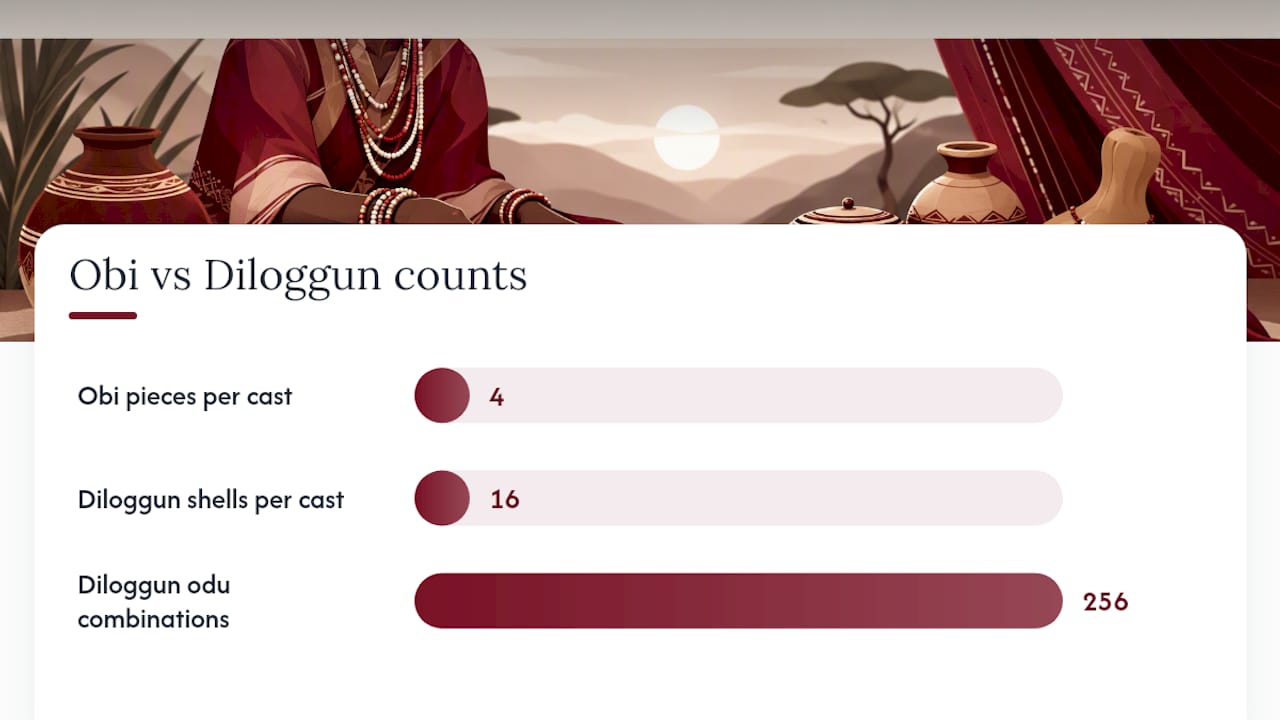
Obi uses four pieces, traditionally coconut or cowrie, cast together to produce a straightforward yes/no/maybe answer. It’s built for everyday questions: should I take this job, is this the right week to travel, is a spirit at peace. Diloggun uses sixteen cowrie shells, each one falling either mouth up (open) or mouth down (closed), and the specific mix maps to one of 256 possible odu combinations. That’s a staggering range of narrative outcomes compared to Obi’s handful of patterns.
A few practical distinctions matter if you’re new to this:
- Obi answers narrow questions; Diloggun addresses complex, layered life situations and produces detailed prescriptions.
- Shell preparation varies by lineage. Some diviners use natural, unaltered cowries; others shave the back flat so the shell reliably lands open or closed rather than rolling on its curve.
- Diloggun is generally read by initiated santeros and santeras, while Obi is simple enough to be taught to newcomers without initiation.
That last point is the one beginners most often overlook, and it shapes everything about how you should approach practicing at home.
How Do You Read Cowrie Shells at Home?
An Obi reading is the one genuinely accessible entry point into cowrie divination, and you can learn a respectful, basic version in an afternoon. Here’s the full process.
What you need:
- Four cowrie shells (or a substitute like coconut rind pieces, which is traditional in some Obi practices)
- A clean cloth or mat to cast on
- A cleansing method: smoke from sage or palo santo, a light salt water rinse, or Florida Water, a citrus-herbal cologne common in many spiritual traditions
- A quiet space and a few minutes without interruption
The steps:
- Cleanse the shells before first use, and periodically afterward, to clear residual energy from handling or storage. Practitioner guides consistently recommend smoke, salt water, or Florida Water for this.
- Hold the shells in both hands, close your eyes, and state your question clearly and specifically. “Should I take this job” works far better than “what does my future hold,” because Obi is built for narrow, answerable questions, not sweeping predictions.
- Cast the shells onto your cloth from a modest height, letting them fall naturally.
- Count how many land mouth up (open) versus mouth down (closed).
- Read the result using the basic four-shell matrix below.
| Mouth-up count | Common meaning |
|---|---|
| 4 open | Strong yes, a blessing or clear favorable answer |
| 3 open | Yes, but proceed with some caution |
| 2 open | Mixed or uncertain, consider rephrasing the question |
| 1 open | No, or a caution against the path in question |
| — | Strong no, often read as a warning |
Pro Tip: If you land on a 2 open result more than twice in a row, stop and rephrase your question rather than recasting the same one. A muddled answer often means the question itself wasn’t specific enough.
What Diloggun Consultations Actually Reveal
Diloggun readings don’t stop at yes or no. When a santero casts sixteen shells, the count of mouth-up shells points toward a specific odu, and that odu carries its own story, proverb, and prescribed course of action. A relationship question might surface an odu warning about betrayal within one’s own household. A health concern might point toward an odu tied to imbalance that calls for a cleansing before any medical or personal decision moves forward. A career question could reveal an odu about hidden opposition, prompting a protective working before a big move.
These outcomes work at a high level, and that’s intentional. A few reasons why:
- The full verses attached to each odu are extensive, orally transmitted texts, documented in academic work like Sixteen Cowries, and not meant for casual reproduction outside the tradition.
- Interpreting which specific verse applies within an odu requires years of trained memory and mentorship, not a quick reference chart.
- Publicly disclosing restricted odu content is considered a real ethical breach within the tradition, not just a formality.
Respecting the Tradition: Ethics and When to Call a Professional
Initiation exists because Diloggun’s authority isn’t self-taught. A santero’s ability to read shells accurately comes from a lineage of teaching, ritual preparation, and accountability to their own elders, not from owning a set of shells. Respecting that means a few concrete things in practice.
- Don’t present yourself as qualified to read Diloggun without initiation, even after watching tutorials or reading books.
- Credit the tradition you’re drawing from, and pay initiated practitioners fairly for their time and training.
- Treat Obi as a personal tool for small questions, not a replacement for a full consultation.
Pro Tip: If a question involves your health, a legal matter, or the same problem showing up in reading after reading no matter how you rephrase it, that’s your signal to book a real consultation rather than keep casting shells at home.
How Practitioners Handle a Reading From Start to Finish
Experienced diviners don’t treat a cast as an isolated event. A reading typically opens with a conversation about the client’s history and the specific situation driving the question, since the same shell pattern can mean something different depending on context. Repeated throws are used to confirm a pattern rather than accepting a single cast as final, and the ritual setting itself, from cleansing to prayer, is treated as part of the reading’s accuracy, not decoration.
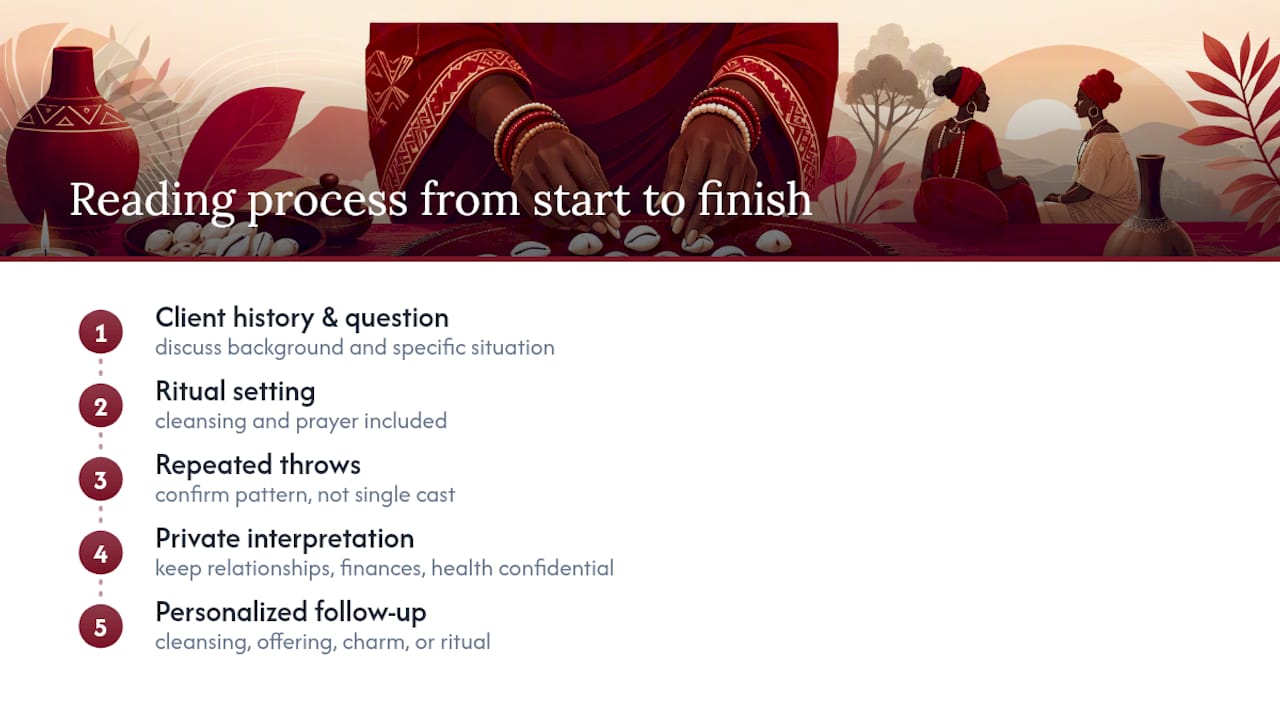
Confidentiality runs through all of it. What a reading uncovers about a client’s relationships, finances, or health stays private. Common follow-ups after a diagnostic reading include a cleansing to clear blockages, an offering to a specific Orisha, a charm built for a stated purpose, or a fully custom ritual designed around what the shells revealed. That personalization, built on someone’s actual history rather than a generic template, is what separates professional guidance from a solo cast at your kitchen table.
A Practitioner’s Note on Respect and Realistic Expectations
Cowrie work, done properly, is consultational and restorative. It names a problem plainly and offers a path toward resolving it, whether that’s a cleansing, an offering, or a change in direction. It was never meant to entertain or to hand someone a fortune to memorize.
Anyone drawn to this practice should hold two things at once: curiosity about a tradition worth learning, and real respect for the lineages and trained practitioners who carry it responsibly. A four-shell Obi cast at home for a small question is a fine place to start. A complicated situation involving your relationships, your finances, or your health deserves an initiated diviner’s attention, not a guess.
— Psychic
Get a Full Reading When Obi Isn’t Enough
An Obi cast at your kitchen table answers a yes or no question. It won’t tell you why the same problem keeps circling back, and it can’t prescribe the specific ritual work a complicated situation actually needs. Motherodessa fills that gap with a Full Spiritual Diagnostic Reading built on the same consultational principle behind Diloggun: diagnose the real issue, then prescribe what actually addresses it, drawn from over 40 years of practice in West African spiritual tradition.
If your question centers on love, a Personal Psychic Reading can clarify what’s really happening before you decide on next steps, while a Money & Abundance Ritual addresses financial blocks a simple shell cast can only hint at. Every reading and ritual is customized to your specific situation and kept private. Browse the full collection of readings and rituals to find the one that matches what’s actually going on in your life, and book a consultation when you’re ready for answers an at-home cast can’t give you.
Sources
For readers who want to go deeper, Wikipedia’s overview of cowrie-shell divination covers the sixteen-shell standard and odu system. Knut Graw’s ethnographic study of Senegambian shell divination explains its consultational role. Sixteen Cowries documents the odu corpus in academic depth, and Divinity Atlas details Diloggun’s practitioner requirements.
- Cowrie-shell divination — Wikipedia
- The Logic of Shells: Knowledge and Lifeworld-Poiesis in Senegambian Cowrie Divination — Knut Graw (Project MUSE summary)
- The Sacred Power of Cowrie Shell Divination — Original Botanica
FAQ
How Do You Read Cowrie Shells?
You cast the shells by hand onto a clean surface and count how many land mouth up versus mouth down. In a basic four-shell Obi reading, the count is matched to a simple yes/no matrix; in the sixteen-shell Diloggun system, the pattern maps to a specific odu that carries its own narrative and prescription, which is why Diloggun is generally read by initiated practitioners.
What Do Cowrie Shells Mean Spiritually?
Cowrie shells are understood as a channel through which the Orishas communicate guidance, warnings, and prescribed remedies rather than fixed predictions. Their spiritual value lies in diagnosing an underlying problem and pointing toward a specific ritual action, or ebbo, to restore balance.
How Many Cowrie Shells Do You Need for Divination?
A basic Obi reading uses four shells and produces a straightforward yes/no/maybe answer suited to everyday questions. The full Diloggun oracle uses sixteen shells, generating far more detailed and specific guidance, and it’s typically performed only by initiated diviners.
How Do You Use Cowrie Shells to Attract Money Spiritually?
A shell reading can point toward what’s blocking financial progress, whether that’s a pattern in your habits, a spiritual obstruction, or timing that isn’t right yet. From there, the usual next step is a specific ritual, offering, or working aimed at the abundance area, rather than expecting the shells themselves to draw money. Motherodessa’s Money & Abundance Ritual is one option built specifically for that follow-up work.