
Bone reading, or osteomancy, is a divination method that reads the positions and relationships of bones and small objects after they’re cast onto a surface. Practitioners toss a set of bones, shells, or tokens and interpret how they land, which pieces sit close together, which point at each other, and which end up face down. The outcome isn’t a fixed prediction. It’s guidance, a way to surface what you already sense but haven’t named yet.
TL;DR:
- Bones and other objects used in divination should be sourced ethically, prioritizing found or responsibly sold animal remains and avoiding protected species.
- Using a small, balanced set of similar-weight materials enhances the accuracy of casts, while ethical alternatives like stones and tokens can substitute animal bones effectively.
- Interpretation focuses on spatial relationships such as proximity, orientation, and stacking, with specific layouts like quadrants or past-present-future aiding beginners.
- Consistent practice, journaling outcomes, and gradually increasing complexity build reliability and skill in bone reading over time.
- Bone readings serve as reflective tools that reveal underlying patterns and attention points rather than precise predictions of future events.
Table of Contents
- What Is Bone Reading Divination and Where Does It Come From?
- What Goes Into a Bone Set: Materials and Ethical Alternatives
- How Do You Source Bones Ethically and Legally?
- How Do You Cast and Read a Bone Set?
- How Do You Interpret a Bone Cast?
- How Do You Build Real Skill at Bone Reading?
- How Does an Experienced Practitioner Use Bone Reading?
- Why Bone Reading Still Matters for Personal Growth
- How Mother Odessa Can Guide Your Bone Reading Journey
- Sources
- FAQ
What Is Bone Reading Divination and Where Does It Come From?
Osteomancy is the umbrella term for divination performed with bones. Two more specific words show up constantly in the literature, and it helps to know the difference. Scapulimancy refers specifically to reading shoulder blades, a method with a documented history stretching from ancient China to parts of North America. Plastromancy uses turtle plastrons, the flat underside of the shell, and shows up in the same East Asian oracle bone traditions that scapulimancy comes from.
Historians split these methods into two camps:
- Pyromantic techniques heat or burn the bone and read the cracks that form, a practice documented in oracle bone research from China’s Shang dynasty period.
- Apyromantic techniques skip the fire entirely and read the bones as cast or as found, which is closer to what most modern practitioners do.
- Southern African sangoma traditions use apyromantic bone throwing, where specific bones carry fixed, taught meanings passed down through structured apprenticeship.
- Indigenous American traditions developed their own bone and shell casting methods, often tied to specific regional animals and local cosmology.
Scapulimancy’s global spread is worth sitting with for a second. This isn’t one culture’s invention borrowed by others. Bone reading emerged independently across continents, which tells you something about how instinctive it is to look for meaning in scattered remains. The methods differ because the cultures differ. Sangoma practice demands years of apprenticeship before a diviner touches a client’s bones unsupervised. Casual Western practitioner traditions tend to lean on personal intuition over inherited rules. Neither approach is more “real” than the other. They’re built for different purposes and different relationships to authority.
What Goes Into a Bone Set: Materials and Ethical Alternatives
A working bone set rarely contains only bones. Most practitioners mix in shells, stones, beads, and carved tokens, each one assigned a specific meaning by the person building the set. Contemporary osteomancy sets typically draw from a handful of categories:
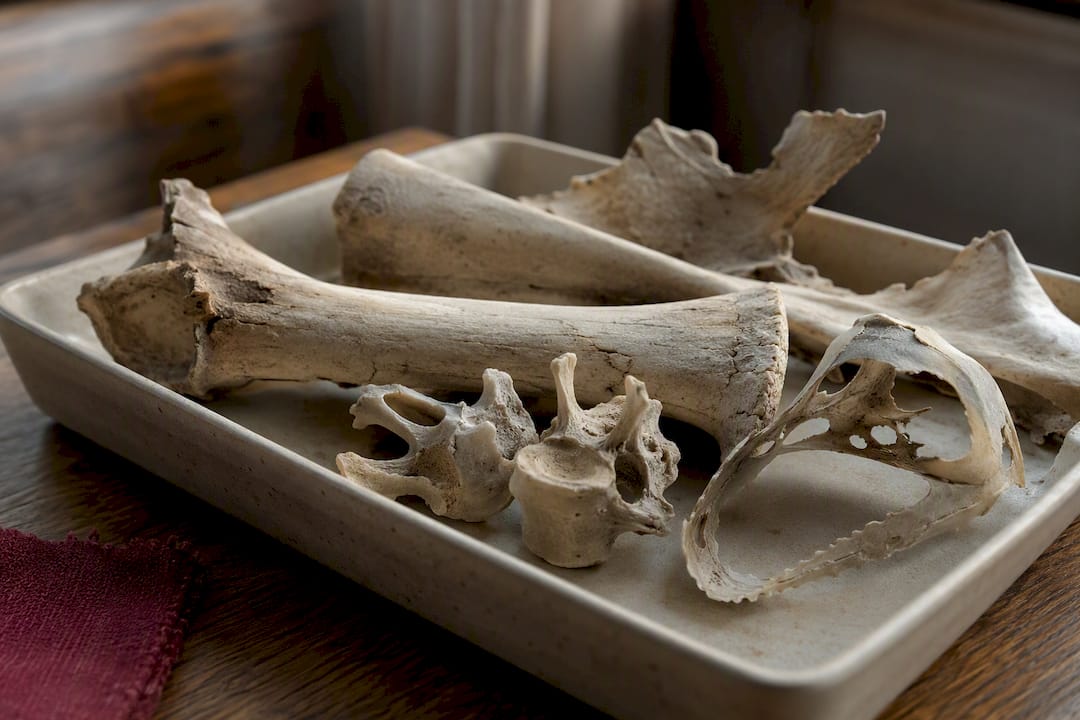
- Small animal bones — vertebrae, knuckles, and rib fragments are common because they’re small enough to cast easily and durable enough to survive repeated handling.
- Shells and stones — cowrie shells and river stones often stand in for bones entirely, especially in traditions or personal practices that avoid animal remains.
- Carved or painted tokens — wood, bone, or resin pieces marked with symbols (a moon, a coin, a cross) give you fixed meanings you can assign without hunting down a specific animal part.
- Found objects with personal resonance — a button from a grandmother’s coat, a shard of sea glass, a chipped marble. If it means something to you, it belongs in the set.
Weight and size balance matters more than people expect. If half your set is heavy vertebrae and the other half is featherlight shells, your casts will skew: the heavy pieces cluster in the center while lighter ones scatter to the edges regardless of what the reading actually wants to tell you. Aim for pieces that fall in a similar weight range so the spread reflects the toss, not just physics.
Ethical alternatives have grown more popular for good reason. Shells, beads, and carved tokens let you build a set with the same interpretive depth as bones, without sourcing animal remains at all. Plenty of practitioners find that a set built entirely from stones and tokens feels just as personally resonant as one built from bone, sometimes more so, because every piece was chosen rather than found.
Pro Tip: Start your set small. A modest number of pieces is plenty for a beginner. A bloated set makes early casts chaotic and hard to read, and you can always add pieces once you know what’s missing.
How Do You Source Bones Ethically and Legally?
Sourcing is where good intentions meet real legal and ethical friction, so it pays to think it through before you start collecting.
Follow a rough hierarchy when building a set:
- Found and cleaned bones from legal hunting, butchering, or roadside finds (where local law permits collection) sit at the top of the list, since nothing was taken from a living population for the purpose of divination.
- Ethically sold bones from reputable sellers who disclose species and sourcing come next.
- Non-animal alternatives (shells, stones, carved tokens) are a fully legitimate substitute, not a lesser one, and they sidestep sourcing questions entirely.
Avoid protected or endangered species without exception, and steer clear of anything marketed as a genuine cultural or ceremonial artifact taken from a specific tradition. Buying a “real sangoma bone set” off a marketplace site is rarely what it claims to be, and even when it is, it strips the object from the practice that gave it meaning.
Check local laws before collecting anything yourself. National and state parks generally prohibit removing animal remains, and some jurisdictions regulate possession of specific species’ bones even when found rather than hunted. A few minutes of research saves you a legal headache later.
Bone structure itself affects what’s worth collecting. Zooarchaeological research on bone taphonomy shows how prior treatment, weathering, and structural density determine whether a piece will hold up to repeated casting or crumble within a year. Dense limb bones and vertebrae tend to survive handling far better than thin skull fragments.
Pro Tip: If you want to learn a specific tradition’s fixed meanings rather than build your own intuitive system, seek out a teacher from that tradition rather than piecing it together from blog posts. Cultural roots strengthen spiritual work in ways that secondhand summaries can’t replicate.
How Do You Cast and Read a Bone Set?
Casting technique is simple to learn and takes longer to refine. Here’s a repeatable process:
- Prepare your surface. A cloth marked with a circle, a wooden board, or even a section of clean floor works. Mark quadrants or a circle boundary in advance if you’re using a layout that depends on zones, since adjusting lines after the toss defeats the point.
- Hold the set loosely in both hands. Cup the bones rather than gripping them tightly. A tight grip makes for an uneven, clumped toss.
- Ask your question silently or aloud, then release the bones over the surface from a modest height, roughly a foot or two above the cloth. Too high and the spread turns chaotic; too low and pieces barely move from your hand.
- Toss with consistent force each time. Consistency matters more than power. A gentle, repeatable toss gives you a spread you can compare across readings.
- Note what lands inside your boundary versus outside it. Many practitioners simply discard or set aside anything that falls off the cloth entirely.
Three layouts work well for beginners. A free scatter gives you the loosest read: proximity and clustering matter, but there’s no fixed zone structure. A quadrant layout divides the surface into four zones, commonly love, money, health, and general path, and you read each zone independently. A past, present, future layout uses three zones in a line or arc, letting you track how a situation is shifting rather than reading it as a single snapshot.
Ask one specific question per cast. Vague questions produce vague spreads, and the temptation to ask three things at once just muddies which piece answers what.
How Do You Interpret a Bone Cast?
Interpretation runs on a handful of spatial principles that show up across most osteomancy traditions.
- Proximity signals relationship. Two pieces landing close together suggests their meanings are connected to the situation in a direct way.
- Orientation matters, especially face up versus face down. A piece landing face down or reversed often signals blockage, delay, or a reversal of its usual meaning.
- Pointing draws a line of influence. If one bone’s long edge points toward another, read it as directing attention or energy toward that second piece’s meaning.
- Stacking intensifies or qualifies. A piece landing on top of another strengthens, complicates, or sometimes overrides the meaning of the piece underneath.
- Clusters and oppositions show groupings worth reading as a unit, and pieces landing on opposite sides of the surface can represent tension or a choice between two paths.
Practitioner guides on casting and reading bones describe an “answer bone,” the single piece that lands closest to the center or most directly addresses the question asked. Finding it first often makes the rest of the spread easier to read, since everything else gets interpreted in relation to it.
Two short examples show the method in practice. In the first, a reader asks about a stalled job application. A coin token (opportunity) lands face up near the center, with a small vertebra (patience) stacked directly on top of it. The read: the opportunity is real, but it’s currently constrained, so the advice leans toward waiting rather than pushing. In the second, someone asks about a strained friendship. Two shells representing each person land on opposite edges of the cloth, with a cracked stone (conflict) sitting exactly between them. That’s a straightforward opposition: distance and an unresolved issue sitting right in the middle of it.
Scholarly treatments of divination generally frame results this way: reflective guidance rather than a literal forecast. A cast doesn’t tell you what will happen. It surfaces what you already half know and gives you a structured way to sit with it.
How Do You Build Real Skill at Bone Reading?
Skill comes from repetition, not talent. Here’s a practice structure that works for most beginners:
- Weeks 1 to 2: Cast once daily with a single yes or no question. Don’t overthink the read. Just note the spread and your gut interpretation.
- Weeks 3 to 4: Move to open questions (“What should I focus on this week?”) and start a journal entry for each cast, recording the question, the spread, your interpretation, and what actually happened afterward.
- Weeks 5 to 6: Try blind casts, where you interpret the spread before remembering what question you asked, then check whether your read still holds once you recall the question.
Journaling is where meanings stop being arbitrary. Beginner guides to osteomancy consistently point to tracking outcomes over time as the method that turns a set of assigned meanings into a system you can actually trust. Write down what each piece meant in a given cast and what happened afterward. Patterns emerge faster than you’d expect.
You’ll know you’re ready for a more experienced teacher when your own readings start feeling inconsistent in a way journaling can’t resolve, or when you want to learn a specific tradition’s fixed vocabulary rather than build an intuitive one from scratch.
Pro Tip: Keep a dedicated notebook or grimoire section just for bone casts. Mixing them into a general journal makes it much harder to spot patterns across dozens of readings.
How Does an Experienced Practitioner Use Bone Reading?
An experienced practitioner of West African spiritual traditions may use bone reading alongside other divinatory tools depending on a client’s situation.
- Bone casts often open a session, surfacing the underlying issue before any ritual work is designed around it.
- Readings get combined with other diagnostic methods rather than treated as the sole source of guidance, since no single tool tells the whole story.
- Every interpretation is built around the client’s specific circumstances. No two sessions run the same script.
- Sacred or fixed-meaning bone systems are used only within the context she was trained in, not performed loosely outside that tradition.
Client sessions remain private, and specifics of individual case outcomes aren’t published here out of respect for that privacy.
Why Bone Reading Still Matters for Personal Growth
Bone reading works best when you stop expecting it to predict your future and start using it as a mirror. The spread doesn’t decide what happens next. It shows you where your attention already is, which is often more useful.
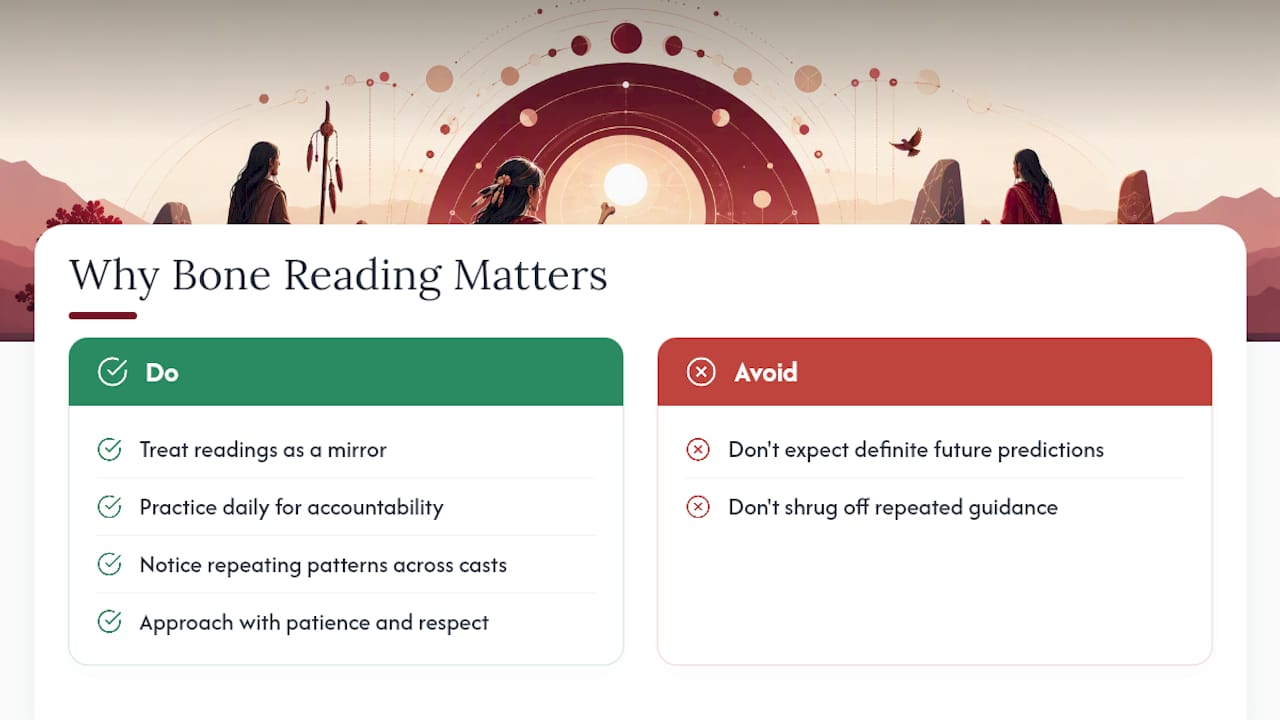
Daily practice builds a kind of accountability that’s hard to get elsewhere. A cast that told you to wait last week and a cast that says the same thing this week is a pattern worth noticing, not a coincidence to shrug off.
Approach it with patience, respect for the traditions it comes from, and a willingness to be wrong about your own first reads. That’s where the real value shows up.
— Psychic
How Mother Odessa Can Guide Your Bone Reading Journey
Reading your own bones teaches you plenty, but there’s a real limit to what self-taught interpretation can catch, especially when the question is heavy: a relationship on the edge, a financial situation that feels stuck, or a pattern you suspect runs deeper than one bad year. Some practitioners bring decades of experience in West African spiritual traditions to readings, integrating bone divination into broader diagnostic processes rather than treating it as a standalone party trick.
A Full Spiritual Diagnostic session identifies what’s actually driving your situation before any ritual work gets designed, and every diagnosis is built around your specific circumstances rather than a generic script. If your question centers on a relationship, the Love & Relationships collection includes readings and rituals designed for exactly that kind of clarity. Some practitioners deliver sessions privately as written reports with respect for client confidentiality. If you’re ready for a guided read instead of guessing alone at home, start with the Spiritual Healing & Clarity collection and book the reading that matches what you’re actually facing.
Sources
- Scapulimancy - Wikipedia
- Oracle Bone Burning research event - Wesleyan University
- Throwing Bones: How to Make & Read Osteomancy Sets – Otherworldly Oracle
- The archaeology of animal bones (chapter excerpts)
FAQ
How Do You Read Bones for Divination?
Cast your bone set onto a marked surface after asking a specific question, then interpret the spread using proximity, orientation, and stacking, starting with whichever piece lands closest to the center.
What Is Divination With Bones Called?
The general term is osteomancy, with scapulimancy referring specifically to shoulder blade divination and plastromancy referring to turtle shell divination.
What Do Bones Symbolize in Witchcraft and Divination Practices?
Bones typically symbolize ancestry, mortality, and grounded truth, since they’re what remains after everything else has decayed, making them a common symbol for what’s real underneath a situation.
What Bones Are Used for Divination?
Small animal vertebrae, knuckle bones, and rib fragments are common, though many practitioners now build sets using shells, stones, and carved tokens instead of animal remains entirely.
Can Bone Reading Predict the Future?
Most practitioner and scholarly sources treat bone reading as reflective guidance rather than a literal forecast. It surfaces patterns and pressures already present in a situation rather than delivering a fixed prediction.