
Most people treat spirituality as something personal and universal, a private inner world that exists above culture and history. But that assumption quietly undermines the depth and durability of their practice. Understanding why cultural roots strengthen spiritual work changes everything. When you know where you come from spiritually, not just personally but ancestrally and culturally, your practice gains an authority and resilience that no amount of meditation apps or generic ritual kits can replicate. The work stops being something you do and becomes something you are.
Table of Contents
- Key takeaways
- Why cultural roots strengthen spiritual work
- How your heritage deepens the spiritual work you do
- Rooted spirituality versus performative spiritual work
- How to integrate cultural roots into your spiritual practice
- My perspective on culture and spiritual depth
- Deepen your practice with Motherodessa
- FAQ
Key takeaways
| Point | Details |
|---|---|
| Cultural roots define spiritual identity | Family traditions, ancestral stories, and community practices shape the core of your spiritual self. |
| Ancestral connection builds resilience | Engaging your cultural heritage protects your spiritual practice from burnout and fragility. |
| Unhealed ancestral trauma blocks growth | Cultural engagement diagnoses and releases inherited patterns that hold your spiritual work back. |
| Rooted spirituality outlasts performative practice | Spiritual work grounded in culture is stable and sustaining, unlike isolated or trend-driven approaches. |
| Integration beats either/or thinking | Blending ancestral tradition with modern life creates a durable, authentic spiritual path. |
Why cultural roots strengthen spiritual work
Cultural roots are not simply traditions your grandparents kept or foods eaten at holidays. They are the living framework through which your ancestors made sense of birth, death, suffering, and transcendence. When you understand that framework, you inherit both a vocabulary and a map for your own spiritual life.
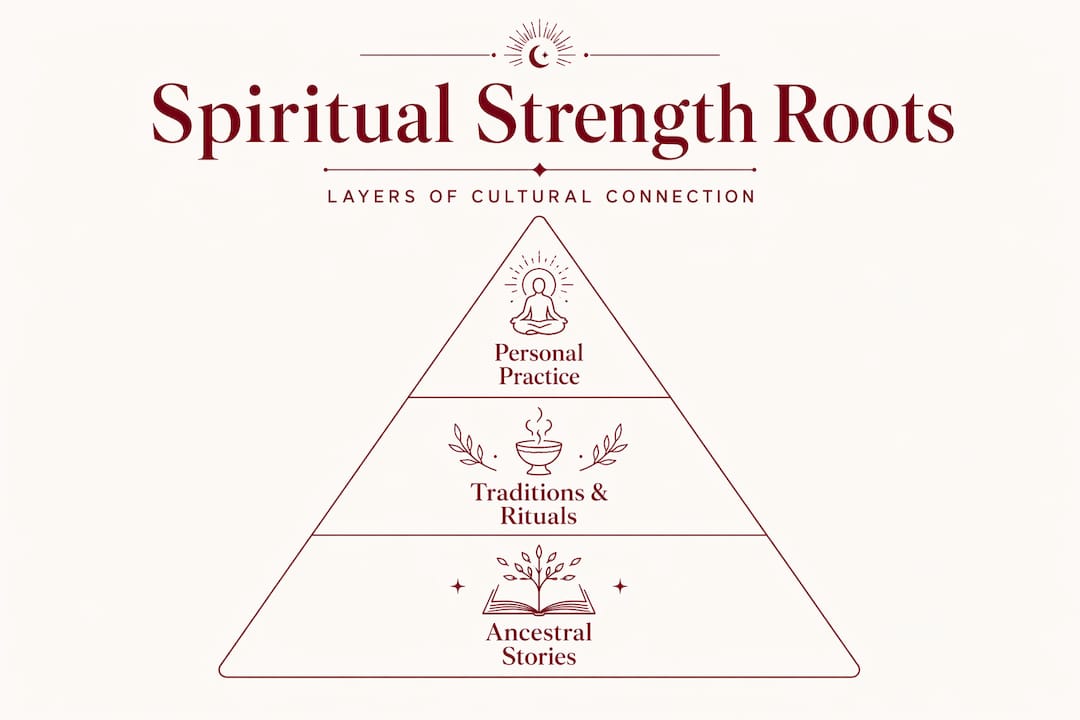
Cultural roots include three interlocking layers:
- Family narratives: The stories passed down about struggle, survival, migration, and faith. Family stories serve as protective psychological anchors that foster belonging and stable identity, especially across generations navigating major change.
- Community practices: Shared rituals, seasonal observances, and ceremonies that give individual experience a collective meaning.
- Symbolic systems: The images, prayers, deities, or spirits your cultural tradition has used to name what cannot be named.
These layers do not just add color to spiritual practice. They form the substance of it. Cultural identity is directly linked to better health, moral development, and personal growth, outcomes that sound psychological but land in the spiritual domain too.
Pro Tip: If you are unsure where your cultural spiritual roots lie, start with the oldest story you know from your family. That story likely carries the spiritual logic your lineage lives by.
Without this grounding, spiritual practice becomes a collection of borrowed techniques without a home. You might feel inspired in moments but groundless in the long run.
How your heritage deepens the spiritual work you do
Once you understand what cultural roots are, the next question is mechanical. How exactly do they deepen spiritual work? The answer operates on several distinct levels.
-
Ancestral wisdom provides spiritual authority. Every cultural tradition carries accumulated knowledge about what works, tested across centuries of real human suffering and real human transformation. Community-led rituals like full-moon meditation reaffirm sacred meaning and provide a buffer against spiritual commodification. That authority is not invented in the moment. It is inherited.
-
Cultural practices diagnose what individual introspection cannot. Unhealed ancestral trauma transmits biologically and psychologically. Ancestral patterns can be diagnosed and released through cultural spiritual engagement, which means the cultural framework is actually a precision tool, not a sentimental detour.
-
Ritual continuity creates consistency. When a ritual has been practiced across generations, it carries a specific gravity. You are not performing an action in isolation. You are participating in a living chain. That changes the felt quality of the work.
-
Cultural narratives guide moral conscience. The Yoruba tradition, for example, is built on teachings emphasizing harmony, character, and communal life. Yoruba spiritual ethics offer an inclusive, nature-centered framework for sacred selfhood. That moral architecture gives spiritual practitioners a compass beyond personal preference.
“A civilization without love for its customs and history becomes spiritually hollow and loses civilizational instinct, leading to disorientation and instability.” Rooted spiritual practice is not nostalgia. It is stability insurance for the soul.
The impact of culture on spiritual beliefs is not just emotional or psychological. It is structural. Culture tells you what to ask, what to honor, and what to release. That structure is the difference between spiritual dabbling and spiritual depth.
Rooted spirituality versus performative spiritual work

There is a growing phenomenon worth naming directly. Call it spiritual tourism. Someone discovers sound baths, borrows a smudging practice without its cultural context, layers in some chakra language, and calls it a spiritual practice. It feels good initially. Then it stops working. Then burnout sets in.
| Feature | Culturally rooted spirituality | Decontextualized spiritual practice |
|---|---|---|
| Source of authority | Ancestral lineage and community | Personal preference or trend |
| Resilience under pressure | High, grounded in inherited practice | Low, collapses under stress |
| Community dimension | Built in and sustaining | Absent or performative |
| Long-term sustainability | Consistent and deepening | Often leads to burnout |
| Relationship with identity | Integrative and affirming | Fragmented or borrowed |
Genuine spiritual growth requires internal formation rooted in ancestral alignment before public spiritual functioning becomes stable. Think of it as a hidden stage of grounding. The practitioners who skip it often look spiritually active from the outside while quietly running on empty.
The contrast is not about judging what tools people use. It is about recognizing that spiritual work without cultural roots often lacks the container needed to hold transformative experiences. When things get hard, there is nothing underneath.
Pro Tip: Ask yourself this: if you stripped away every spiritual practice you have borrowed from another culture, what would remain? That remainder is your starting point for building a rooted practice.
A society without love for its own cultural heritage becomes spiritually disoriented and vulnerable to radical identity shifts. That principle scales down to the individual level too. A person without cultural spiritual grounding is similarly exposed.
How to integrate cultural roots into your spiritual practice
Reconnecting with your cultural roots spiritually does not require living in the past or rejecting the present. The most successful practitioners approach this as a curated blend of tradition and modern life rather than a rigid either/or choice.
Here is where to start:
- Trace the spiritual practices of your lineage. Interview older relatives. Research your ancestral homeland’s spiritual traditions. Identify what was practiced before colonization, migration, or assimilation interrupted it.
- Recover the stories. Stories are the original spiritual technology of every human culture. Write down what you know. Notice the themes. Notice what was valued and what was feared. These are the bones of your inherited spiritual worldview.
- Incorporate ancestral symbols deliberately. This might mean placing objects tied to your lineage on a personal altar, learning prayers in your ancestral language, or observing seasonal ceremonies your tradition recognized.
- Work with a practitioner who understands your lineage. Solo reconstruction is possible but slow. A practitioner with deep cultural knowledge of your tradition can help you access and apply ancestral wisdom with precision.
- Address inherited wounds directly. Cultural spiritual engagement is partly diagnostic. If anxiety, scarcity, or shame run through your family line, that pattern likely has a cultural and ancestral origin. Ritual work oriented toward ancestral healing addresses those patterns at the root.
Appreciating religious cultural heritage fully means developing virtues of reverence and communal practice, not just intellectual interest. Read that again. Reverence is a spiritual posture, not a passive one.
Pro Tip: You do not need to practice your ancestral traditions perfectly to benefit from them. Even partial reconnection shifts the quality and depth of your spiritual work significantly.
The goal is not to recreate the past but to carry its wisdom forward. When you do that consciously, your spiritual work stops being something you manage and starts being something that sustains you.
My perspective on culture and spiritual depth
I have worked with people across decades of spiritual practice, and I will tell you what I keep seeing. The ones who struggle most with spiritual burnout are not the people who work too little. They are the people who work without roots. They have technique without lineage. Sincerity without context.
What I have learned is that when someone reconnects with their cultural spiritual heritage, even partially, something shifts in the quality of their presence. The work stops being effortful in the wrong way. There is a steadiness that no amount of meditation or journaling produces on its own. That steadiness comes from knowing you are not the first to walk this path. Your ancestors walked it before you, and their experience lives in your bones whether you acknowledge it or not.
I also want to say something that most spiritual content avoids. The discomfort of reconnecting with cultural roots is real. For people whose cultural heritage was disrupted by trauma, forced migration, or religious suppression, approaching that lineage can feel painful before it feels powerful. That discomfort is not a sign you are doing it wrong. It is usually a sign you are doing it right, touching something that needs to be touched.
The spiritual growth through cultural understanding that I have witnessed does not look like instant enlightenment. It looks like steadier people. People who can hold more. People whose spiritual practice survives hard seasons instead of crumbling under them. That is worth every uncomfortable moment of reconnection.
— Psychic
Deepen your practice with Motherodessa

Knowing why cultural roots strengthen your spiritual work is the beginning. Translating that knowledge into actual ritual practice is where transformation happens. Motherodessa specializes in exactly that translation, bringing over 40 years of West African spiritual tradition to personalized ritual work that honors your specific situation, ancestry, and need. No two clients receive the same approach because no two people carry the same history.
Whether you are working through generational patterns, seeking ancestral reconnection, or need a ceremony built around your unique spiritual circumstances, Motherodessa’s spiritual healing services offer the cultural depth and personal precision that generic spiritual content cannot provide. For clients ready for a fully personalized ceremony, the full custom ritual service is built from the ground up around your life. For those drawn specifically to ancestral restoration, the soul retrieval ceremony addresses the deepest layers of disconnection. Reach out and start where you actually are.
FAQ
What are cultural roots in spiritual practice?
Cultural roots in spiritual practice refer to the ancestral traditions, stories, rituals, and belief systems inherited through your lineage and community. They provide the foundational framework through which your spiritual identity is shaped and sustained.
Why does spiritual work feel unsustainable without cultural grounding?
Performative spiritual work without ancestral alignment often leads to burnout because it lacks the container that cultural continuity provides. Research supports that genuine spiritual growth depends on internal formation rooted in heritage before consistent spiritual functioning becomes possible.
How do ancestral trauma and cultural roots connect?
Ancestral trauma transmits biologically and psychologically across generations. Engaging cultural roots in spiritual practice helps identify and release those inherited patterns, using ancestry as a diagnostic and healing tool rather than just a historical reference.
Can I integrate cultural roots if my heritage was disrupted?
Yes. Cultural integration is best approached as a curated blend of recovered tradition and modern life rather than a strict reconstruction. Even partial reconnection with ancestral practices and stories significantly deepens spiritual work.
How does Motherodessa incorporate cultural roots into her rituals?
Motherodessa draws on over 40 years of West African spiritual tradition to create personalized rituals tailored to each client’s specific ancestry, history, and need. Her approach treats cultural heritage as the foundation of effective spiritual healing, not as an optional addition.