
Family secrets are hidden truths that create lasting wounds passed down through generations by shaping family dynamics, identity, and emotional health. The field of intergenerational trauma research defines these wounds as psychological and biological injuries that descendants inherit without ever knowing the original source. Understanding why family secrets create generational wounds requires looking at three distinct levels: the biology of stress inheritance, the psychology of silence, and the systemic patterns that keep dysfunction alive. The evidence is clear. Secrets do not stay buried. They travel.
Why family secrets create generational wounds: the biological evidence
Trauma from family secrets does not stop with the person who lived it. Epigenetic changes in the NR3C1 gene, documented in studies of Holocaust survivors’ descendants, show that DNA methylation patterns shift in response to severe stress. These shifts alter how the body regulates cortisol, the primary stress hormone, leaving descendants with a dysregulated HPA axis before they ever face a major life challenge.
The biological reach of this inheritance is striking. Trauma can persist for 3–4 generations through these epigenetic mechanisms, even when descendants have no direct exposure to the original trauma. That means a grandmother’s unspoken grief over a lost child, a grandfather’s shame about financial ruin, or a parent’s silence about abuse can show up in a grandchild’s nervous system as chronic anxiety or accelerated biological aging.
Research on famine survivors adds another layer. Genetic changes caused by severe food deprivation have been documented in grandchildren, showing increased metabolic disease risk. The body treats inherited stress as a survival signal, and it prepares future generations accordingly.

Pro Tip: If you experience unexplained anxiety, emotional numbness, or a persistent sense of dread with no clear cause, consider asking about your family’s history. The body often carries what the mind was never told.
| Biological Marker | What It Means for Descendants |
|---|---|
| NR3C1 gene methylation | Altered stress response, often leading to low cortisol and emotional dysregulation |
| HPA axis dysfunction | Difficulty managing stress, heightened anxiety under normal pressure |
| Accelerated biological aging | Cells age faster, increasing vulnerability to chronic illness |
| Epigenetic famine effects | Grandchildren show higher metabolic disease risk from ancestral starvation |
How do family secrets function as survival strategies and create dysfunction?
Family secrets did not originate as acts of cruelty. Silence once reduced danger in contexts where disclosure meant persecution, economic ruin, or social exclusion. A family that hid its Jewish identity during the Holocaust, or concealed a member’s mental illness in an era of institutionalization, was making a rational choice. The problem is that survival strategies outlive their usefulness. Once the original threat disappears, the silence remains, and it hardens into family law.
Systemic therapists describe silence as an active force, not a passive absence. Silence reorganizes family anxiety into emotional distance, rigid loyalty structures, and distorted roles. Children grow up sensing that something is wrong without being able to name it. That unnamed tension shapes how they attach to others, how they handle conflict, and how they define themselves.
“The emotional residue of secrets is more potent than the facts themselves. Descendants sense a ‘narrative absence’ and fill the gaps with anxiety and fragmented realities, perpetuating dysfunction across generations without ever knowing the original source of their pain.”
Therapists who work with family systems recognize several patterns that secrets create:
- Triangulation: One family member becomes the keeper of a secret, creating an unspoken alliance that excludes others and distorts relationships.
- Role reversals: Children take on adult emotional burdens, becoming caretakers for parents who carry unresolved shame or grief.
- Loyalty binds: Family members feel unconsciously obligated to maintain silence, even when doing so harms their own mental health.
- Identity fragmentation: Without access to the full family story, descendants struggle to form a coherent sense of who they are and where they come from.
Families keep secrets to protect younger members from judgment, but this protection actually blocks learning. Younger generations repeat dysfunctional patterns precisely because they lack the context to understand or interrupt them. The secret does not protect. It perpetuates.
What are the psychological impacts of family secrets on individuals?
The psychological consequences of growing up inside a family shaped by secrecy are well documented. Systematic reviews confirm that descendants of trauma survivors show higher rates of treatment-resistant depression, anxiety disorders, and emotional numbness. These symptoms are not random. They are triggered by family environment stressors that echo the original trauma without naming it.
The impact on attachment is particularly significant. Children who sense hidden tension learn that the adults around them are not fully trustworthy sources of truth. That lesson becomes a template for all future relationships. They grow up expecting deception, struggling to trust partners, friends, and even themselves. Shame and guilt compound the problem. Descendants often absorb the emotional weight of events they never witnessed, feeling responsible for pain they cannot explain.
Unresolved grief is another consistent feature. When a family secret involves loss, such as a miscarriage, a suicide, an addiction, or an affair, the grief never gets processed openly. It circulates instead as a vague, persistent sadness that no one can locate or name. This is what therapists call “disenfranchised grief.” It cannot be mourned because it was never acknowledged.
- Depression and anxiety appear at higher rates in descendants, often without a clear triggering event in their own lives.
- Emotional numbness develops as a protective response to a family environment that signals danger without explanation.
- Impaired trust shapes attachment styles, making close relationships feel unsafe or unreliable.
- Shame and guilt attach to events the descendant never participated in, creating a burden that feels both personal and inexplicable.
- Fragmented identity results from gaps in the family narrative, leaving descendants uncertain about their own history and sense of self.
Pro Tip: Therapy modalities like Internal Family Systems (IFS) and narrative therapy are specifically designed to help people reconstruct fragmented family stories and process inherited shame without requiring full disclosure from living relatives.
When secrets are eventually revealed, the reaction is rarely simple relief. Disclosure often triggers a family system crisis. The person who speaks the truth may face gaslighting, exclusion, or accusations of disloyalty. The family’s entire structure was built around the silence, and removing it destabilizes everyone.
How can addressing family secrets help heal generational wounds?
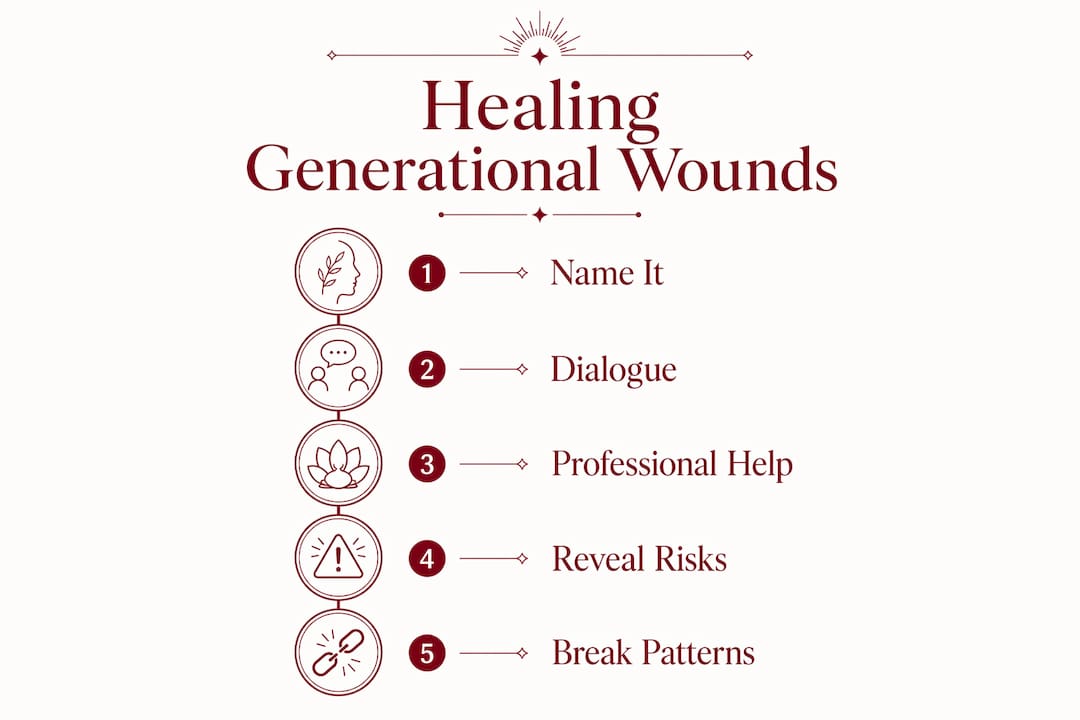
Healing generational wounds begins with naming what was hidden. Reinterpreting secrets through dialogue transforms rigid behavioral patterns, restoring empathy and reducing the emotional isolation that secrecy creates. This does not require a dramatic family confrontation. It requires a willingness to ask questions and sit with uncomfortable answers.
Professional support is not optional when the stakes are high. Revealing secrets carries real risks, including family rupture, gaslighting, and ostracism. A skilled therapist or family counselor can help manage the crisis that disclosure often triggers, holding space for multiple family members’ realities simultaneously.
Supportive caregiving and social resilience act as genuine buffers against trauma transmission. Psychiatric experts identify emotional availability as a critical protective factor. A parent who is present, honest, and emotionally regulated gives children a fundamentally different inheritance than one who is closed off and shame-driven. That shift alone can interrupt the cycle.
Practical steps that support healing include:
- Family therapy with a practitioner trained in systemic or intergenerational approaches, who can map patterns across generations.
- Narrative reconstruction through journaling, oral history projects, or genealogical research that fills gaps in the family story with facts rather than anxiety.
- Somatic practices such as breathwork, yoga, or body-based therapy that address the biological dimension of inherited stress.
- Ancestral healing ceremonies, including family altar rituals rooted in West African traditions, which create intentional space to honor and release ancestral burdens.
- Community support through grief groups, cultural organizations, or spiritual communities that normalize the experience of inherited pain.
Understanding how family curses repeat across generations is itself a healing act. When you can see the pattern clearly, you gain the ability to choose differently. That choice is where the cycle breaks.
Key Takeaways
Family secrets create generational wounds by transmitting trauma biologically, psychologically, and systemically, and healing requires naming what was hidden, seeking professional support, and building new patterns of openness.
| Point | Details |
|---|---|
| Biological inheritance is real | Epigenetic changes from trauma alter stress regulation in descendants for 3–4 generations. |
| Silence is an active force | Family secrecy reorganizes anxiety into rigid roles, loyalty binds, and distorted relationships. |
| Psychological impact is wide | Descendants experience depression, anxiety, impaired trust, and fragmented identity without knowing why. |
| Disclosure carries risk | Revealing secrets often triggers family crisis; professional guidance reduces the risk of rupture. |
| Healing is possible | Dialogue, therapy, somatic practices, and ancestral ceremonies can interrupt the cycle of inherited wounds. |
What I’ve learned from watching families carry their silence
I have sat with many people who came to me confused about why their lives felt so heavy. They had not experienced obvious trauma. Their childhoods looked fine from the outside. But something was wrong, and they could feel it without being able to name it. Almost every time, the weight they carried belonged to someone else first.
What strikes me most is how loyal people are to their family’s silence, even when that silence is destroying them. They protect secrets they were never told. They carry shame for events they never witnessed. They repeat patterns they never chose. That loyalty is not weakness. It is love, expressed in the only language the family ever taught them.
The hardest part of healing is not the disclosure itself. It is the moment when you realize that the people who kept the secret were also trying to protect you. That complexity deserves compassion, not judgment. Understanding healing the family tree means holding both truths at once: the harm was real, and the intention was love.
My practical advice is this. You do not need the full story to begin healing. You need the willingness to stop pretending the silence is not there. Start with a therapist. Start with a question. Start with a ceremony that honors what came before you. The ancestors who carried these burdens deserve to be seen, and so do you.
— Psychic
Spiritual support for breaking family patterns
Generational wounds run deep, and intellectual understanding alone rarely closes them. Spiritual healing addresses the layers that therapy sometimes cannot reach: the ancestral dimension, the energetic residue, and the felt sense of being bound to a painful past.

Motherodessa has spent over 40 years helping people clear the burdens their families passed down without meaning to. Her spiritual healing services are built around your specific situation, not a generic program. Whether the wound in your family line involves loss, shame, financial hardship, or broken relationships, Motherodessa works with you directly to identify what needs to be released and how. Each ritual is personalized, private, and grounded in West African healing traditions that have addressed generational pain for centuries. If you are ready to stop carrying what was never yours to carry, her work offers a real place to begin.
FAQ
What are generational wounds caused by family secrets?
Generational wounds are psychological and biological injuries passed from one generation to the next through unresolved trauma, silence, and dysfunctional family patterns. They manifest as depression, anxiety, impaired trust, and identity confusion in descendants who never knew the original secret.
How does trauma pass biologically through families?
Trauma alters DNA methylation patterns, particularly in the NR3C1 gene, which regulates the body’s stress response. These epigenetic changes can persist for 3–4 generations, affecting cortisol levels and emotional regulation in descendants.
Why do families keep secrets that cause harm?
Families keep secrets to protect members from judgment or danger, but protective motives block younger generations from learning and lead them to repeat dysfunctional patterns unknowingly.
What happens when a family secret is revealed?
Disclosure frequently triggers a family system crisis. The person who speaks the truth may face gaslighting or exclusion, which is why professional support is strongly recommended before and during the process of revealing long-held secrets.
Can generational wounds actually be healed?
Yes. Dialogue, systemic therapy, somatic practices, and ancestral healing ceremonies all reduce the transmission of inherited trauma. Supportive caregiving and emotional availability are the most consistently documented protective factors against passing wounds to the next generation.