
Unhealthy relationship patterns in families are defined as recurring cycles of dysfunction, conflict, and emotional harm that pass from one generation to the next through learned behavior and unresolved trauma. Understanding why unhealthy relationship patterns repeat in families requires looking at three core forces: behavioral modeling in childhood, trauma-driven changes in the brain, and family systems that reward stability over honesty. These forces do not operate in isolation. They reinforce each other across decades, which is why so many people recognize the cycle of unhealthy relationships in their own lives yet still struggle to escape it. The clinical term for this phenomenon is intergenerational trauma transmission, and it is far more common than most people realize.
Why unhealthy relationship patterns repeat in families: the role of behavioral modeling
Children learn how to relate to others by watching their caregivers. This process, called observational learning, means that a child raised in a home where conflict is handled through silence, rage, or manipulation will internalize those responses as normal. The brain does not label these behaviors as harmful during childhood. It simply files them as “how relationships work.”
Specific behaviors children absorb include:
- Avoiding direct communication during conflict
- Equating love with volatility or unpredictability
- Taking responsibility for a parent’s emotional state
- Suppressing personal needs to keep the peace
- Treating jealousy or control as signs of care
The impact of caregiver affection styles runs equally deep. A parent who withholds warmth teaches a child that love must be earned. A parent who swings between affection and anger teaches a child to stay hypervigilant, always scanning for the next shift in mood. These lessons do not disappear at adulthood. They shape how a person chooses partners, handles disagreements, and defines what intimacy feels like.
Pro Tip: If you notice you feel most comfortable in relationships that feel slightly chaotic or uncertain, that comfort is a signal worth examining. Familiarity and safety are not the same thing.
The impact of family on relationships extends beyond individual behavior. It shapes a person’s entire template for what a relationship is supposed to feel like, often without their awareness.

How does trauma change the brain and fuel family dysfunction?
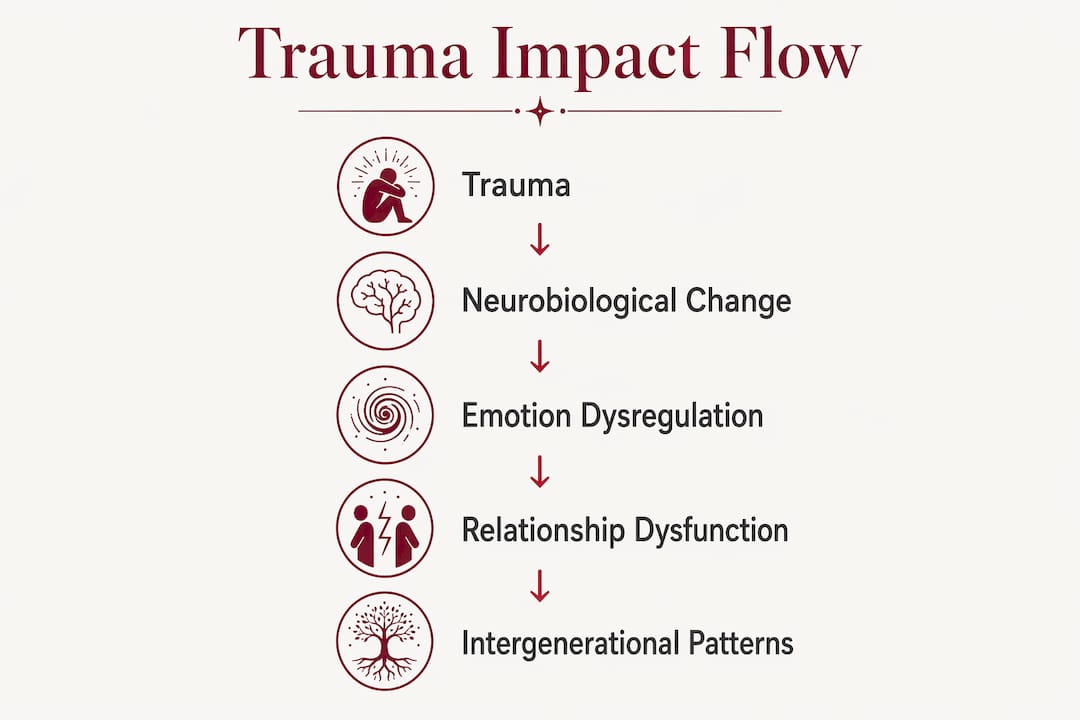
Trauma does not just leave emotional scars. It alters neurobiological function, changing how the brain processes threat, regulates emotion, and responds to stress. When a child grows up in a home with chronic conflict, neglect, or abuse, the nervous system adapts to survive that environment. Those adaptations become the default setting in adulthood.
Emotion dysregulation is the most direct consequence. A person who cannot manage their emotional responses will struggle with impulse control, conflict resolution, and consistent parenting. Research confirms that dysregulated parents are more likely to exhibit poor parenting behaviors, which increases their children’s future risk of abuse and dysfunction. The cycle does not require intent. It runs on autopilot.
The cycle of abuse itself follows a predictable structure, first identified by psychologist Lenore Walker in 1979:
- Tension building. Stress accumulates and communication breaks down.
- Incident. An outburst, act of abuse, or major conflict occurs.
- Reconciliation. Apologies, affection, and promises of change appear.
- Calm. A period of relative peace creates the illusion of resolution.
The reconciliation and calm stages are the most dangerous parts of this cycle. They feel like proof that the relationship is fundamentally good. They are not. They are the mechanism that keeps people trapped in escalating cycles of dysfunction.
Trauma bonding makes this worse. When stress and relief are paired repeatedly, the brain fuses attachment to both the person causing harm and the relief that follows. Leaving feels impossible not because the relationship is good, but because the nervous system has learned to need both the wound and the comfort.
This is why so many people describe feeling inexplicably drawn back to harmful relationships or family dynamics they consciously want to escape. The pull is neurological, not a character flaw.
How do family systems keep unhealthy patterns alive?
Families operate as systems, and systems prioritize their own stability above all else. When one member begins to change, the system pushes back. Destructive family systems suppress conflict, assign rigid roles, and require members to perform versions of themselves that serve the group’s equilibrium rather than their own growth.
| Family system trait | Constructive dynamic | Destructive dynamic |
|---|---|---|
| Conflict handling | Open discussion and repair | Suppression or explosion |
| Individual identity | Encouraged and respected | Subordinated to group needs |
| Role flexibility | Roles shift as members grow | Roles are fixed and enforced |
| Emotional expression | Welcomed and validated | Punished or dismissed |
| Boundary setting | Modeled and supported | Treated as betrayal or threat |
The table above shows how the same family function can either support or damage individual members depending on how the system operates. Most families fall somewhere between these two poles, which is part of what makes the patterns so hard to identify. Dysfunction rarely announces itself. It hides inside routines, expectations, and unspoken rules that feel like love.
Pro Tip: Pay attention to how your family responds when you set a new boundary or change a long-standing behavior. Resistance from the system is often the first confirmation that the pattern is real.
Unhealthy family communication is frequently the most visible symptom of a dysfunctional system. Sarcasm used as a substitute for honesty, silence used as punishment, and guilt used as a control mechanism are all signs that the system values its own stability over the wellbeing of its members. Understanding signs of toxic family patterns is the first step toward seeing them clearly.
Why do people repeat patterns even when they know better?
Awareness alone does not break a cycle. This is one of the most frustrating realities for people who have done significant self-reflection. The reason is that patterns form as survival strategies, deeply wired into the nervous system during childhood. The brain favors familiarity because familiarity once meant safety. That wiring does not update automatically when a person gains insight.
Several psychological factors keep people locked in repeating cycles:
- Emotional outcome repetition. People do not just repeat events. They repeat emotional outcomes. Feeling unseen, unworthy, or responsible for others’ emotions signals an unbroken role, regardless of how different the relationship looks on the surface.
- Identity erosion. When a person’s sense of self has been built around a dysfunctional role, changing that role feels like losing themselves entirely.
- Tolerance shifts. Unresolved inner issues alter a person’s tolerances and boundaries, making certain harmful dynamics feel acceptable or even comfortable.
- Nervous system conditioning. Toxic familiar patterns feel safer to the nervous system than healthy new dynamics. Healing initially causes nervous system destabilization, which the brain interprets as danger.
- Misconception about attraction. People often believe they keep choosing the wrong partners. The more accurate reality is that they keep responding to boundary violations in the same way, which produces the same outcomes regardless of who the other person is.
The distinction between attracting harmful people and repeating harmful responses is critical. It shifts the focus from external circumstances to internal patterns, which is where real change becomes possible.
How to recognize, interrupt, and heal family relationship cycles
Breaking intergenerational relationship issues requires more than willpower. It requires deliberate, sustained work across several areas.
- Name the pattern specifically. Vague awareness is not enough. Write down the specific emotional outcome you keep experiencing. “I always end up feeling invisible” is more useful than “my relationships are bad.”
- Regulate your nervous system first. Practices like somatic therapy, breathwork, and EMDR directly address the neurobiological roots of dysregulation. Cognitive insight without body-level work rarely produces lasting change.
- Change your role in the family system. Breaking family patterns requires tolerating being the “odd one out.” When you stop playing your assigned role, the system will pressure you to return. Holding the new behavior through that pressure is the work.
- Set and maintain boundaries. Boundaries are not ultimatums. They are statements about what you will and will not participate in. Consistency matters more than the words you use.
- Seek support outside the system. Therapy, spiritual guidance, and community provide perspective that is impossible to generate from inside the pattern. External support also reduces the isolation that makes reverting to old roles feel inevitable.
Healing the roots of relationship dysfunction is not a single event. It is a process of repeatedly choosing a different response until the new response becomes the default.
Key Takeaways
Unhealthy relationship patterns repeat in families because behavioral modeling, trauma-driven emotion dysregulation, and rigid family systems normalize dysfunction across generations, and breaking these cycles requires changing one’s own role and tolerating the discomfort that follows.
| Point | Details |
|---|---|
| Behavioral modeling drives early learning | Children absorb caregiver conflict styles and carry them into adult relationships as their baseline. |
| Trauma rewires the nervous system | Emotion dysregulation from childhood trauma increases conflict, poor parenting, and abuse risk across generations. |
| Family systems resist change | Rigid roles and conflict suppression keep dysfunction stable; the system pushes back when members try to grow. |
| Awareness alone is not enough | Patterns persist because the brain favors familiar emotional outcomes, not just familiar events or people. |
| Role change is the turning point | Breaking cycles requires tolerating discomfort and holding new behaviors even when the family system resists. |
What I’ve learned from watching people try to break these patterns
Most people come to this work believing that understanding the pattern is the hardest part. It is not. The hardest part is tolerating the discomfort of being different inside a system that needs you to stay the same. I have seen people do years of therapy, read every book, and still revert the moment they sit down at a family dinner. That is not failure. That is the nervous system doing exactly what it was trained to do.
What actually moves people forward is not more insight. It is repeated, uncomfortable action taken in the presence of the old pull. Every time you respond differently to a familiar trigger, you are literally rewiring the pattern. That process is slow, and it often feels like nothing is working right before something shifts.
The spiritual dimension of this work matters too. Generational patterns carry weight that psychology alone does not always reach. Rituals, ancestral connection, and intentional ceremony can access parts of the healing process that talk therapy leaves untouched. I have seen people experience genuine release through family pattern interruption rituals that they could not achieve through years of analysis alone. Both approaches have their place. The most effective healing uses both.
— Psychic
Spiritual support for breaking family relationship cycles
Psychological awareness opens the door. Spiritual work helps you walk through it.

Motherodessa has spent over 40 years working with people carrying the weight of generational dysfunction, toxic family bonds, and repeating relationship pain. Her approach, rooted in West African healing traditions, addresses the spiritual and energetic dimensions of these cycles that conventional methods often miss. Every ritual is personalized to your specific situation. No two sessions are the same. Whether you are seeking clarity, protection, or a way to release patterns that have followed your family for generations, Motherodessa’s spiritual healing services and love and relationship rituals offer a grounded, experienced path forward.
FAQ
Why do unhealthy family patterns repeat across generations?
Unhealthy family patterns repeat because children learn relationship behaviors by observing caregivers, and trauma-driven emotion dysregulation alters the nervous system in ways that persist into adulthood. Without deliberate intervention, these learned responses become the default template for all future relationships.
What is the cycle of abuse in family relationships?
The cycle of abuse includes four stages: tension building, incident, reconciliation, and calm. The reconciliation and calm stages create a false sense of resolution that keeps individuals trapped in escalating cycles of dysfunction.
Can you break intergenerational relationship patterns on your own?
Breaking intergenerational patterns is possible but rarely achieved in isolation. Changing your role within the family system, regulating your nervous system, and seeking outside support, whether through therapy, community, or spiritual guidance, significantly increases the likelihood of lasting change.
Why do I repeat patterns even though I know they are harmful?
The brain favors familiar emotional outcomes because those patterns were formed as childhood survival strategies. Awareness does not automatically update the nervous system’s wiring. Body-level work and repeated behavioral change are required to shift the pattern at its root.
What are the signs of toxic family patterns?
Key signs include rigid roles that cannot be questioned, conflict suppression disguised as keeping the peace, guilt used as a control mechanism, and strong resistance from the family system whenever a member tries to change or set a boundary.