
Ancestor offerings are intentional acts of food, drink, objects, or words given to honor deceased family members and keep an active relationship with them alive. The safest cross-cultural default: set up a small, dedicated altar with a photo or memento, offer something simple like fresh fruit or water, light a candle, speak a few words of gratitude, and remove perishable items after a day or two. Readers who want a guided version of this rather than a solo attempt often turn to an experienced practitioner like Mother Odessa.
TL;DR:
- Offering fresh, non-perishable items such as fruit, water, and symbolic tokens weekly or on special occasions sustains the connection without fostering waste or pests.
- A simple altar placed in a quiet, consistent location with minimal objects arranged neatly is sufficient to honor ancestors with regular, deliberate offerings.
- Personalization and understanding the specific cultural or family tradition behind offerings enhance respect and effectiveness, rather than blending practices blindly.
- Disposing of offerings properly through compost, sharing, or safe burning aligns with respectful practice; avoid neglecting or leaving perishables to rot.
- For unresolved family issues or recurring patterns, guided rituals with an experienced practitioner can deepen ancestral relationships and support healing.
Table of Contents
- How to Set Up an Ancestor Offerings Altar
- What to Offer: Food, Drink, Flowers, and Symbolic Items
- How to Perform an Ancestor Offering Ritual
- Frequency and Timing: How Often to Make Ancestor Offerings
- Cultural Variations in Ancestor Veneration Practices
- What Mother Odessa’s Approach Adds to Ancestor Offerings
- Adapting Offerings for Direct Ancestors Versus Distant Relatives
- How to Dispose of Ancestor Offerings Respectfully
- Taboos and Respectful Practices to Avoid
- An Editorial Take on What Offerings Actually Do
- How Mother Odessa Can Help With Your Ancestor Offerings
- Sources
- FAQ
How to Set Up an Ancestor Offerings Altar
An altar doesn’t need a temple room or inherited furniture. A clean shelf, a corner of a dresser, or even a small tray on a bookcase works as long as it’s a spot you’ll actually walk past and notice. What matters more than square footage is consistency: the same surface, treated the same way, so the space starts to carry its own weight in the room.
Pick a location first. Somewhere quiet, away from foot traffic, ideally not in a bedroom you share with a partner who isn’t part of this practice. A bit of natural light helps, but direct sun will fade photographs fast, so keep that in mind if you’re framing anything irreplaceable.
Once you’ve got the spot, the objects matter more than most people expect. According to a cross-cultural academic overview, items placed on an ancestral altar don’t need to have belonged to the person you’re honoring to carry meaning. A stone from a place they loved, a book in their handwriting, a tool they used, all work. What’s called an “energetic signature” in that research is really just a fancy way of saying: objects that remind you of someone hold weight even secondhand.
A basic setup includes:
- One or two photographs of the ancestor or ancestors you’re focused on
- A small bowl or plate for food and drink offerings
- A candleholder (LED candles are fine if you’re worried about fire risk)
- Incense holder or a small dish of salt if you’d rather skip smoke
- A cloth or tray to define the space visually
- A cup for water or tea
- A notebook or notepad for written messages
Arrange things by prominence, not clutter. Photos go slightly elevated, food and drink sit in front and lower, and anything symbolic (coins, small tokens, flowers) fills the edges. Don’t crowd the surface. A cramped altar with ten trinkets and three candles reads as busy, not devoted. Fewer objects, arranged with care, communicate more than a shrine full of everything you could find in a junk drawer.
Pro Tip: Keep a small dish just for ash and spent matches near your candle. It sounds unglamorous, but it keeps the surface clean and turns lighting a candle into a slower, more deliberate motion instead of a rushed strike-and-drop.
Avoid leaving anything permanently perishable. Real fruit, bread, or cooked food left for weeks becomes a pest problem, not a devotional one. Rotate it out. If you want a “forever” object on the altar, use something durable like a stone, a photo in a sealed frame, or a piece of cloth instead of food meant to spoil.
What to Offer: Food, Drink, Flowers, and Symbolic Items
Across most traditions, the offerings themselves are simple, not exotic. Journalistic accounts of household altar practice consistently describe fresh food, water or tea, flowers, incense, and small symbolic tokens as the backbone of a home altar, rotated regularly rather than left indefinitely.
Food and drink offerings usually fall into a few categories:
- Fresh fruit (bananas, oranges, and apples travel well and hold up for a day or two)
- Bread, rice cakes, or simple baked goods
- Plain water or tea, sometimes in a small, dedicated cup
- A favorite dish or drink of the specific ancestor, if you know it
- Flowers, especially ones with scent or seasonal meaning to your family
- Incense or a lit candle in place of smoke if you have breathing sensitivities
- A short handwritten note or a symbolic token, like a coin or paper money folded a certain way
That last one, symbolic money, shows up widely in East Asian ancestor veneration practices, where paper offerings and small denominations are burned or placed as provisioning for the afterlife, according to Smithsonian material-culture research. You don’t need to adopt a practice wholesale to borrow the underlying idea: a token that represents care or provision, not necessarily currency at all.
Perishable handling matters more than people expect. Leave fresh food out for a day, maybe two at the outside, then remove it. Compost what you can, or if you’re outdoors, leave a small portion for birds or other wildlife as a way of extending the offering rather than just discarding it. Letting food rot on an altar isn’t reverent. It’s neglect dressed up as ritual.
Meat and blood offerings deserve a specific note. Many traditions historically use animal sacrifice or blood offerings in communal, specialist-led ceremonies, not household practice. If your lineage includes that history, a cooked meat dish or a symbolic token (a small carved animal figure, a written description) usually stands in respectfully for the home altar version. Save literal blood or animal sacrifice for community-led ceremonies with someone trained in that tradition, not a solo attempt in your kitchen.
When you can’t source a specific item, whether that’s a food your ancestor loved but you can’t find, or an object lost to time, substitutes work fine. A scent (perfume, cooking smell), a piece of music they loved playing quietly, or even a digital photo slideshow on a small screen near the altar all carry the same intention. The offering is a gesture of attention, not a checklist you need to complete exactly.
How to Perform an Ancestor Offering Ritual
A ritual doesn’t need to be elaborate to work. What it needs is intention, a clear beginning, and a clear end, so the practice feels like something you did rather than something that happened around you.
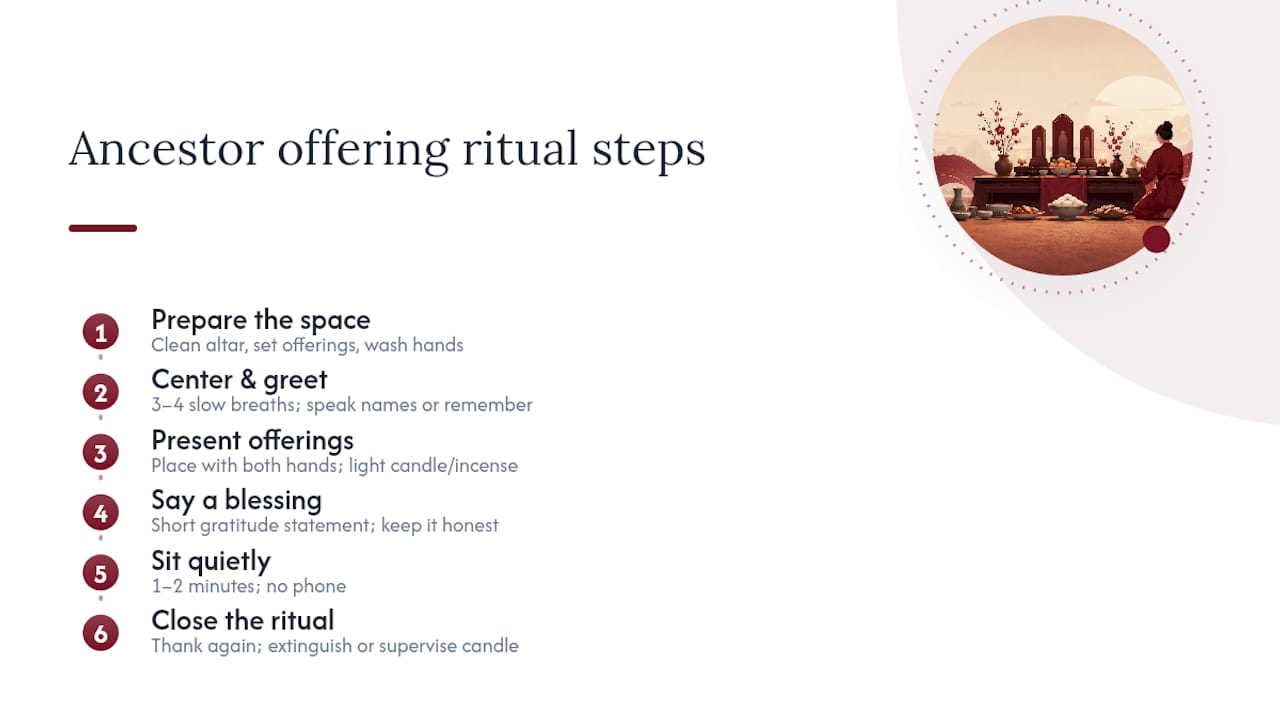
1. Prepare the space. Clean the altar surface, dust off old wax or ash, and set your fresh offerings nearby before you begin. This is also the moment to wash your hands, which is both practical and, across many traditions, a marker of stepping into a different mental state.
2. Center yourself. Take three or four slow breaths. You’re not performing for anyone. This pause is what separates “placing food on a shelf” from an actual offering.
3. Greet your ancestors. Speak aloud or silently, using their names if you know them. Something as plain as “I’m here, I remember you” works. You don’t need formal language.
4. Present the offerings. Place the food, drink, or object with both hands if that feels right to you. Some people light the candle or incense at this point rather than before.
5. Say a short blessing or gratitude statement. This can be as simple as “Thank you for what you gave me, even the parts I didn’t know I inherited.” Keep it honest over poetic.
6. Sit for a moment. A minute or two of quiet, no phone, is usually enough. This is where a lot of people report a shift, not because anything dramatic happens, but because it’s rare to sit still and think about someone specific for even sixty seconds.
7. Close the ritual. Thank the ancestors again, and either let the candle burn out under supervision or extinguish it safely. Never leave an open flame unattended, especially overnight.
Pro Tip: If you live in an apartment or have neighbors sensitive to smoke, swap incense for a small diffuser with a scent tied to the offering (sandalwood, citrus, or something your ancestor associated with home). The gesture matters more than the specific medium.
Frequency and Timing: How Often to Make Ancestor Offerings
There’s no universal schedule, and that’s actually freeing once you stop looking for one. What research on household altar practice does suggest is that people sustain the habit longest when they scale it to their actual life, not to some imagined ideal version of devotion.
A workable rhythm usually looks like three tiers:
- Daily micro-practice: A short greeting, maybe thirty seconds, when you pass the altar. Light acknowledgment, no full ritual required.
- Weekly refresh: Swap out flowers, change the water, light a candle, and spend five or ten minutes with the full ritual above.
- Annual or occasion-based offerings: Death anniversaries, birthdays, cultural festivals, or harvest dates get the full treatment, often with a shared meal or a family gathering component.
The pattern of adapting a big communal rite into a compact daily habit shows up across cultures. A short cup of tea swapped daily, a flower changed weekly, maintains continuity without requiring the elaborate version every single time. That’s really the whole trick: consistency beats intensity.
Lifecycle events deserve special attention. A wedding, a new baby, a graduation, or a difficult diagnosis are all moments where many people instinctively want to “tell” their ancestors what’s happening. Treat that instinct as legitimate. A brief offering marking a major life event, even outside your normal schedule, reinforces the relationship rather than diluting it.
Practical maintenance matters too. Set a recurring reminder if you need one. Clean wax drips monthly. Replace photos that fade. An altar that looks neglected sends a different message than one that’s simply modest.
Cultural Variations in Ancestor Veneration Practices
Ancestor offering traditions vary enormously, and the details matter more than casual observers realize. Mexican ofrendas built for Día de los Muertos layer marigolds, sugar skulls, and a deceased person’s favorite foods on tiered altars, timed to specific calendar dates. Buddhist household altars often favor simple, vegetarian offerings, incense, and daily rather than seasonal attention. Balinese banten offerings, small woven-palm trays of rice, flowers, and incense, get placed multiple times a day as part of ongoing devotional life, not just ancestor-specific moments. West African libation practices pour water, alcohol, or other liquids to the ground while speaking to ancestors directly, a practice with deep roots in the traditions Mother Odessa’s own work draws from.
Scholars studying offering practices note that the same gesture, a bowl of rice, a poured drink, a lit candle, can serve devotion, request, communal cohesion, or moral instruction all at once, and the purpose behind an offering is rarely singular. That complexity is worth respecting rather than flattening into a single “correct” meaning.
A few rules of thumb keep borrowed or blended practices respectful, recognizing the role of ritual as knowledge in Caribbean literature and cultural lineage:
- Research where a practice comes from before adopting it wholesale into your own altar.
- Ask a living elder or community member if you’re unsure whether something is meant for private or specialist use.
- Credit the tradition when you explain your practice to others, rather than presenting a borrowed custom as something you invented.
- Leave specialist or public rites, lineage-head officiations, ancestral hall ceremonies, communal sacrifice ceremonies, to people trained within that tradition rather than attempting a solo version at home.
If your own background blends several traditions, that’s not a problem to solve. It’s simply the shape your altar practice should take.
What Mother Odessa’s Approach Adds to Ancestor Offerings
Personalization is the difference between a general template and a ritual that actually addresses your family’s specific history. Mother Odessa builds rituals around each client’s individual lineage, drawing on decades of West African spiritual practice rather than applying one fixed script to every situation, an approach detailed further in how ancestral work supports generational healing.
A DIY altar handles most day-to-day ancestor offerings well. Where a practitioner becomes useful is when patterns repeat: recurring family conflict, a sense of being blocked despite consistent effort, or a specific lineage-related issue (a broken relationship, a financial pattern, an inherited fear) that a candle and a note haven’t shifted. That’s the point where a lineage blessing restoration or a guided petition ceremony offers something a solo practice can’t: a custom-built ritual plan and a second set of eyes trained to read what’s actually happening in a family’s history.
Adapting Offerings for Direct Ancestors Versus Distant Relatives
Offerings for a parent or grandparent you knew personally naturally look different from offerings for a great-great-grandmother whose name you found on a records site last year. For direct ancestors, specificity is easy: their favorite food, a photo you actually took, a memory you can speak aloud without guessing.
For distant or unnamed ancestors, the offering shifts toward representing a lineage rather than an individual. A general phrase like “to those who came before me, whose names I may not know” works fine. Regional foods tied to where that branch of the family lived, a language phrase, or a map marking the place stand in for personal detail you simply don’t have.
Some households keep two tiers on the same altar: named photos front and center for direct ancestors, and a small collective marker (a candle, an object, a written list of surnames) representing the wider, unnamed lineage behind them. This isn’t a compromise. It reflects how memory actually works across generations; some names stay vivid, most eventually blur into a general sense of “family,” and an altar that only makes room for the vivid names leaves out most of who you actually descend from.
Adjust offering size to match, too. A distant, symbolic ancestor doesn’t need a full meal each week; a token gesture on a monthly or seasonal basis usually fits better than daily attention you can’t sustain.
How to Dispose of Ancestor Offerings Respectfully
What you do after the ritual matters as much as the ritual itself. Leftover offerings shouldn’t just get thrown in the regular trash, at least not without a bit of thought first.
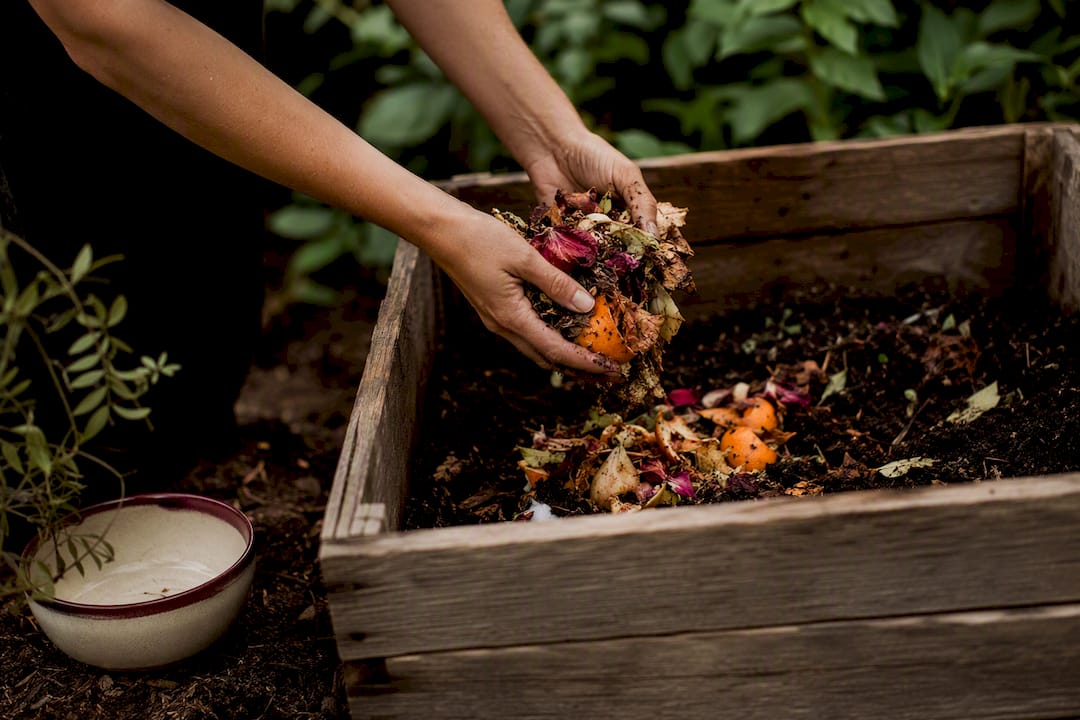
Composting is the simplest respectful option for fruit, flowers, and most plant-based offerings. It returns the material to the earth rather than a landfill, which fits the spirit of the gesture better than a garbage bag does. If you don’t compost at home, many municipal programs accept food scraps separately.
Sharing food with others, family, a neighbor, or leaving a portion outside for birds and wildlife, extends the offering rather than ending it. Ethnographic research on communal ritual meals describes this pattern directly: offerings often conclude with a shared meal, “eating the leftovers,” which reinforces the social bond the ritual was built around in the first place. You don’t need a family gathering to borrow that logic. Even eating the offered fruit yourself afterward, rather than discarding it, keeps that thread intact.
Burning is appropriate for paper offerings, written notes, or symbolic tokens meant to be released rather than kept, as long as it’s done safely, outdoors or in a fireproof container, never indoors unsupervised. Water offerings can be poured onto soil or a plant rather than down a drain. Whatever you choose, treat disposal as the final line of the ritual, not an afterthought you handle once nobody’s watching.
Taboos and Respectful Practices to Avoid
A few missteps come up often enough to flag directly. Letting perishable offerings rot on the altar reads as neglect in most traditions, not devotion, so the removal window matters as much as the offering itself. Performing a specialist or public rite, lineage-head officiations, communal sacrifice ceremonies, ancestral hall rituals, as a solo home practice is generally discouraged; those require community protocols and trained officiants, not a well-meaning improvisation.
Mixing unrelated traditions without understanding either one is another common misstep. Borrowing a Buddhist incense ritual, a West African libation phrase, and a Mexican ofrenda color scheme into one altar isn’t inherently wrong, but doing it without knowing what any of it means risks flattening practices that carry specific weight for the communities they come from. A little research first goes a long way.
Treating offerings as a transaction, “I’ll give you this if you give me that,” tends to sour the practice over time. The framing that holds up better across traditions treats offerings as relationship maintenance, not a request form. Speaking disrespectfully about the dead near the altar, using the space for unrelated clutter, or letting family conflict over “who does the altar right” turn into an actual fight are the more mundane taboos, but they matter just as much as the ceremonial ones.
Finally, don’t feel obligated to keep offering things a specific ancestor didn’t actually like. Sentiment matters more than tradition-for-tradition’s-sake; if your grandmother hated flowers and loved strong coffee, the coffee is the more honest offering.
An Editorial Take on What Offerings Actually Do
Most people approach ancestor offerings looking for a formula, and the formula matters less than the habit of showing up. Offerings work less like a request and more like an ongoing conversation, a way of keeping social memory alive and giving yourself a fixed point to return grief, gratitude, or confusion to. Adapt the practice until it fits your actual life, then keep doing it. That consistency is the whole ritual.
— Psychic
How Mother Odessa Can Help With Your Ancestor Offerings
A home altar handles the daily relationship. When something in your family history feels stuck, a repeated pattern, an estrangement that won’t heal, a sense that something inherited is working against you, that’s a different problem than what a candle and a kind word can solve. Each ritual can be built around a specific lineage rather than using a fixed script, which differentiates a general guide from a session tailored to a family’s history.
The Ancestor Petition Ceremony is built specifically for readers who want a formal, guided offering directed at named or unnamed ancestors, without guessing at the details themselves. If what’s showing up feels broader than ancestor work alone, family patterns tangled with love, money, or protection concerns, the Spiritual Healing & Clarity collection covers rituals designed around those specific needs. Before booking, gather what you have: names, photos, or even a general sense of where a family line settled. That’s enough to start. From there, the process is custom, private, and shaped around what your family’s history actually needs, not a fixed package.
Sources
- How to make an ancestral altar: A cross-cultural guide (NPR, 2022)
- Ancestor worship — Looking at the altar (Smithsonian)
- Ancestral hall sacrifice ritual and its social functions (Scientific Reports, 2025)
- Creating an ancestral altar is a practice found across diverse cultures (academic paper)
- The Wooded Mountains, Ancestral Spirits and Community: Yi ritual study (MDPI, 2026)
FAQ
What Are Good Offerings for Ancestors?
Fresh fruit, water or tea, flowers, incense, and a favorite food or drink of the specific ancestor all work well, rotated out before they spoil. Written notes or symbolic tokens, like folded paper money, are common substitutes when a physical favorite isn’t available.
Is Ancestor Veneration a Sin?
That depends entirely on your own religious framework rather than any universal answer; many traditions, including West African, East Asian, and Latin American practices, treat ancestor veneration as honoring memory rather than worship of a deity. If you belong to a faith with specific teachings on the subject, that guidance should take precedence over general cultural practice.
What Should I Put on an Ancestor Altar?
A photo or memento of the person, a small offering bowl, a candle, and something they loved, food, a drink, or an object, form the core of most altars. Keep the arrangement simple and rotate perishable items regularly rather than leaving them indefinitely.
How Do I Appease My Ancestors?
Reframe the goal away from “appeasing” and toward maintaining an ongoing relationship: consistent small offerings, honest words, and attention matter more than any single grand gesture. If a specific issue feels unresolved despite regular practice, a personalized ritual through a practitioner like Mother Odessa can address patterns a general altar practice may not fully reach.