
Spiritual blockages reduce revenue because they create safety based, embodied reactions that quietly limit what you charge, what you offer, and how consistently you show up to sell. Your nervous system, not your business plan, is often the thing deciding your income ceiling.
Three fast signs point to a blockage rather than a market problem:
- You avoid posting your prices or you discount before anyone asks.
- You feel dread before sales conversations and cancel or delay them.
- Your income spikes and crashes instead of building steadily month over month.
Two things you can do right now, before reading further:
- Spend 60 to 90 seconds breathing out longer than you breathe in (four counts in, six counts out) while placing a hand on your chest. This signals safety to your body and lowers the activation that drives impulsive discounting.
- Pick one price on your site or menu and raise it today, or post one offer you have been sitting on. Small, immediate exposure retrains your nervous system faster than thinking your way out of fear.
The rest of this guide walks through where these blocks come from, exactly how they drain revenue, and a 30-day plan that pairs spiritual clearing with business follow-through.
Key Takeaways
Spiritual blockages reduce revenue by triggering safety-based behaviors, underpricing, offer avoidance, and inconsistent selling, that only shift when nervous-system clearing pairs with concrete business action.
| Point | Details |
|---|---|
| Blockages are embodied, not just mental | Felt patterns stored in the body drive underpricing and offer avoidance more than conscious beliefs do. |
| Origins are traceable | Childhood messages, family scripts, religious teachings, and inherited stories each produce a specific business symptom. |
| Ritual alone rarely fixes revenue | Clearing work needs a paired business action, like a price change or a sales call, within the same week. |
| Track four numbers weekly | Leads, calls booked, calls closed, and average invoice reveal whether clearing is translating into income. |
| Motherodessa customizes each ritual | Sessions are built around each client’s specific financial history, drawing on 40+ years of West African-rooted practice. |
Table of Contents
- What Spiritual Blockages and Money Blocks Actually Are
- Where These Blockages Actually Come From
- How Blockages Translate Into Lost Revenue
- Are Your Blockages Costing You Money? A Quick Diagnostic
- Spiritual Techniques That Clear Money Blocks
- Turning Cleared Energy Into Actual Revenue
- A 30-Day Plan to Clear Blocks and Rebuild Revenue
- Real Shifts: What Clearing Work Looks Like in Practice
- How Motherodessa Supports This Work
- Sources
What Spiritual Blockages and Money Blocks Actually Are
A spiritual blockage is a stored pattern, often held in the body rather than the intellect, that interrupts the natural flow between your effort and your reward. A money block is the same pattern applied specifically to earning, pricing, receiving, or asking for payment. The two overlap constantly for spiritual entrepreneurs, because the identity of “healer” or “helper” frequently carries its own inherited rules about what it means to profit from spiritual gifts.
You will hear this concept described by several names: money blocks, abundance blocks, energetic blockages, scarcity programming, or limiting money beliefs. They all point to the same mechanism. A belief formed early, often before age seven, gets stored as a felt sense in the body. Practitioners frequently describe these clusters living in the root, solar plexus, or throat, showing up as chest tightness before a sales call or a stomach drop when a client asks about pricing.
“The body asks a simple question before any transaction: is it safe to have more? Until that question gets a clear yes, behaviors like underpricing, hiding your offers, and inconsistent selling keep showing up no matter how much strategy you learn.” That framing, drawn from practitioner and clinical observation on how money blocks operate as nervous-system safety responses, explains why so many talented practitioners stay stuck at the same revenue ceiling year after year.
Consider a tarot reader who grew up hearing that “money changes people” and that her grandmother’s gift was corrupted the one time she charged for it. Her skill never changed. Her nervous system’s definition of safe income did.
Where These Blockages Actually Come From
Most money blocks trace back to a handful of predictable origins, and naming yours is the first real diagnostic step.
- Childhood money messages. Phrases like “we can’t afford that” or “money doesn’t grow on trees,” repeated enough times, become a felt truth rather than a memory.
- Family money scripts. Watching a parent hoard, overspend, or fight about money teaches a child that money equals conflict, so the adult avoids conversations about it entirely.
- Religious or cultural teachings. Many traditions frame material wealth as suspect or spiritually dangerous, which creates internal conflict the moment a spiritual entrepreneur tries to profit from sacred work.
- Trauma or acute loss. A bankruptcy, a sudden layoff, or a financial betrayal can wire the body to associate money with danger long after the event passes.
- Inherited generational stories. Immigrant families, in particular, often carry stories of scarcity that outlive the actual scarcity by decades.
- Identity conflicts. The “healer” or “helper” identity frequently comes with an unspoken rule that charging fairly for gifts is greedy or impure.
Each origin tends to produce a specific business symptom. Childhood scarcity messages often show up as chronic underpricing. Religious conflict about wealth shows up as invisibility, avoiding marketing entirely rather than risk being seen as materialistic. Identity conflict shows up as scope creep, where a practitioner keeps adding free extras because charging the full rate feels like a betrayal of the calling.
Mindvalley’s framing of an internal “thermostat” set by childhood and culture is useful here. When income exceeds that setting, the nervous system can manufacture a crisis, a canceled client, a sudden expense, a health scare, that pulls earnings back down to the familiar range. That is not bad luck. It is a regulation mechanism doing exactly what it was built to do.

How Blockages Translate Into Lost Revenue
The mechanism is not mystical. A blockage triggers a felt sense of danger, and the body responds the way bodies respond to danger: it avoids, shrinks, or freezes. Applied to a business, that shows up as six repeatable behaviors.
Risk aversion keeps you from launching the higher-ticket offer you know your clients need, because putting a bigger number in front of people feels exposing. Underpricing follows directly from the safety question described earlier: a lower price feels less dangerous even when it undercuts your actual expertise. Offer avoidance means the sales page sits unfinished for months, or the DM with pricing information never gets sent. Inconsistent marketing produces a stop-start pattern where you post daily for two weeks, then disappear for six, because visibility itself triggers the block. Discounting under pressure happens when a client hesitates and you drop the price rather than sit with the discomfort of a “no.” And weak conversion conversations, rushing through the pricing part of a call or avoiding eye contact with the number, quietly kill deals that were otherwise ready to close.
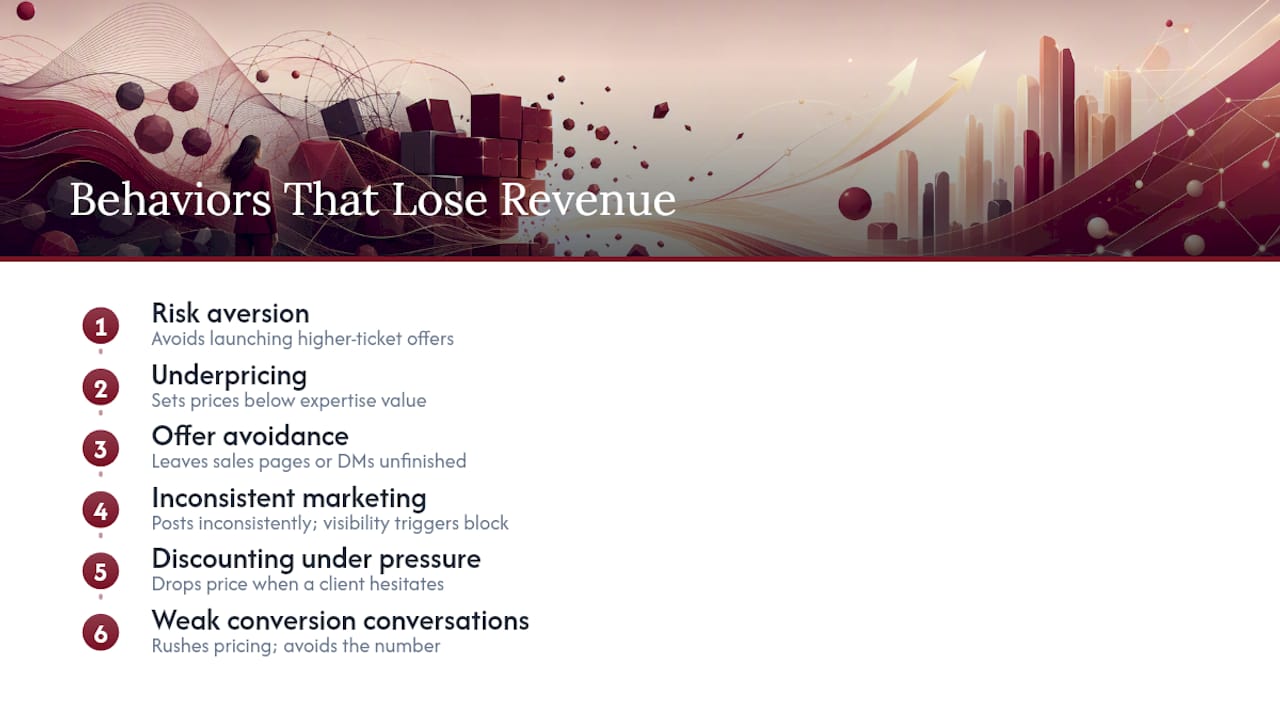
Each of these maps to a measurable business metric: fewer discovery calls booked, a lower close rate on the calls you do have, a lower average revenue per client, and a monthly income chart that looks like a heartbeat instead of a staircase.
Research on the connection between spiritual practice and decision-making backs up why this happens at the nervous-system level. A study on religion, spirituality, and economic decision-making found that structured religious practice, but not most general measures of spirituality, predicted more consistent decision-making and reduced emotional reactivity to financial gains and near-miss losses. The distinction matters: unstructured belief without consistent practice does not appear to change financial behavior much. Ritualized, repeated practice does. That is a direct argument for treating money-block clearing as a discipline with a schedule, not a one-time insight you have during meditation.
Income also correlates with religious and spiritual affiliation more broadly. Pew Research data shows household income distribution differs meaningfully across U.S. religious groups, shaped by education and demographics alongside belief systems, a reminder that the story around money and spirit was never purely individual. You inherited more of it than you think.
Are Your Blockages Costing You Money? A Quick Diagnostic
Score yourself honestly on these five questions. Give one point for every “yes.”
- Do you avoid posting your prices publicly, or feel a flash of anxiety when someone asks what you charge?
- Have you discounted or given away work in the last 30 days specifically to avoid an awkward conversation?
- Does your monthly revenue swing by more than 50% from your best month to your worst, without a clear seasonal reason?
- Do you delay launching an offer you have already built, waiting for a vague sense that it is “not ready yet”?
- Do you feel more relief than excitement when a sales call gets rescheduled or canceled?
0 to 1 points (low likelihood): Your revenue issues are probably strategic, not spiritual. Focus on marketing and offer clarity first.
2 to 3 points (medium likelihood): A real block is influencing at least one part of your sales process. Start with the fast techniques in the next section before touching your pricing.
4 to 5 points (high likelihood): Blockages are very likely shaping your income ceiling directly. Combine nervous-system work with a structural business audit, not either one alone.
Track this over eight weeks: chart your close rate and your average invoice amount monthly. A pattern where close rate climbs before invoice size does is a common signature of clearing working, your fear of rejection eases before your fear of asking for full price does.
Spiritual Techniques That Clear Money Blocks
Start with the fastest, lowest-effort practices and build toward deeper ceremonial work only once the small wins are consistent.
Grounding and breath (60 seconds, daily). Feet flat on the floor, hand on your belly, four-count inhale through the nose, six-count exhale through the mouth, for ten rounds. This is the fastest way to lower the activation that drives impulsive discounting mid-conversation.
Money block release ritual (10 minutes, weekly).
- Light a candle and write down the exact fear (“If I charge full price, my clients will leave”) on paper.
- Read it aloud once, then cross it out and write the opposite belief beneath it (“Clients who value my work pay full price without hesitation”).
- Burn or tear up the original fear statement and keep the new belief somewhere you will see it daily, on your desk or your phone lock screen.
Somatic scan before sales calls (5 minutes, before every call). Sit quietly and notice where tension shows up, throat, chest, stomach, without trying to fix it. Simply naming “I feel tightness in my throat right now” often reduces its grip within a minute. This targets the same somatic clusters practitioners have linked to limiting beliefs around worth and visibility.
Deeper ceremonial work (monthly or as needed). For patterns that trace back generations, a structured ceremony designed around ancestral or inherited money stories can address root layers that a five-minute daily practice cannot reach on its own.

Journal prompts to track weekly: What did I feel in my body the last time I quoted a price? What did I avoid saying this week out of fear of seeming greedy? Where did I shrink an offer to make it feel safer to sell?
Pro Tip: Never perform release or ancestral work on someone else’s behalf without their explicit consent, and never promise a guaranteed financial outcome from any ritual. Ethical ceremonial practice names what the work addresses and lets the results speak honestly, without overselling certainty a nervous system alone cannot control.
Turning Cleared Energy Into Actual Revenue
Clearing work without a business follow-up produces relief, not revenue. The two have to move together.
Within a week of any clearing session, run through this checklist:
- Audit your three most-booked offers and raise the lowest-priced one by at least 15%.
- Publish one offer or price you have been hiding, on your site, your bio, or your next post.
- Book one sales conversation this week specifically to practice stating your price out loud without flinching or over-explaining.
- Set up a simple three-step funnel: one piece of content, one call to action, one booking link, nothing more complicated than that.
- Track four numbers weekly: leads, calls booked, calls closed, and average invoice amount.
- Repeat one small, visible action every week rather than one big launch every quarter.
Pricing audits work best when you look at three things: what your closest competitors charge for comparable work, how long ago you last raised a price, and how often clients say yes without negotiating. If clients rarely push back, you are underpriced. Spiritual alignment and consistent business habits reinforce each other here; the connection between spiritual alignment and productive follow-through is well documented among practitioners who track both.
Run a 30-day experiment: raise one price by 20% and track close rate weekly. Most practitioners who do this see close rate dip slightly in week one, then recover to baseline or higher by week three, because the fear was louder than the actual client reaction.
A 30-Day Plan to Clear Blocks and Rebuild Revenue
Break the month into four phases rather than trying to fix everything on day one.
Week 1: Assess and regulate. Run the five-question diagnostic above, start the 60-second breath practice daily, and track your current close rate and average invoice as a baseline.
Week 2: Clear and adjust pricing. Run the money block release ritual twice this week, then raise one price and publish it somewhere visible.
Week 3: Practice visibility and sales. Post one offer publicly, book at least two sales calls, and use the somatic scan before each one.
Week 4: Consolidate and measure. Review your four tracked numbers against week 1, repeat whichever ritual produced the strongest felt shift, and plan one repeatable weekly action to carry into month two.
The practitioners who see the fastest revenue movement are rarely the ones doing the most ceremonial work. They are the ones who pair one consistent clearing practice with one consistent business action, week after week, without skipping either half.
Track daily: one line in a notebook noting your energy level and one business task completed. Track weekly: leads, calls booked, calls closed, average invoice. That simple log, kept for 30 days, tells you more about which blocks are actually costing you money than any single insight from a single ceremony.
Real Shifts: What Clearing Work Looks Like in Practice
An intuitive business coach kept launching group programs and canceling them two weeks in when enrollment felt slow. Tracing the pattern back to a family story about her father’s failed business, she paired ancestral clearing work with a simpler, lower-pressure launch structure. Her next three launches ran to completion instead of being pulled early.
Practitioner sources cite similar patterns across the wellness field: many practitioners inherit beliefs that make charging and visibility difficult, and combining energy clearing with basic business structure has produced measurable revenue stabilization in documented practitioner cases.
Mother Odessa’s practice draws on more than 40 years of West African-rooted ritual work, built around the same principle: no two clients carry the same story, so no two rituals should look the same.
- Individualized ritual design based on the client’s specific financial history, not a generic script
- Decades of documented client outcomes across love, protection, and financial abundance work
- A consistent emphasis on privacy and customization in every session
Common Pitfalls and When to Get Outside Help
Watch for a few warning signs before going deeper into this work. If a ritual brings up intense grief, panic, or memories of past trauma, that is a signal to pause and involve a licensed therapist, not to push through with more ceremony. Relying on ritual alone while ignoring your actual bookkeeping, unpaid invoices, missed taxes, no budget, will stall your progress no matter how cleared you feel. And any practitioner who guarantees a specific dollar outcome from a ritual is overselling something no ethical practice can promise.
See a therapist for trauma that surfaces during clearing work, a financial advisor for structural money problems like debt or cash flow, and a spiritual practitioner for the felt, embodied patterns sitting underneath both.
Pro Tip: Ethical ceremonial work always starts with clear consent, never promises a guaranteed financial result, and treats every client’s story as unique rather than running the same script for everyone.
A Note From the Practice
Every entrepreneur I have worked with who felt stuck at the same income for years had a story underneath it, not a lack of skill. Clearing that story rarely fixes revenue by itself, and neither does a pricing spreadsheet alone. The two have to move together, which is exactly why the case examples and the 30-day plan above pair ritual work with concrete business tasks rather than treating them as separate paths.
How Motherodessa Supports This Work
Reading about money blocks is one thing. Clearing a pattern that has shaped your pricing for a decade often takes more than a journal prompt, especially when the story traces back through family or ancestral lines. Motherodessa builds each ritual around your specific situation, drawing on more than 40 years of West African-rooted practice, rather than running every client through the same generic script.

This approach tends to help spiritual entrepreneurs who feel the underpricing pattern in their body but cannot talk themselves out of it, practitioners stuck in feast-or-famine income cycles despite steady demand, and anyone who suspects a generational money story is quietly running their pricing decisions. Clients most often report steadier bookings and less dread around naming their price after working through a money and abundance ritual designed for their exact circumstances.
If a pattern in this article felt familiar, browse the money and abundance collection and book a session built around your specific history rather than a one-size ritual.
Sources
- In God We Trust: Effects of spirituality and religion on economic decision making
- How income varies among U.S. religious groups — Pew Research Center
- 10 Things Blocking Your Manifestations (& How to Find Yours) — Mindvalley blog
- Money Blocks Are Not What You Think and Why Healing Them Changes Everything — Brainz Magazine
- Release Money Blocks: Energy Clearing for Wellness Business — Igniteur Wellness
Religious groups fall into the $100,000-plus income bracket according to Pew’s analysis, a reminder that spiritual affiliation, education, and income have always been tangled together rather than separate stories.