
You can be fully operational, hitting your revenue targets, and showing up every day, yet feel completely hollow inside. That experience, where the work continues but the meaning has quietly left the building, is exactly why businesses experience spiritual dry spells. It happens to founders who started with a clear sense of mission and to seasoned entrepreneurs who built something real. The emptiness is disorienting precisely because nothing on the surface looks wrong. Understanding what actually causes this state, and what can shift it, changes everything about how you respond.
Table of Contents
- Key takeaways
- Why businesses experience spiritual dry spells
- Organizational systems and the alignment problem
- Why isolation accelerates spiritual stagnation
- Practical strategies for overcoming business dry spells
- Common misconceptions that make things worse
- My perspective on spiritual dry spells in business
- Reconnect with your spiritual purpose
- FAQ
Key takeaways
| Point | Details |
|---|---|
| Spiritual burnout is gradual | The loss of purpose rarely arrives suddenly. It erodes slowly through compounding fatigue and small unaddressed drains. |
| Organizations can cause stagnation | When spirituality is used as a productivity tool rather than honored as intrinsic, it hollows out meaning at the structural level. |
| Community support is non-negotiable | Spiritual attitude alone cannot sustain entrepreneurial drive without relational anchors like family cohesion and peer networks. |
| Pushing harder often backfires | Adding more spiritual demands on top of exhaustion tends to deepen the disconnect rather than resolve it. |
| Early recognition is the real advantage | Noticing mechanical feelings and small dips in satisfaction early prevents full disengagement and far more costly recovery. |
Why businesses experience spiritual dry spells
The most accurate way to understand spiritual burnout in business is to think of it as a fire banking down. The embers are still there. Heat still exists. But the visible flame, the one that made the work feel alive, has withdrawn. Clergy teaching describes this as “the light going out,” a phase where joy and meaning drain away even while the person continues to function outwardly. For entrepreneurs, this is particularly cruel because the external machinery of the business can keep running while the inner drive quietly suffocates.
Spiritual burnout as a concept refers to the depletion of emotional and spiritual energy to the point where a person can no longer connect their actions to a felt sense of purpose. It moves through recognizable stages. First comes a loss of zeal, where the things that once excited you feel flat. Then mechanical routine sets in, and you find yourself executing tasks without any of the engagement that once defined your work. Cynicism follows. Small frustrations start to feel like personal affronts, and optimism begins to feel naive.
“Spiritual dryness is not the absence of faith or calling. It is the experience of a system running on fumes, still moving forward but no longer drawing from a live source.”
What makes this especially hard to address is the pace at which it develops. Spiritual dry spells function as gradual internal processes, not sudden events. The term “spiritual quiet cracking” captures this well. Burnout, comparison fatigue, and ignored rest phases compound slowly until motivation is no longer recognizable. Most entrepreneurs miss the early window for intervention precisely because nothing feels dramatically wrong until it very much is.
Pro Tip: Watch for the mechanical feeling. When you complete tasks without any emotional resonance at all, that low-grade numbness is the earliest signal that your spiritual energy is draining. Address it then, not six months later.
Organizational systems and the alignment problem
Much of the conversation about business spiritual challenges focuses on individual behavior. That misses something significant. The organization itself can be a source of spiritual stagnation, and this happens in a specific and underappreciated way.
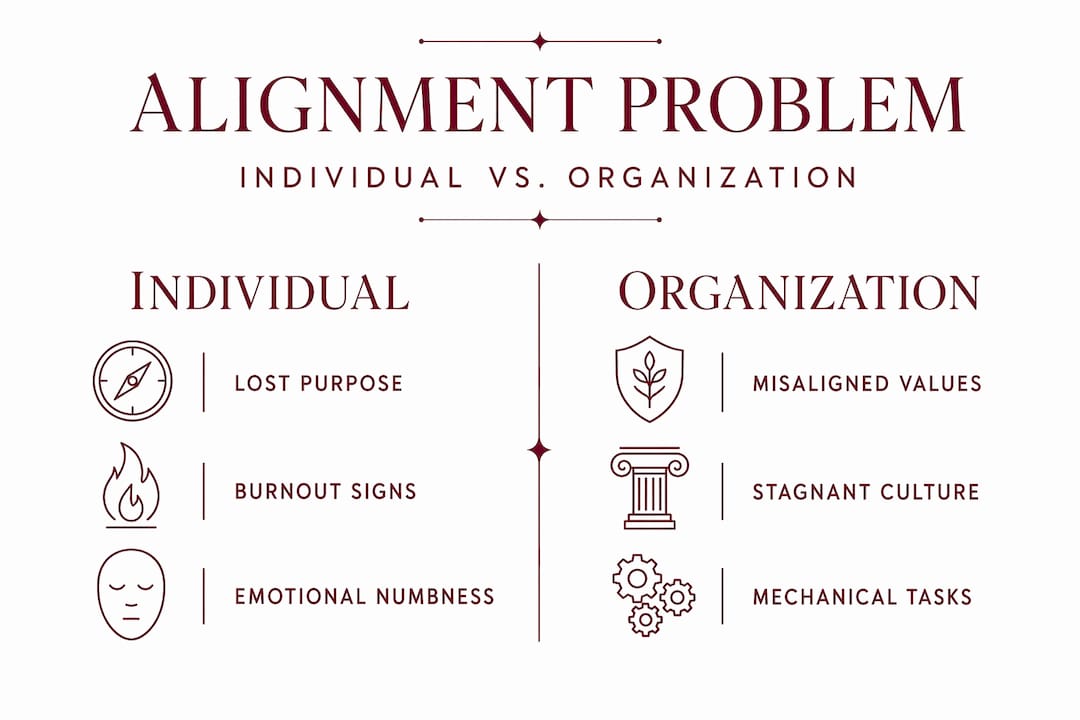
Research from the Journal of Business Ethics examines what it calls the alignment problem in spiritual leadership. The core critique is that when organizations adopt “spiritual leadership” frameworks in for-profit settings, they risk subordinating spirituality entirely to productivity goals. Spirituality becomes a tool for driving engagement, reducing turnover, and increasing output. The instrumental logic takes over. And when that happens, the intrinsic value of spiritual connection is hollowed out, even as the language of meaning and purpose continues to appear in mission statements and team retreats.
Consider the difference between two business cultures:
| Cultural approach | What it looks like in practice | Effect on spiritual vitality |
|---|---|---|
| Spirituality as intrinsic | Leaders model rest, reflection, and purpose-driven decisions even when costly | Meaning remains connected to action |
| Spirituality as instrument | “Wellness programs” tied to productivity metrics, meaning used to justify overwork | Meaning erodes as the manipulation becomes felt |
The second column in that second row describes what spiritual stagnation looks like when invisible at the organizational level. Meaning erodes not with a visible announcement but with a creeping sense that the values being spoken about are not actually lived. Entrepreneurs who build their companies on this instrumentalized model often find themselves as the most spiritually depleted person in the room, because they carry both the gap between stated values and real decisions and the weight of modeling something they can no longer feel.
Pro Tip: Audit your company’s actual decisions, not its stated values. If spiritual language is used to justify working through illness, skipping rest, or ignoring team exhaustion, the misalignment is structural. You cannot pray your way out of a system that is built to drain you.
Why isolation accelerates spiritual stagnation
Here is what the research makes strikingly clear: spiritual attitude alone is not enough to sustain entrepreneurial persistence. The social context around a founder matters enormously. Without family cohesion and community support, spiritual attitude fails to moderate entrepreneurial persistence the way most people assume it would.

This finding reframes something many entrepreneurs believe about themselves. The lone founder with strong personal conviction is not actually the most spiritually resilient figure in business. The founder who is embedded in a relational network, whether through family, faith community, or peer groups, is the one whose spiritual drive tends to persist through difficulty. Isolation is not just emotionally draining. It actively removes the moderating conditions that keep spiritual motivation alive.
The ways isolation triggers dry spells include:
- No external reflection. Without people who know you well, the early signs of spiritual fatigue go unspoken and therefore unaddressed.
- Comparison without context. Social media fills the gap left by real community, and comparison fatigue accelerates the erosion of purpose.
- No permission to rest. Peer communities and family systems often give implicit permission for rest and recovery. Without them, entrepreneurs push far past the point where exhaustion is doing damage.
- Loss of accountability to meaning. People who know your original “why” can name the drift when it starts. Isolated founders lose that mirror.
Practical steps to build the relational conditions for spiritual persistence include joining a small business peer group with an explicit culture of honesty, investing in a supportive life community where vulnerability about struggle is normalized, and scheduling regular conversations with people outside your industry who know you as a person rather than a founder.
Practical strategies for overcoming business dry spells
The most well-meaning advice in this space gets it wrong in one consistent way: it tells exhausted entrepreneurs to do more. Pray more. Meditate more. Read more. Attend more retreats. But increasing spiritual demands without rest when the dryness comes from exhaustion can backfire badly, deepening the disconnect and in some cases creating real spiritual harm.
The smarter framework is energy and attention management. Here is how to apply it:
- Identify your attention leaks first. Energy and attention drain from overstimulation, especially social media, is one of the most common hidden causes of entrepreneurial spiritual dry spells. You cannot build stillness while flooding your bandwidth with notifications, news, and comparison loops.
- Reduce before you add. Before adding new spiritual practices, remove what is draining you. A temporary break from social media, a lighter schedule for two weeks, or delegation of tasks that carry emotional weight. Create space before trying to fill it.
- Rebuild through small, consistent routines. A two-minute grounding practice done daily beats a weekend retreat followed by nothing. The “banking down” model of spiritual energy means re-ignition is slow and requires consistent small inputs, not dramatic gestures.
- Notice and name the mechanical feeling early. Early recognition of spiritual quiet cracking is among the highest-leverage moves available to an entrepreneur. Catching the drift at 10% depletion requires weeks to recover. Catching it at 80% depletion requires months.
- Align recovery with your actual workload. If you are in the middle of a product launch or a financial crisis, this is not the moment for intensive spiritual rebuilding. Triage the immediate pressure, then address the spiritual root with proper time and attention.
Pro Tip: Spiritual restoration is closer to physical rehabilitation than to motivation. You do not “push through” a torn muscle. You give it consistent, appropriate care over time. Treat your spiritual depletion with the same clinical respect you would give a real injury.
Common misconceptions that make things worse
Several deeply held beliefs about why businesses experience spiritual dry spells actually prevent recovery. Recognizing them is part of the work.
- Myth: Spiritual dryness means you failed spiritually. It does not. Entrepreneurs frequently misinterpret dry spells as personal spiritual failure when relational and structural factors are the primary cause.
- Myth: The solution is always more spiritual effort. Pushing harder is often the worst response. Exhaustion does not respond to discipline. It responds to rest.
- Myth: Dryness means you have lost your calling. A fire banking down is not an extinguished fire. The calling is often still present, waiting for the conditions that allow it to re-emerge.
- Myth: This is unique to you. Spiritual stagnation in business is widespread and recognized across faith traditions, leadership research, and entrepreneurship studies. You are not broken. You are depleted.
The compassionate response to a dry spell is honest self-assessment, not shame. Ask what has been draining you. Ask where the alignment between your stated values and your actual decisions has broken down. Start there.
My perspective on spiritual dry spells in business
I have worked with hundreds of business owners over more than four decades of spiritual practice, and the pattern I see most consistently is this: the entrepreneurs who struggle longest with dry spells are the ones who treat spirituality as a performance rather than a relationship. They track how often they pray, how many rituals they complete, how spiritually “productive” they have been. And when the dryness comes, they panic because their metrics look fine but the feeling is gone.
What I have learned, through both the work of self-leadership and the ancient wisdom I draw from in my own practice, is that spiritual vitality in business is not a result you manufacture. It is a relationship you tend. You tend it through honest attention to what you are losing, through real community rather than curated networks, and through patience with a recovery process that cannot be rushed.
The most important reframe I can offer you is this: a dry spell is not a verdict. It is information. It is your inner world telling you that something in the structure of how you work, rest, relate, and lead has gone out of alignment. The work is to listen carefully and respond with wisdom rather than panic.
— Psychic
Reconnect with your spiritual purpose
If what you have read here resonates, you are probably at a point where understanding the causes is not enough. You need something that moves energy, not just concepts. At Motherodessa, we specialize in exactly this kind of deep restoration, drawing on 40+ years of West African spiritual tradition to work with the actual roots of depletion, not just the symptoms.

Every situation is different, and every ritual Motherodessa creates is tailored to your specific circumstances. Whether you are experiencing full spiritual collapse or a slow, grinding disconnection from your original purpose, there is a path back. The Full Spiritual Restoration Ceremony is designed for business owners who need comprehensive renewal, not a surface-level reset. For those carrying accumulated spiritual weight and blockages, the Spiritual Cleansing Bath Ritual can clear the residue that keeps you stuck. And if outside forces or sustained stress are draining your field, the Spiritual Shield Working offers ongoing protection. Reach out to Motherodessa to begin where you actually are.
FAQ
What causes spiritual dry spells in business?
Spiritual dry spells in business are most commonly caused by sustained fatigue, isolation from community support, and organizational cultures that instrumentalize spirituality for productivity. Structural and relational factors matter as much as individual practice.
What are the early signs of spiritual burnout in entrepreneurship?
Early signs include feeling mechanical during work you once found meaningful, a drop in enthusiasm without an obvious external cause, and increasing cynicism toward the purpose behind your business.
Does more prayer or spiritual effort fix a dry spell?
Not always. Increasing spiritual demands without addressing the exhaustion or structural causes can deepen the dryness. Recovery typically requires rest, reduced overstimulation, and rebuilding slowly through consistent small practices.
How does community support affect spiritual vitality in business?
Research shows that family cohesion and community support are decisive moderators of whether spiritual attitude actually sustains entrepreneurial persistence. Spiritual conviction without relational anchors tends to erode faster under pressure.
How long does it take to recover from a business spiritual dry spell?
Recovery time depends on how long the depletion has been building and what structural changes are made. Because spiritual energy re-ignites slowly, consistent small practices over weeks or months are more effective than single intense interventions.