
Spiritual alignment measurably increases productivity by reducing internal conflict, regulating the nervous system, and shifting decision-making toward values-driven clarity. When your inner state and outer actions point in the same direction, you spend less mental energy managing friction and more on the work that actually matters.
Two mechanisms stand out from the research:
- Internal locus of control: Alignment pulls decision-making inward, away from external noise. When you know what you stand for, fewer choices feel paralyzing.
- Reduced counterproductive behaviors: A systematic literature review links workplace spirituality to lower rates of cyberloafing, reduced burnout, and stronger resilience — all direct productivity gains.
The rest of this guide covers the causal mechanisms, the evidence base, specific West African ritual forms, a practical integration plan, and how to measure your progress.
Table of Contents
- Why spiritual alignment boosts productivity: the core mechanisms
- What the research actually shows about spirituality and performance
- West African rituals and daily practices that build real alignment
- How to integrate alignment practices into your actual workweek
- How to measure results and what to expect in the U.S.
- Ethics, cultural respect, and privacy when working with West African traditions
- What real alignment shifts look like in practice
- Key Takeaways
- What most people get wrong about alignment and work
- Motherodessa offers personalized rituals for business and personal alignment
Why spiritual alignment boosts productivity: the core mechanisms
Four pathways connect alignment to measurable output.
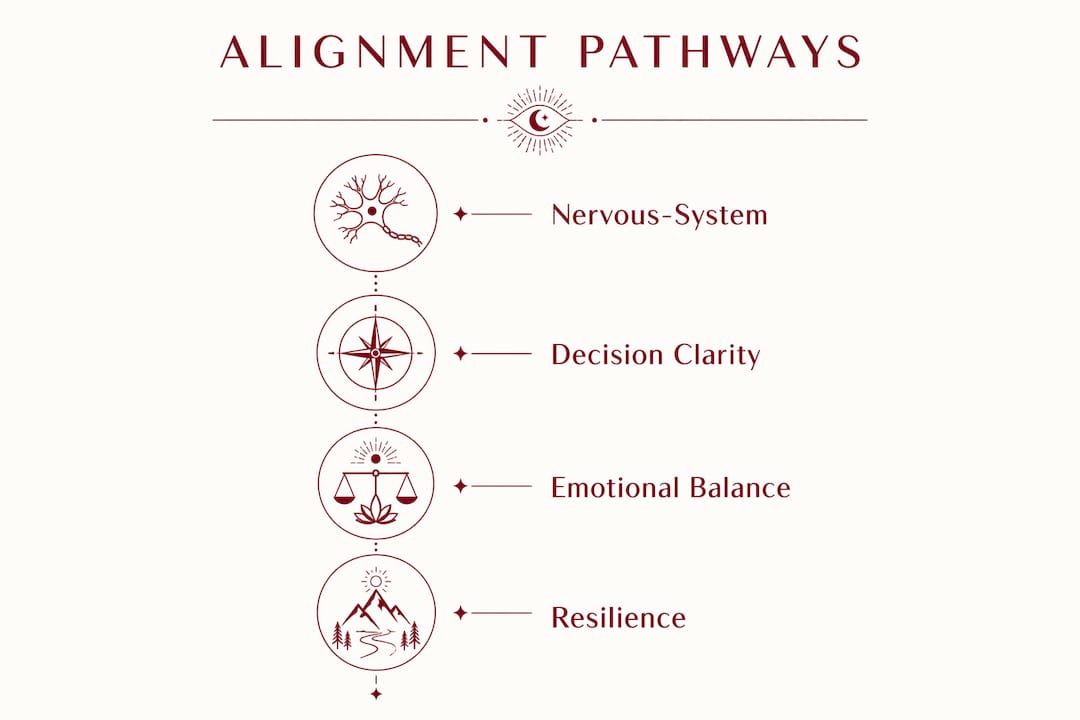
Nervous-system regulation is the most immediate. Chronic stress narrows cognitive access — you literally lose the ability to think creatively or make sound decisions when your body is in threat mode. Practices that combine breath and prayer restore nervous-system safety and reopen access to problem-solving. That is not metaphor; it is physiology.
Locus of control is the second pathway. When alignment is absent, you react to whoever or whatever is loudest. When it is present, you operate from an internal compass. Fewer reactive emails, fewer decisions made from fear, fewer hours spent second-guessing.
Coherence — synchronizing internal values, nervous-system state, and external business actions — moves work from survival-based struggle to natural flow.
Values-based decision-making reduces cognitive load. Every choice that conflicts with your values costs mental energy. Alignment removes that friction. Decisions become faster and more consistent, which compounds over a full workweek.
Resilience is the fourth mechanism. Spiritually grounded people recover faster from setbacks, maintain momentum through disruption, and are less likely to burn out. That sustained momentum is what separates people who grow their businesses from those who plateau.

What the research actually shows about spirituality and performance
The evidence base is growing and credible, though not without limits.
A peer-reviewed Springer article identifies mindfulness and spiritual leadership as pathways to better task performance and reduced emotional fatigue. A structural equation modeling study found a significant positive relationship between spirituality and task performance (t = 3.27, p < 0.05) and between mindfulness and task performance (t = 4.16, p < 0.05) across a diverse, multi-industry sample.
| Research Finding | Outcome Measured | Significance |
|---|---|---|
| Spirituality → task performance | Direct positive relationship | t = 3.27, p < 0.05 |
| Mindfulness → task performance | Direct positive relationship | t = 4.16, p < 0.05 |
| Workplace spirituality → reduced counterproductive behaviors | Resilience, lower cyberloafing | Systematic review |
A separate study on workplace spirituality and productivity found that meaningful work, sense of community, and alignment with organizational values all positively and significantly predict productivity, with workplace culture acting as a partial mediator.
Limitations worth knowing: Most studies are correlational, not causal. Cultural context matters — findings from one region do not automatically transfer to another. And no single practice works identically for every person. Personalized application, not generic prescription, is what produces results.
West African rituals and daily practices that build real alignment
West African spiritual traditions offer some of the most structured and outcome-specific ritual forms available. Each practice below targets a distinct productivity-relevant outcome.
- Cleansing bath ritual: Removes energetic residue from difficult interactions or stressful periods. Practically, it functions as a hard reset between work modes. A spiritual cleansing bath is often the first step before a major decision or launch.
- Altar practice: A dedicated physical space for daily centering. A five-minute morning altar routine — candle, intention-setting, brief prayer — anchors the day before external demands take over. For business goals, the altar can hold symbols of abundance or clarity.
- Libation and offerings: Honoring ancestral lineage through small daily offerings builds a felt sense of continuity and purpose. This directly counters the disconnection that drives burnout.
- Grounding breath and centering ritual: Short (2–3 minute) breathwork sequences before high-stakes meetings restore nervous-system regulation on demand. Pair with a brief spoken intention for decision clarity.
- Seven African Powers ceremony: A deeper, personalized ceremony that calls on seven Orishas for protection, abundance, clarity, and strength. Best suited for business launches, major transitions, or periods of sustained stagnation.
When adapting these for business versus personal goals, the intention shifts, not the structure. A morning altar routine for decision clarity uses different symbols and prayers than one for financial abundance. The ritual form stays consistent; the energetic target changes.
Crystals are a natural complement to altar practice. Crystals for creativity and focus can anchor specific intentions on your altar and reinforce the energetic work between deeper ceremonies.
Pro Tip: Before your first ritual, write down one specific business outcome you want to shift — not a vague wish, but a concrete metric (e.g., “close two new clients this month”). That specificity makes the ritual’s intention measurable and keeps you honest about results.
Cultural respect is non-negotiable. Engage deeply with cultural roots and lineage before adopting any practice. Consult a trained practitioner, credit the tradition’s origin, and avoid extracting rites from their context for aesthetic purposes alone.
How to integrate alignment practices into your actual workweek
The goal is not to add more to your schedule. It is to replace reactive, low-value time with intentional, high-return practice.
- Daily centering (5–10 minutes, morning): Altar visit, breath sequence, spoken intention. Do this before checking messages. It sets the internal compass before external demands can override it.
- Pre-decision ritual (2–3 minutes, as needed): Before any significant choice, pause for three slow breaths and a brief prayer or affirmation. This activates the internal locus of control and reduces reactive deciding.
- Weekly altar review (Friday, 15 minutes): Review the week’s intentions against actual outcomes. Adjust the altar’s focus for the coming week. This is your spiritual dry-spell early warning system.
- Quarterly re-alignment ceremony: A deeper ritual or ceremony every 90 days to clear accumulated misalignment and reset longer-term intentions. This is where personalized work with a practitioner pays off most.
Map these to your calendar like any other commitment. Morning centering fits the same slot as coffee. The pre-decision pause fits before any meeting that requires a yes or no. Friday review replaces the unfocused end-of-week scroll.
Pro Tip: Alignment often requires subtraction first. Before adding rituals, identify one habit or commitment that drains your energy without producing results. Removing it creates the white space rituals need to work.
Combine this with standard productivity tools: time-blocking protects the morning centering slot, task batching reduces the number of pre-decision pauses needed, and delegation frees the cognitive bandwidth that alignment work then fills with higher-quality thinking.
How to measure results and what to expect in the U.S.
Measurement keeps the practice honest. Track both subjective and objective signals.
Subjective metrics: Decision speed (how long before you commit to a choice), perceived mental clarity (rate 1–10 each morning), and stress level at end of day.
Objective metrics: Time-on-task, missed deadlines, client retention rate, and revenue per week. These are harder to attribute solely to ritual work, but trends over 4–8 weeks become visible.
| Timeline | Ritual Intensity | Expected Shifts |
|---|---|---|
| 1–2 weeks | Daily centering only | Reduced morning reactivity, slightly faster decisions |
| 4–8 weeks | Daily + weekly review | Clearer priorities, fewer energy drains, improved focus |
| 3 months | Full integration + quarterly ceremony | Measurable resilience, sustained momentum, reduced burnout |
Disruption during this process is normal. Periods of stagnation often signal the need to pause and recalibrate rather than push harder. Treat them as data, not failure.
U.S. cost ranges: Digital custom ritual reports typically range from $50–$300 depending on complexity and practitioner experience. In-person or remote ceremonies with a seasoned practitioner run higher, often $150–$600 or more for a bespoke, multi-step ceremony. Prices vary significantly based on customization depth and the practitioner’s lineage and track record.
Ethics, cultural respect, and privacy when working with West African traditions
Getting this right matters as much as the practice itself.
Cultural respect:
- Consult a trained practitioner before adopting any West African rite.
- Credit the tradition’s origin — Yoruba, Akan, Vodun, and related lineages are distinct, not interchangeable.
- Avoid using sacred symbols as décor or branding without understanding their meaning.
- Do not share ritual details publicly in ways that commodify or trivialize the practice.
Privacy for digital rituals:
- Confirm that your practitioner keeps your personal details confidential and does not share your situation with third parties.
- Motherodessa’s approach is built on one-on-one spiritual counsel with strict privacy and full customization — no two clients receive the same ritual.
Authentic spiritual work requires consent, context, and lineage. A ritual stripped of its cultural grounding is not neutral — it is incomplete. Engaging with the tradition respectfully is what makes the work effective.
Safety note: Spiritual practices are not a substitute for licensed mental health care. If you are managing a diagnosed psychological condition, work with a licensed therapist alongside any spiritual practice. Ritual work complements clinical support; it does not replace it.
What real alignment shifts look like in practice
Because client privacy is paramount, the following examples are anonymized composites drawn from common patterns in transformation work.
- Focus and decision clarity: A business owner experiencing decision paralysis began a daily altar practice and pre-decision breath ritual. Within four weeks, she reported faster client responses and fewer hours spent in indecision loops. Her weekly client intake increased noticeably.
- Burnout recovery: A consultant running on empty completed a cleansing bath ritual series and a quarterly re-alignment ceremony. The disruption phase lasted about two weeks. By week six, he had restructured his service offerings and dropped two draining clients.
- Client retention: A service provider who felt disconnected from her work added a weekly libation practice honoring her lineage. Over three months, her referral rate improved and she described her client interactions as more grounded and purposeful.
Results vary. No outcome is guaranteed. What is consistent across 40+ years of practice is the pattern: disruption, recalibration, and then sustained flow. The timeline differs; the arc does not.
Key Takeaways
Spiritual alignment reduces internal friction, regulates the nervous system, and shifts decision-making to values-driven clarity, producing measurable gains in focus, resilience, and sustained productivity.
| Point | Details |
|---|---|
| Core mechanism | Nervous-system regulation and internal locus of control reduce cognitive friction and reactive decisions. |
| Research support | Studies show a significant positive relationship between spirituality and task performance (t = 3.27, p < 0.05). |
| Practical entry point | A daily 5–10 minute centering ritual before checking messages anchors the day before external demands take over. |
| Realistic timeline | Noticeable shifts in clarity and decision speed typically appear within 4–8 weeks of consistent practice. |
| Motherodessa | Offers personalized West African rituals, ceremonies, and digital reports for business and personal alignment, backed by 40+ years of practice. |
What most people get wrong about alignment and work
The conventional productivity conversation treats output as a willpower problem. Work harder, track more, optimize the system. What that misses is that most productivity loss is not a discipline failure. It is a coherence failure. When your values, nervous system, and daily actions are pulling in different directions, no amount of time-blocking fixes the underlying drag.
What I see repeatedly in transformation work is that the people who struggle most are not lazy. They are misaligned. They are doing the right tasks in the wrong energetic state, making decisions from fear rather than clarity, and pushing through disruption signals that are actually invitations to recalibrate. The moment they stop and realign, the work does not just feel easier. The results change.
The other thing worth saying plainly: cultural lineage is not decoration. West African spiritual traditions carry centuries of tested, refined practice for exactly these human challenges. Engaging with that lineage respectfully, through a practitioner who holds it properly, is what separates a ritual that works from one that is just a routine.
Motherodessa offers personalized rituals for business and personal alignment
If you have read this far, you already know that generic advice does not produce specific results. Motherodessa’s approach is different from a self-help framework or a wellness app. Every ritual is built around your exact situation, your goals, and your timeline.
Services available for business and personal transformation include the Money & Abundance Ritual for financial clarity and growth, the Spiritual Cleansing Bath Ritual for energetic reset, Protection & Banishing for clearing obstacles, and the Seven African Powers Ceremony for deeper, multi-dimensional alignment. All services are delivered digitally as custom written reports, with full privacy and no two rituals alike.
With 40+ years of practice and a client base that spans continents, Motherodessa brings both lineage and precision to every engagement. Browse the full spiritual healing and clarity collection and place your order to receive a ritual designed specifically for your situation.