
Spiritual advantage is the deliberate embedding of spiritual values, practices, and principles into how an organization operates, competes, and leads. Competitors who use it are not simply being pious. They are building something rivals cannot easily copy: a culture of deep trust, intrinsic motivation, and ethical clarity that holds together under pressure. The research backs this up. A 2020 study of 550 healthcare staff found that workplace spirituality has a stronger direct effect on competitive advantage than any indirect path through organizational commitment alone. That is a finding worth sitting with.
Here is what spiritual advantage actually looks like in practice:
- Values alignment: Employees and leaders share a common ethical framework, reducing internal conflict and accelerating decisions.
- Intrinsic motivation: People work from a sense of purpose, not just a paycheck, which sustains performance through difficult periods.
- Trust with stakeholders: Customers, partners, and staff extend more goodwill to organizations they perceive as spiritually grounded and honest.
- Resilience under pressure: Spiritual practices like reflection, prayer, and community reduce stress responses and sharpen focus.
- Differentiation: In crowded markets, a genuine spiritual identity is nearly impossible for a competitor to replicate quickly.
- Ethical consistency: Spiritual values create a natural guardrail against the shortcuts that erode brand reputation over time.
How workplace spirituality gives organizations a real competitive edge
Workplace spirituality (WS) is not a soft concept. It describes the degree to which employees experience meaning, community, and a sense of inner life at work, and organizations that cultivate it tend to outperform those that do not. The mechanism is straightforward: when people feel their work connects to something larger than a quarterly target, their emotional commitment to the organization deepens. That commitment translates into lower turnover, stronger collaboration, and a willingness to go beyond the minimum.
The 2020 empirical study on 550 healthcare staff is one of the clearest demonstrations of this. Researchers used structural equation modeling and found that workplace spirituality directly enhances competitive advantage, with the direct path carrying a higher coefficient than the indirect path through organizational commitment. Crucially, of the three dimensions of organizational commitment tested (affective, continuance, and normative), only affective commitment, the emotional attachment employees feel, mediated the relationship between WS and competitive performance. People who feel spiritually connected to their workplace do not just stay. They care.
Research finding: A structural equation model applied to 550 healthcare staff showed that workplace spirituality’s direct effect on competitive advantage outweighed its indirect effect through organizational commitment, with affective commitment as the key mediating variable.
| Research dimension | Finding |
|---|---|
| Direct WS to competitive advantage | Higher path coefficient than indirect route |
| Mediating commitment type | Affective commitment (emotional attachment) |
| Sample | 550 healthcare staff, two international hospitals |
| Method | Structural equation modeling |
| Practical implication | Spiritual culture builds loyalty that drives performance |
Turnover costs organizations real money, and spiritual cultures reduce it. When employees feel seen as whole people, not just productive units, they stay longer, mentor others, and protect the organization’s reputation in ways no policy manual can mandate. Group cohesion also improves because shared values give teams a common language for resolving conflict without escalating it.
Pro Tip: If you want to test whether your organization has genuine workplace spirituality, ask employees whether their work feels meaningful, not just whether they are satisfied. Satisfaction is transactional. Meaning is what drives discretionary effort.
How spiritual capital fuels innovation and organizational learning
Spiritual capital is the reservoir of values, beliefs, and practices an organization draws on to make decisions, build culture, and sustain identity over time. Think of it as the ethical and motivational infrastructure beneath the visible business. Organizations with strong spiritual capital tend to innovate more consistently because their people feel psychologically safe enough to take creative risks and share unconventional ideas.
Research on spiritual capital, innovation, and organizational learning shows that these three variables interact to create a durable competitive position. Spiritual values encourage what researchers call innovative work behavior, the willingness to generate, champion, and implement new ideas. Organizations that pair this with a culture of continuous learning compound the advantage over time because each new idea becomes a building block rather than a one-off event.
Key insight: Spiritual capital functions as a form of institutional resilience. When an organization’s identity is grounded in shared spiritual values, it becomes harder to disrupt because the collective sense of purpose acts as a stabilizing force during market turbulence.
Spiritual capital also drives competitive advantage through spiritual marketing and entrepreneurial orientation. Structural equation modeling on this relationship confirmed that entrepreneurial orientation has a positive and direct effect on sustainable competitive advantage, with factor loads exceeding the critical threshold of 1.96. Spiritual marketing, which prioritizes ethics, honesty, and compassionate customer relationships over pure profit extraction, creates consumer trust that is genuinely difficult for rivals to undercut on price alone.
Ways spiritual capital fuels innovation and learning:
- Psychological safety: Spiritual values reduce fear of judgment, making people more willing to propose and test new ideas.
- Long-term orientation: Spiritually grounded organizations resist the pressure to sacrifice quality for short-term gains.
- Shared language: Moral and spiritual frameworks give teams a common vocabulary for evaluating ideas beyond financial metrics.
- Mentorship culture: Spiritual traditions emphasize passing knowledge forward, which accelerates organizational learning.
- Ethical innovation: Products and services developed within a spiritual framework tend to align more closely with genuine customer needs.
- Collective identity: A strong spiritual identity makes the organization harder to disrupt because people are invested in something beyond their individual roles.
What psychology and leadership research say about spiritual advantage
The psychological case for spiritual advantage is grounded in neuroscience, not just philosophy. Dr. Lisa Miller, a clinical psychologist and director of the Spirituality Mind Body Institute at Teachers College, Columbia University, has spent years studying what spiritual thinking does to the brain. Her findings are specific: spiritual thoughts activate brain regions associated with greater blood flow, lower stress hormones, and emotional bonding responses.
“A strong spiritual awareness protects against the most prevalent forms of inner suffering, the diseases of despair: addiction, depression and even suicidality. Character strengths and virtues such as optimism, grit, commitment and forgiveness go hand-in-hand with strong spiritual awareness. It helps us be more creative. It also leads to more gratitude and more resilience.”
— Dr. Lisa Miller, Columbia University, as cited in Guideposts
For a competitor, this translates directly. Leaders who practice spiritual awareness show up with more steadiness, more creativity, and more capacity to absorb setbacks without making reactive decisions. Teams led by spiritually aware leaders tend to trust each other more, communicate more honestly, and recover from failure faster.
The leadership dimension is equally well documented. Grab CEO Anthony Tan has publicly credited his faith-based leadership with giving him the steadiness and humility to navigate intense competition in Southeast Asia’s ride-hailing market. His approach converts what most executives treat as a zero-sum rivalry into something more collaborative, building trust with drivers, regulators, and customers simultaneously.
Psychological and leadership benefits of spiritual advantage include:
- Stress reduction: Spiritual practices lower cortisol and sharpen decision-making under pressure.
- Grit: Spiritually grounded individuals persist through setbacks because their motivation is not purely external.
- Humility: Leaders who see themselves as stewards rather than owners make better long-term decisions.
- Ethical behavior: Spiritual accountability reduces the temptation to cut corners when no one is watching.
- Creativity: Lower stress and higher emotional bonding open cognitive pathways that produce original thinking.
- Trust: Teams with shared spiritual values extend more good faith to each other, which speeds up collaboration.
Real-world examples of spiritual advantage working in organizations
The most persuasive evidence for spiritual advantage is not theoretical. It shows up in how specific organizations have built durable competitive positions by treating spiritual principles as operational strategy, not just cultural decoration.

Charity as competitive strategy. Some of the most resilient businesses in the United States have built their competitive moat around what theologians call charity, the active love of neighbor. When a business treats customer relationships as genuinely sacred rather than transactional, it generates loyalty that price cuts cannot dislodge. Christian charity in business transforms competition into a relational advantage, increasing both profits and organizational longevity by making customers feel genuinely valued rather than processed.
Hallow’s tiered growth model. The Hallow prayer app built a nine-figure business by refusing to chase mass-market adoption before it had earned institutional trust. The company scaled through parish partnerships and celebrity endorsements, using a freemium model that kept the core spiritual experience free while gating premium content. That sequencing, niche first, institutional second, mass market third, preserved authenticity and prevented the brand dilution that kills most spiritual ventures when they grow too fast.
Servant leadership in practice. Organizations that adopt servant leadership, where the leader’s primary role is to remove obstacles for the team rather than accumulate authority, consistently outperform command-and-control structures in employee retention and customer satisfaction. The spiritual root of servant leadership is the idea that power is a responsibility, not a reward.
| Application | Spiritual principle | Competitive outcome |
|---|---|---|
| Charity-based customer relationships | Love of neighbor | Brand loyalty, reduced churn |
| Freemium spiritual product model | Authenticity over profit | Sustained trust, scalable growth |
| Servant leadership | Humility, stewardship | Higher retention, stronger culture |
| Spiritual marketing | Ethics, honesty | Consumer trust, differentiation |
| Faith-driven resilience | Purpose beyond profit | Stability during market disruption |
Practical applications organizations use to activate spiritual advantage:
- Transparent communication: Spiritual values demand honesty, which builds the kind of trust that survives bad news.
- Community investment: Businesses that give back to their communities create goodwill that functions as a long-term marketing asset.
- Ritual and ceremony: Regular practices, whether prayer, reflection, or team rituals, reinforce shared values and group identity.
- Ethical sourcing and labor: Treating suppliers and employees with spiritual dignity reduces conflict and attracts talent.
- Purpose-driven branding: Communicating a genuine mission attracts customers who share those values and stay loyal through price fluctuations.
Motherodessa’s perspective on spiritual advantage in practice
Motherodessa brings over 40 years of experience working with clients across the United States and internationally, applying West African spiritual traditions to the specific challenges people face in business, relationships, and personal resilience. What sets this work apart from generic spiritual coaching is the degree of customization. No two rituals are the same because no two situations are the same. That precision is itself a competitive principle: generic solutions produce generic results.
The practical insight Motherodessa offers to business-minded clients is that spiritual advantage requires maintenance, not just activation. A ritual that clears financial blockages, for example, creates an opening. What you do with that opening, how you show up, how you treat others, how you protect your energy, determines whether the advantage compounds or dissipates. This is why spiritual investment in business is not a one-time event but an ongoing practice.
Key practices Motherodessa identifies as drivers of sustained spiritual advantage:
- Personalized ritual: Addressing the specific energetic and circumstantial reality of each client, not a template.
- Ancestral alignment: Drawing on West African traditions that have been tested across generations and cultures.
- Privacy and discretion: Protecting clients’ spiritual work from external interference or skepticism.
- Energetic protection: Actively guarding against negative forces that drain motivation, clarity, and competitive focus.
- Relational healing: Repairing trust in business partnerships and client relationships through targeted spiritual intervention.
- Financial clarity: Removing spiritual blockages that manifest as cash flow problems, missed opportunities, or persistent bad luck.
For those navigating competitive pressure in business, Motherodessa’s spiritual healing services offer a grounded, culturally rooted path to the kind of clarity and resilience that no management consultant can provide.
Challenges and criticisms of using spirituality as a competitive advantage
Spiritual advantage is not without its complications. The most serious criticism is the risk of instrumentalization: when organizations adopt spiritual language primarily to motivate employees or attract customers, rather than from genuine conviction, the inauthenticity tends to surface. People are perceptive. A company that talks about purpose but treats its workers poorly will find that the spiritual branding accelerates distrust rather than building it.
There is also the question of inclusion. Spiritual cultures can inadvertently exclude employees who do not share the dominant tradition. A workplace that centers Christian prayer, for example, may alienate Muslim, Jewish, Hindu, or secular employees, creating the opposite of the cohesion spiritual advantage is supposed to produce. Organizations that navigate this well tend to focus on universal spiritual values, meaning, purpose, ethical behavior, and community, rather than specific religious practices.
Measurement is another genuine challenge. The benefits of spiritual advantage, trust, resilience, creative output, are real but difficult to quantify on a quarterly earnings call. This makes it hard to justify investment in spiritual culture to boards and investors who want metrics. The research exists, as the workplace spirituality studies demonstrate, but translating it into the language of financial reporting requires patience and a long time horizon.
Finally, claiming spiritual authority carries reputational risk. If an organization positions itself as spiritually grounded and then behaves unethically, the gap between claim and conduct becomes a liability rather than an asset. The higher the spiritual claim, the more damaging the contradiction. This is why spiritual advantage works best when it grows from genuine values rather than marketing strategy.
How to integrate spirituality into organizational culture without losing credibility
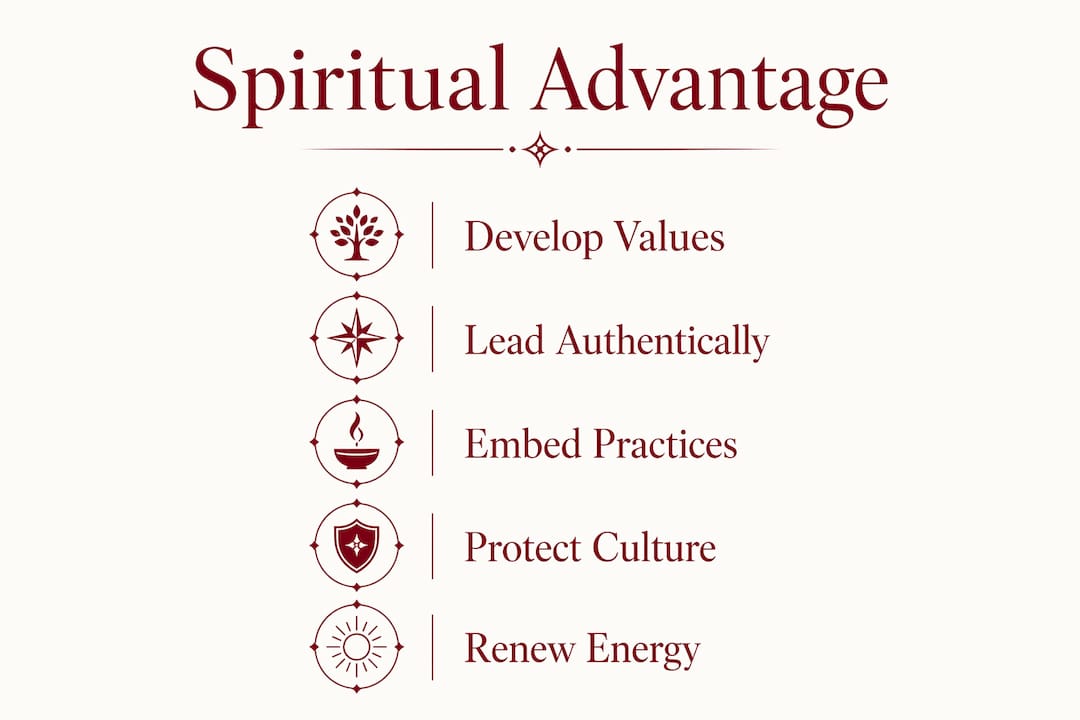
The organizations that do this well share one trait: they start with values, not programs. Before launching a mindfulness initiative or a purpose statement, they ask what the organization actually believes and whether leadership is willing to be held accountable to it. That internal honesty is the foundation everything else rests on.
Practical integration follows a sequence. Begin with leadership. Spiritual culture cannot be delegated to HR. When senior leaders visibly practice the values, whether through transparent communication, charitable behavior toward competitors, or genuine humility in failure, the culture follows. Employees model what they see at the top, not what they read in a handbook.

Next, build practices into the rhythm of work. Hallow’s parish partnership model is instructive here: the company did not try to be spiritual in the abstract. It embedded itself in existing communities of practice, people who already gathered regularly around shared values. Organizations can do the same by creating regular spaces for reflection, whether that is a weekly team check-in that goes beyond task updates or a quarterly retreat that addresses meaning and direction alongside strategy.
Pro Tip: When introducing spiritual practices into a workplace, frame them around outcomes people already care about, such as reducing burnout, improving trust, or making better decisions under pressure. The spiritual dimension becomes accessible when it solves a real problem rather than asking people to adopt a new belief system.
Protect the culture as it scales. The biggest risk for spiritually grounded organizations is growth that dilutes the founding values. Hallow’s decision to grow through niche and institutional channels before pursuing mass adoption was a deliberate defense against this. Hiring practices, onboarding, and performance evaluation all need to reflect the spiritual values explicitly, or those values get crowded out by operational pressure.
Address spiritual dry spells proactively. Every organization goes through periods when the energy feels flat, motivation drops, and the culture seems to be running on fumes. Recognizing these periods as spiritual rather than purely operational opens up a different set of responses, ones that address the root cause rather than just the symptoms.
Key Takeaways
Spiritual advantage gives competitors a durable edge because it builds trust, motivation, and resilience that rivals cannot easily copy or undercut on price.
| Point | Details |
|---|---|
| Workplace spirituality drives performance | Affective commitment, the emotional bond employees feel, is the key mechanism linking spiritual culture to competitive advantage. |
| Spiritual capital enables innovation | Organizations with strong spiritual values create psychological safety that encourages creative risk-taking and continuous learning. |
| Leadership is the entry point | Spiritual culture cannot be delegated; it requires visible modeling from senior leaders to take root across the organization. |
| Authenticity is non-negotiable | Spiritual branding without genuine values accelerates distrust; the advantage only holds when conduct matches the claim. |
| Maintenance sustains the edge | Spiritual advantage compounds through ongoing practice, protection, and alignment, not from a single initiative or ritual. |