
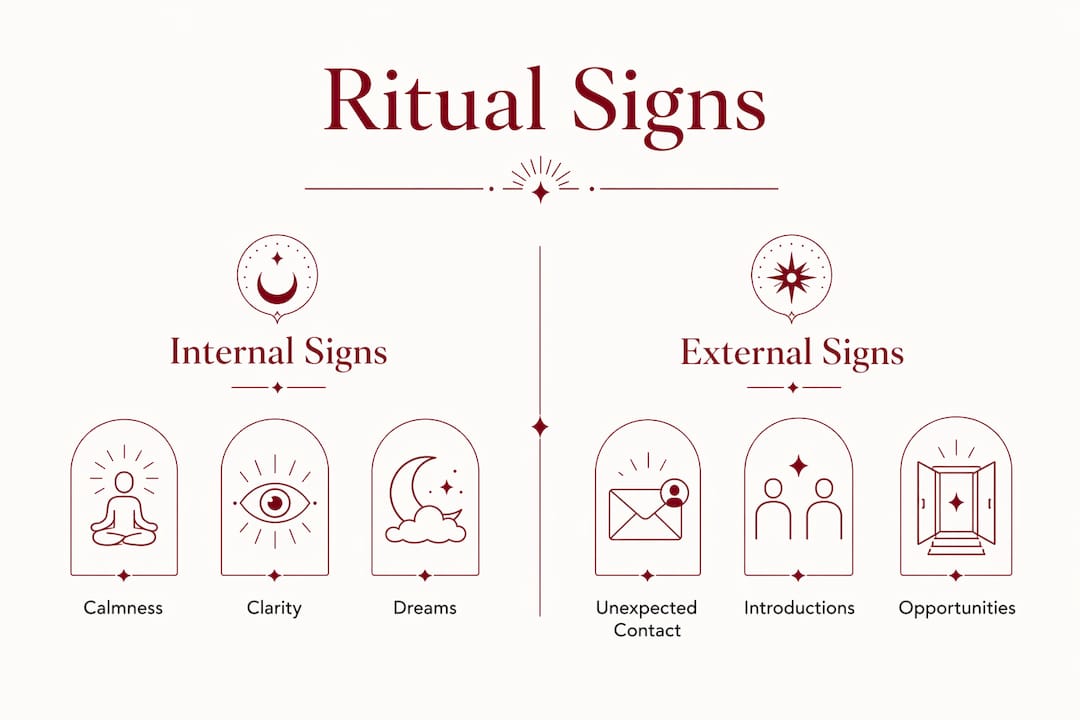
The most reliable signs a reconciliation ritual is working are internal calm after casting, stacking synchronicities, unexpected relevant contact from the other person, clearer intuition, and small but concrete real-world movements toward reconnection. These signals rarely arrive as dramatic proof. They show up quietly, often in combination, and they build.
Quick checklist: signs to watch for in the first 28 days
- A noticeable drop in anxiety or obsessive thinking about the situation (a common internal sign after ritual)
- Unexpected, neutral or warm contact from the other person (a text, a comment, a mutual friend reaching out on their behalf)
- Vivid or emotionally resonant dreams involving the person
- Stacking coincidences: two or three small, specific reminders of your shared connection appearing in close succession
- A sense of inner clarity or calm that replaces the urgency you felt before casting
- Opportunities or conversations that create a natural path toward reconnection
- Symbolic themes repeating in your environment (songs, places, objects tied to your intention)
- A shift in how others around you speak about the situation, often softening without prompting
Allow roughly one lunar cycle before deciding a working has not moved. Motherodessa, whose practice draws on 40+ years of West African ancestral tradition, consistently notes that genuine signs arrive as coherence, not chaos. Research on ritual and anxiety regulation confirms that the calming effect after a ritual is itself a measurable early indicator, not just a feeling. Timing and the other person’s free will both matter: do not expect immediate dramatic results, and never continue work that crosses into coercion or harm.
Table of Contents
- What are the signs a reconciliation ritual is working externally?
- What internal signs tell you the ritual is taking effect?
- How do signs differ by spell type?
- How long do reconciliation rituals typically take to show results?
- What should you do if no signs appear?
- How do you tell a genuine sign from coincidence?
- How does Mother Odessa approach reading signs?
- Does your personal energy affect how well a ritual works?
- How should you prepare before performing a reconciliation ritual?
- What should you do after signs appear?
- How do reconciliation rituals vary across traditions?
- Key Takeaways
- What the waiting period actually teaches you
- Motherodessa’s personalized reconciliation ritual service
- Useful sources
What are the signs a reconciliation ritual is working externally?
External signs are the ones you can track in a log. They are also the ones easiest to misread, so specificity matters more than frequency.
The clearest external indicator is unexpected contact that carries a different emotional tone than what came before. Not a hostile message, not a drunk text at 2 AM, but something neutral or warm: a calm question about a shared friend, a comment on something you posted, an invitation to a low-stakes event. That shift in tone is the signal, not just the contact itself.
Third-party introductions matter too. A mutual friend who suddenly suggests you two should talk, or who passes along that the other person asked about you, is a meaningful external movement. These are opportunity windows, and they require you to act. A sign that you ignore closes.
Chance meetings that feel oddly timed, invitations to spaces where you might naturally cross paths, and conversations that organically turn to the subject of your relationship are all worth noting. In long-distance situations, external signs tend to arrive digitally first: a follow, a reaction, a message that breaks a long silence. For local relationships, they often come through shared social circles before direct contact resumes. For a deeper look at behavioral signals, signs your ex wants to reconnect covers nine specific patterns worth cross-referencing with what you observe after a working.
What internal signs tell you the ritual is taking effect?
Internal signs arrive before external ones. That is not wishful thinking; it is how ritual works on the mind.

Research published in PMC on ritual and anxiety shows that rituals regulate the brain’s response to uncertainty, producing a genuine calming effect. That calm is not just relief. It is an early indicator that your nervous system has shifted out of the threat-response loop that was keeping you stuck. When you stop white-knuckling the outcome, you create the mental space to notice and act on real openings.
Other internal signs include reduced obsessive thinking about the situation, a clearer sense of what you actually want (not just what you fear losing), and intuition nudges that feel steady rather than frantic. The frantic version is anxiety. The steady version is direction. Knowing the difference takes practice, which is exactly why journaling matters.
Pro Tip: Keep a ritual journal with a simple daily entry: date, your emotional state, any dreams, and one observation from your environment. After two weeks, patterns that felt random will start to look deliberate. This is the baseline that separates genuine stacking from wishful thinking.
Dreams are a particularly reliable channel. Vivid or recurring dreams connected to your intention, especially ones that feel emotionally resolved rather than anxious, are commonly reported after successful ritual work. They function as the subconscious processing the shift before your waking mind catches up.
Cognitive science adds another layer here. Research in Trends in Cognitive Sciences describes how rituals prime attention and shape expectations through model-based learning. In plain terms: after a ritual, you are more likely to notice and act on opportunities that were always there but previously invisible to you. The ritual does not manufacture the opening. It changes what you see.
How do signs differ by spell type?
Different techniques produce different patterns of early signals. Knowing what to expect from the method you used prevents you from looking for the wrong thing.
Candle work: The first signs tend to be internal. A sudden calm during or right after the burn, small communications that feel unexpectedly warm, and symbolic moments (a song, a place, a phrase) that echo your intention. Watch the flame behavior during the working as an early read, then give the energy a week before expecting external movement.

Honey jar: Signs here stack as sweetness. Conversations that go better than expected, a softening in the other person’s tone, compliments or warmth from people in your shared circle. The honey jar works slowly and socially. Do not expect a dramatic breakthrough; expect a gradual thaw.
Freezer or banishing work used in a reconciliation context: This one confuses people. The initial signs can look like contrast events: a brief flare-up, a moment of distance, or a period of silence. That is the clearing phase. The smoothing comes after. If you mistake the contrast event for failure and re-cast, you muddy the work.
Charms and amulets: These produce slow-maturing, subtle openings. A door that was closed starts to feel less locked. Opportunities appear at the edges of your awareness. Give these at least three to four weeks before evaluating.
Road-opener work: Signs arrive as introductions and opportunities. A new connection who knows the other person, a conversation that opens a path, a circumstance that removes a previous obstacle. These are practical openings that require you to walk through them.
The common thread across all methods: signs arrive as increased coherence, not dramatic interruption. If you are forcing a match between a random event and your intention, it probably is not a sign.
How long do reconciliation rituals typically take to show results?
The practitioner standard is to allow roughly one lunar cycle, about 28 days, before a major reassessment. That heuristic exists for good reason: most energetic movement happens beneath the surface before it becomes visible, and over-casting before the initial working has had time to unfold is one of the most common ways people slow their own results.
A practical breakdown by timeframe:
- The first week tends to show internal signs like calm and sense of direction.
- The next weeks may show early external movement like subtle shifts in communication.
- Later weeks bring more visible external signs such as softened tone or invitations.
- Further time may bring deeper shifts like restored trust and real-world reconnection.
Variables that speed things up: clarity of intention, a prior relationship with genuine warmth still in it, and a practitioner with deep experience in the specific tradition. Variables that slow things down: energetic congestion from previous castings, significant external life events affecting the other person, unclear or conflicted intention on your part, and the other person’s own emotional state and agency. Client history plays a real role in how timing unfolds, which is why bespoke ritual design consistently outperforms generic approaches.
After one full cycle with no internal shift and no external movement at all, revisit the intention, check for personal blocks, and consider whether the work needs adjustment rather than repetition.
What should you do if no signs appear?
No signs after two to three weeks is information, not failure. Work through this checklist before re-casting.
- Re-evaluate your intention. Was it specific? Conflicted? Rooted in fear rather than genuine desire for reconnection?
- Check for personal blocks. Unresolved grief, anger, or ambivalence on your part can create energetic resistance that slows or mutes results.
- Review timing. Did you allow enough space? Repeating a ritual within days of the first casting rarely helps and often creates confusion in the working.
- Examine consent and safety. Is the other person in a situation where contact would be harmful to either of you? Are there legal or safety concerns that make reconnection genuinely inadvisable?
- Avoid over-casting. Stacking spell after spell from a place of anxiety is one of the clearest ways to muddy results. Give the initial working its full cycle.
- Consider practitioner support. If you have done the above and still see nothing, a personalized assessment from an experienced practitioner is more useful than another DIY attempt.
Ethical guardrails matter here too. If the “signs” you are hoping for would require the other person to act against their own wellbeing, or if continuing the work edges toward surveillance, control, or harm, stop. Spiritual boundary setting is not a contradiction of reconciliation work; it is part of it. Reconciliation work must never justify violating another person’s autonomy.
How do you tell a genuine sign from coincidence?
Confirmation bias is the biggest risk in sign-reading. The brain is extraordinarily good at finding patterns it is looking for, and a mind primed by ritual is even more alert to them. Research on ritual failure and rationalization shows that ritual systems are culturally designed to explain away disconfirming evidence, which means the practitioner has to do the critical work themselves.
Two tests cut through most false positives.
The stacking test: A single coincidence means little. Multiple relevant coincidences in close succession, each specific to your intention, is a different category of event. One song that reminds you of the person is not a sign. That song, followed by a message from a mutual friend, followed by a dream, all within 48 hours, is stacking.
The specificity test: Is the sign unusually specific to your intention, or could it apply to almost anything? A red cardinal is a common symbol. A red cardinal appearing the morning after your working, at the window of the place where you and this person had your first conversation, is specific.
Pro Tip: Run a quick five-point check on any potential sign: How often does this happen normally? Is it specific to my intention? Does it feel calm or frantic? Does it open a real path forward? Would an independent witness find it notable? If you can only answer yes to one of those, let it go.
A false positive looks like this: you cast a honey jar on a Tuesday, and on Thursday your phone autocompletes the other person’s name. That is your phone’s algorithm, not a sign. The stacking test would flag it immediately: one event, low specificity, no external corroboration, no actionable opening.
A genuine sign tends to feel like increased coherence in your life, not a dramatic interruption of it. If you are working hard to make a match, it probably is not one.
How does Mother Odessa approach reading signs?
With over 40 years of practice rooted in West African ancestral traditions, Motherodessa has developed a reading framework built on coherence rather than drama. The most reliable signal is not a single striking event but a pattern of small, specific movements that all point in the same direction.
Motherodessa weighs internal signs first, because they are the most immediate and the least susceptible to projection. External signs are then evaluated against the internal baseline: if the internal state has shifted and the external signs are specific and stacking, the working is moving. If only external signs appear with no internal shift, the practitioner looks more carefully before drawing conclusions.
Every client situation is different, which is why customized rituals consistently produce clearer, more readable signs than generic approaches. A ritual designed around your specific relationship history, the nature of the separation, and the energetic dynamics at play gives you a much more precise set of expected signals to track. Client confidentiality is maintained throughout, a practice Motherodessa holds as non-negotiable given the deeply personal nature of reconciliation work.
When clients ask whether they should continue DIY adjustments or commission personalized work, the answer usually comes down to one question: have you seen any internal shift at all? If yes, continue with patience. If no internal shift has appeared after a full cycle, personalized support is the more effective path.
Does your personal energy affect how well a ritual works?
Yes, and more directly than most people expect. Your emotional and energetic state at the time of casting, and in the days following, is not separate from the ritual. It is part of it.
Conflicted intention is the most common block. If part of you wants reconciliation and another part believes it is impossible or undeserved, that conflict shows up in the working. The ritual amplifies what is already present in your energy field. Clarity of desire, not desperation, is what creates the conditions for movement.
Energetic congestion from previous castings, unresolved grief, or sustained anxiety can also slow results. This is why grounding practices in the days after casting matter as much as the ritual itself. Short meditations, time in nature, and deliberate attention to your own wellbeing are not optional extras. They are maintenance.
How should you prepare before performing a reconciliation ritual?
Preparation is where most DIY rituals either succeed or fail before they begin.
Start with a cleansing. Clear your physical space and your own energy field before casting. Smoke, blessed water, or sound clearing all work; the method matters less than the intention behind it. A cluttered or emotionally charged space introduces noise into the working.
Ground yourself. Slow breathing, a short visualization, or five minutes of journaling to settle your mind. You want to enter the ritual from a place of calm clarity, not urgency. Urgency is the energy of fear, and fear-based castings tend to produce fear-based results.
Write your intention clearly, in your own words, before you begin. Not “I want him back” but something specific: the quality of connection you want to restore, the emotional tone you are calling in, the outcome that would genuinely serve both people. Specificity in intention creates specificity in signs.
Finally, pair the ritual with a realistic assessment of what mundane actions you can take to support the opening. A ritual creates opportunity; you still have to walk through the door.
What should you do after signs appear?
Signs are not the finish line. They are the beginning of a different kind of work.
When external signs appear, respond to them with calm, measured action. A warm text deserves a warm reply, not an overwhelming outpouring. An invitation deserves a yes, not a confession. Match the energy of the opening rather than flooding it.
Continue your journaling practice. Document what is shifting, how you are responding, and what feels like it is building. This keeps you grounded and gives you a record to evaluate honestly.
Building intimacy after reconnection requires consistent, low-pressure engagement. The ritual creates the opening; the relationship is rebuilt through real interaction, honest communication, and patience. Spiritual hygiene during this period matters too: keep your space clear, maintain short weekly grounding practices, and avoid casting additional workings on top of an already-moving situation.
If obstacles appear during the integration phase, treat them as information rather than setbacks. A brief flare-up or a moment of distance after initial positive signs is often part of the clearing process, not evidence that the working has failed.
How do reconciliation rituals vary across traditions?
The signs themselves are broadly consistent across traditions, but what practitioners look for and how they interpret those signs varies considerably by cultural and spiritual framework.
In West African and diaspora traditions, including the Yoruba-derived practices that inform Motherodessa’s work, ancestral guidance plays a central role. Signs are often read through dreams, divination (such as cowrie shells or tarot), and the behavior of ritual objects like candles or offerings. A candle that burns cleanly and steadily is a positive sign; one that sputters or produces heavy smoke signals interference.
In European folk magic traditions, signs tend to be read through natural omens: bird behavior, plant growth, weather patterns, and the condition of charm bags or petition papers. The “rule of threes” common in many Western practices (a sign in three days, direction in three weeks, results in three months) is a widely used timing heuristic that aligns loosely with the 28-day lunar cycle standard.
Indigenous American healing traditions often frame reconciliation work within community and relational healing rather than individual desire, and signs are evaluated in terms of restored harmony in the broader relational field, not just direct contact between two people.
What all these traditions share is the emphasis on coherence over drama, patience over urgency, and the practitioner’s own alignment as a prerequisite for effective work.
Key Takeaways
The most reliable evidence a reconciliation ritual is working is a combination of internal calm, stacking synchronicities, and specific external movement, all appearing within the first 28-day cycle.
| Point | Details |
|---|---|
| Internal calm comes first | A measurable drop in anxiety after casting is a research-backed early indicator, not just a feeling. |
| Use the stacking test | Multiple specific coincidences in close succession carry far more weight than a single event. |
| Allow a full lunar cycle | Wait roughly 28 days before reassessing; over-casting before this window muddies results. |
| Track signs objectively | A ritual journal with dated entries prevents confirmation bias and reveals genuine patterns. |
| Motherodessa’s approach | Personalized reconciliation rituals from Motherodessa are designed around your specific situation, producing clearer, more readable signs than generic workings. |
What the waiting period actually teaches you
The hardest part of reconciliation work is not the ritual. It is the 28 days after.
What I notice most in clients during this window is the pull toward doing something, anything, to feel in control. A second casting. A confrontational message. An obsessive re-reading of old texts. None of it helps. All of it disrupts the energetic space the working just created.
The clients who see the clearest results are the ones who treat the waiting period as active, not passive. They journal. They respond to small openings with measured action. They ground themselves daily, not because it feels spiritual, but because it keeps them out of the anxiety loop that blocks everything. When a sign appears, they note it, respond proportionately, and keep moving.
A gentle reminder on timelines: if you cast a candle working on a Monday and nothing visible has happened by Friday, that is not failure. That is Tuesday. Give the work its cycle. If you reach 28 days with no internal shift at all, that is when you reassess, not before.
Motherodessa’s personalized reconciliation ritual service
If you have read this far and still feel uncertain about what you are seeing, or if you want the clarity that comes from a ritual designed specifically for your situation, that is exactly what Motherodessa offers.

The Reconciliation & Reunion Ritual is built around your specific relationship history, the nature of the separation, and the energetic dynamics at play. No two workings are the same. After your order, you receive a custom ritual assessment, a tailored ceremony drawing on West African ancestral tradition, and follow-up guidance on what signs to watch for and how to respond to them. Everything is handled with complete confidentiality. For readers who want to explore the full range of love and relationship offerings, that collection covers reunion work, return-a-lover rituals, and more. Place your order, share your situation honestly, and let the work begin.
Useful sources
The research and practitioner writing behind this article:
| Source | What it contributes |
|---|---|
| PMC — Ritual and Anxiety Regulation | Psychology of ritual: explains why internal calm after casting is a measurable early indicator |
| Trends in Cognitive Sciences — Ritual and Cognitive Computations00105-1) | Cognitive science of ritual priming: how rituals shift attention and make practitioners more likely to notice real opportunities |
| When Rituals Fail — Rationalization and Predictive Processing | Cautionary framework: how ritual systems rationalize failure and why objective sign-tracking matters |
| WitchesLore — Reading the Signs Your Spell Is Working | Practitioner checklist: stacking and specificity as the core evaluation tools |
| Wonderfully Witchy Web — How to Know If a Spell Has Worked | Journaling practice and the 28-day lunar cycle heuristic |
| Original Botanica — Signs Your Spell Is Working | Practitioner warning on over-casting and energetic frustration |
| Pagan Grimoire — Signs Your Spell Is Working | Practical sign checklist and the coherence-vs-coincidence distinction |
| Motherodessa — Reconciliation & Reunion Ritual | Personalized reconciliation ritual service for readers seeking professional support |