
Most people assume that a ritual is a ritual. Light a candle, say a prayer, follow the steps. But that assumption is exactly why so many people feel like their spiritual practices aren’t working. The truth about how customized rituals outperform standard practices comes down to one thing: specificity. A generic routine cannot speak to your grief, your broken relationship, or the weight your family has carried for generations. New research from 2025 and 2026 confirms what experienced spiritual practitioners have known for decades. When a ritual is built around you, its power multiplies.
Table of Contents
- Key takeaways
- How customized rituals outperform standard practices
- What the research says about personalized rituals
- Why cultural resonance amplifies ritual power
- How to design your own customized ritual
- Standard vs. customized rituals: a direct comparison
- My perspective on why customized rituals changed everything
- Ready to experience a ritual built for you
- FAQ
Key takeaways
| Point | Details |
|---|---|
| Customization drives results | Rituals tailored to your personal situation produce measurably better emotional and spiritual outcomes than generic routines. |
| Science backs personalization | Recent RCTs show culturally adapted spiritual practices reduce anxiety and improve well-being far more than standard treatments. |
| Cultural resonance matters | Rituals connected to your values and heritage increase engagement, ownership, and long-term effectiveness. |
| Start small and build | One sustainable, well-designed ritual outperforms an ambitious routine you abandon after two weeks. |
| Rituals are living systems | Effective rituals evolve with your life stage, priorities, and challenges rather than staying fixed. |
How customized rituals outperform standard practices
Before you can understand why personalized rituals work better, you need to understand what separates a ritual from a habit or a routine. A habit is automatic. You brush your teeth without thinking. A routine is a sequence of habits, like a morning schedule. A ritual is different in one critical way: it carries intention and meaning.
Rituals are not just repeated actions. They are symbolic acts that signal to your mind and spirit that something significant is happening. Rituals provide psychological organization, reduce anxiety, and act as resilience anchors during life transitions by conserving cognitive energy for higher-order thinking and decision-making.
Here is where standard practices fall short:
- Generic rituals lack personal context. A morning meditation script written for the masses does not know that you are carrying guilt about a family estrangement or fear about a failing relationship.
- Standard routines ignore cultural identity. A practice rooted in a tradition foreign to your upbringing can feel hollow, even alienating.
- One-size-fits-all approaches miss emotional specificity. Grief, love, financial stress, and family conflict each require a different spiritual response.
- Generic practices rarely evolve. They are static. Your life is not.
Pro Tip: When evaluating any spiritual practice, ask yourself: “Was this designed for someone in my exact situation?” If the answer is no, it may be time to customize.
The difference between a habit and a ritual is the difference between going through the motions and actually moving something inside you. That distinction is where the real power lives.
What the research says about personalized rituals
The evidence is no longer anecdotal. A growing body of rigorous research confirms that personalized and culturally adapted spiritual rituals produce outcomes that standard practices simply cannot match.
A 2026 randomized controlled trial found that Yoga and Bhagavad Gita-based practices reduced anxiety by four or more points on the GAD-7 scale in 41.2% of healthcare workers, compared to just 11.8% in control groups following standard care. That is not a marginal difference. It is nearly four times the impact.
The data gets even more specific when you look at chronic illness management. A separate RCT of 140 women found that psycho-spiritual programs combining CBT with culturally tailored prayer and gratitude journaling significantly improved medication adherence and glycemic control over standard education programs at both 8 and 16 weeks. The rituals were not just spiritually meaningful. They changed measurable health behavior.
| Outcome Measured | Standard Practice Result | Customized Ritual Result |
|---|---|---|
| Anxiety reduction (GAD-7) | 11.8% achieved ≥4 point drop | 41.2% achieved ≥4 point drop |
| Medication adherence | Baseline improvement | Significant improvement at 8 and 16 weeks |
| Psychological well-being | Moderate short-term gains | Sustained moderate-to-large effect sizes |
| Participant engagement | Lower retention rates | Higher ownership and participation |
Research on Buddhist-wisdom-informed mindfulness interventions tailored to cancer populations showed sustained psychological benefits with effect sizes ranging from Cohen’s d of 0.53 to 0.68. That places these customized interventions solidly in the moderate-to-large effectiveness range, outperforming generic mindfulness protocols.
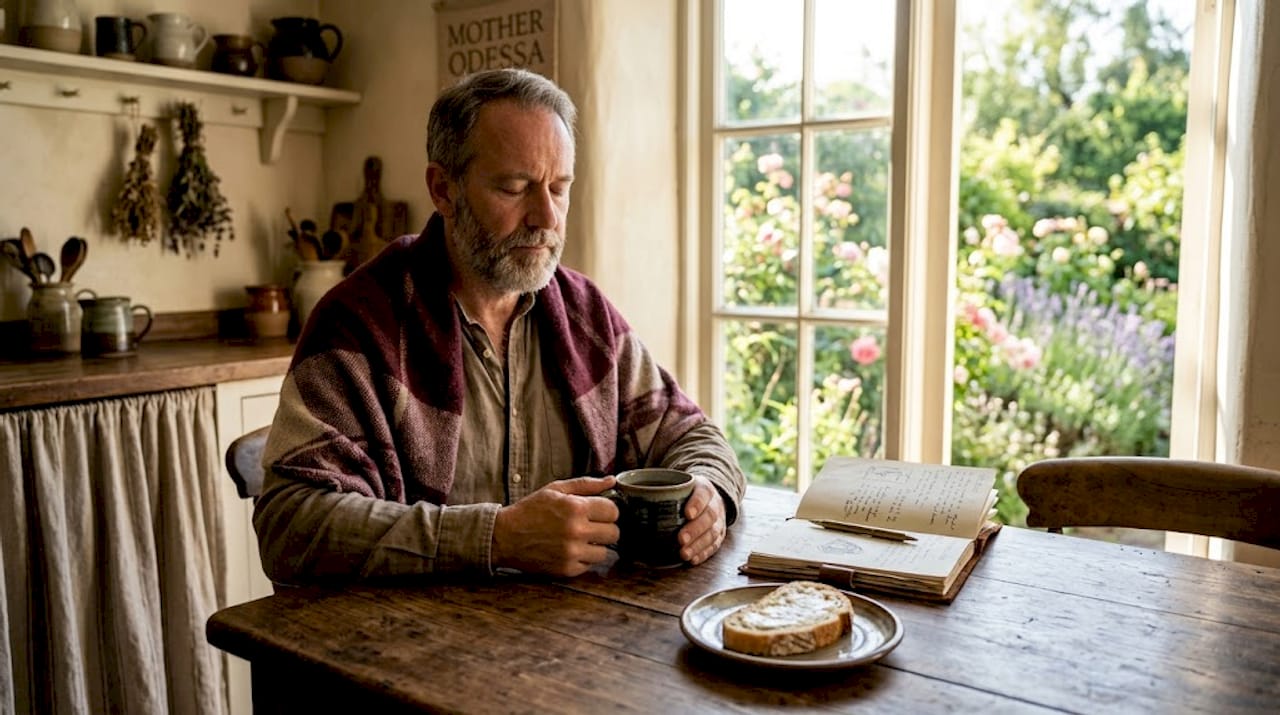
Perhaps most striking is research on intentional, short-term stress-inducing rituals. A 29-day semi-randomized trial found that rituals improve performance by decreasing anxiety in a dose-dependent way, meaning the more consistently participants practiced their specific ritual, the greater the cumulative benefit. Standard mindfulness meditation did not produce the same effect.
Why cultural resonance amplifies ritual power
Science can measure outcomes, but it takes a deeper look to understand the mechanism. Why does a personalized ritual work when a standard one does not? The answer is cultural and personal resonance.
The IndigenousMIND study is one of the clearest examples available. Researchers worked directly with Indigenous communities to co-create mindfulness programs that incorporated local language, prayers, and ceremonies. The result was not just better participation rates. Mood outcomes improved because participants felt ownership over the practice. It was theirs.
This principle applies far beyond Indigenous communities. A large study of more than 3,000 individuals across 19 countries found that prayer frequency and Mass attendance had direct and significant effects on spiritual well-being, forgiveness, and gratitude. The practices were meaningful because they were rooted in a tradition the participants genuinely identified with.
Here is what this means for you practically:
- A ritual borrowed from a tradition you have no connection to will feel performative.
- A ritual that uses language, symbols, or practices tied to your actual heritage or belief system will feel true.
- When a ritual feels true, you engage with it fully. Full engagement is where transformation happens.
- Community-led or personally co-created rituals consistently outperform rituals imposed from outside.
Pro Tip: Before designing any ritual, spend five minutes writing down three things that feel sacred or deeply meaningful to you personally. Your ritual should speak directly to at least one of them.
The concept of “ritual ecology” is useful here. Think of your rituals not as isolated acts but as a living system that reflects your values, your relationships, and where you are in life right now. That system needs to be tended, adjusted, and allowed to grow.
How to design your own customized ritual
Knowing that personalized rituals work is one thing. Building one that actually holds is another. Here is a practical process grounded in both research and real-world spiritual practice.
-
Identify your specific challenge. Do not start with a ritual. Start with the problem. Is it a strained relationship with a parent? Grief after a loss? Anxiety about your financial future? Name it clearly. A ritual designed to address a vague sense of “wanting to feel better” will be just as vague in its results.
-
Connect it to something meaningful. Choose symbols, words, objects, or times of day that carry personal or cultural weight. Neuroscience shows the brain needs consistent repetition, so anchoring your ritual to an existing meaningful cue helps it take root faster.
-
Start with one manageable practice. Effective rituals are small and realistic, built within your actual time and energy constraints. A five-minute candle lighting with spoken intention beats a 45-minute elaborate ceremony you will skip when life gets hard.
-
Build in reflection. After two weeks, ask yourself: Does this feel alive or mechanical? Is it addressing the actual challenge? Adjust based on what you notice. Iterative refinement and adapting rituals to life changes keeps practitioners engaged and the practice effective.
-
Layer in specificity over time. Once the core ritual feels stable, add elements that speak more directly to your situation. If you are working through a relationship rupture, you might add a written release practice. If you are calling in financial stability, you might incorporate specific prayers or offerings tied to abundance.
-
Protect the ritual’s integrity. Do not share it with people who will minimize it. The psychological power of ritual depends partly on the meaning you assign to it. Skepticism from others can erode that meaning before the practice has time to work.
Pro Tip: Treat your ritual like a conversation, not a performance. You are not trying to impress anyone. You are trying to reach something real inside yourself and, if your belief system includes it, something greater than yourself.
Standard vs. customized rituals: a direct comparison
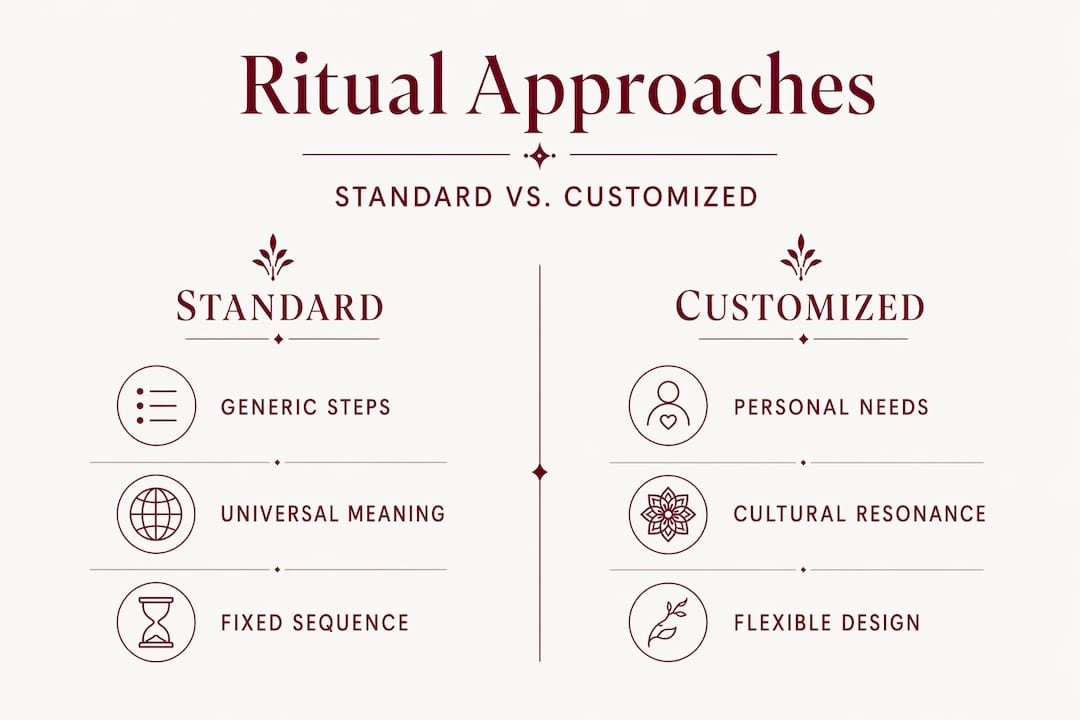
Not every situation demands a fully customized ritual. Understanding when each approach serves you best saves time and energy.
| Factor | Standard Practice | Customized Ritual |
|---|---|---|
| Design | Generic, pre-written | Built around your specific situation |
| Cultural fit | May or may not align | Rooted in your values and heritage |
| Emotional specificity | Low | High |
| Adaptability | Fixed | Evolves with your life |
| Effectiveness for complex challenges | Limited | Significantly higher |
| Time to create | None | Requires reflection and intention |
| Best suited for | General maintenance, beginners | Specific challenges, deep healing |
Standard practices have real value as entry points. If you have never had a spiritual practice and want to start somewhere, a guided meditation or a simple gratitude journal gives you a foundation. The problem is staying there when you are facing something that demands more.
When you are dealing with a broken family relationship, a pattern of financial struggle that feels generational, or the aftermath of a painful separation, a generic practice will not go deep enough. Those situations call for something built specifically for them.
My perspective on why customized rituals changed everything
I have worked with people in the deepest kinds of pain. Couples who had not spoken in years. Families fractured by betrayal. Individuals carrying curses that were not even theirs to begin with. And in every one of those situations, the people who came to me had already tried the standard approaches. The apps. The books. The generic prayers.
What I have learned over more than four decades of this work is that standardized rituals fail not because they are wrong, but because they are incomplete. They do not know your name. They do not know what your grandmother carried, or what your partner walked away from, or what specific wound in you keeps reopening.
The moment a ritual is built around the actual truth of your situation, something shifts. I have seen it happen more times than I can count. It is not magic in the theatrical sense. It is precision. The right spiritual tool applied to the right problem with the right intention. That is what changes things.
I also want to be honest about what I have seen go wrong. People who design rituals that are too ambitious burn out fast. People who borrow practices with no personal connection feel nothing. And people who never evaluate or refine their rituals end up going through motions that stopped serving them months ago. The ritual has to stay alive. That means you have to stay honest with yourself about whether it is working.
If you are dealing with a relationship challenge or a family wound, do not settle for something generic. Honor the specificity of your pain with a practice that is specific enough to meet it.
— Psychic
Ready to experience a ritual built for you
If this article has shown you anything, it is that the difference between a ritual that transforms and one that merely occupies your time is personalization. Motherodessa has spent more than 40 years doing exactly this work, rooted in West African spiritual traditions that have guided people through love, loss, financial hardship, and family fracture.
No two clients receive the same ritual. Every practice Motherodessa creates is built around your specific situation, your energy, and what your life actually needs right now. Whether you are working through a relationship rupture and need a love and relationship ritual, seeking emotional renewal through a spiritual cleansing bath, or ready for a complete reset with a full spiritual restoration ceremony, there is a path built specifically for you. Your situation is not generic. Your healing should not be either.
FAQ
What makes customized rituals more effective than standard ones?
Customized rituals are built around your specific emotional, cultural, and situational needs, which increases engagement and psychological resonance. Research shows culturally adapted spiritual practices produce outcomes nearly four times better than standard treatments for anxiety reduction.
How do I know if my current ritual is working?
If your ritual still feels meaningful and you notice shifts in your mood, clarity, or relationships after consistent practice, it is working. If it feels mechanical or your situation has not changed after several weeks, it likely needs refinement or a more personalized approach.
Can customized rituals help with relationship and family issues?
Yes. Rituals designed specifically around relational wounds, family estrangement, or emotional disconnection address the actual dynamics at play rather than offering generic comfort. Practitioners like Motherodessa specialize in rituals built for exactly these challenges.
How long does it take for a customized ritual to produce results?
Research on personalized spiritual interventions shows measurable improvements as early as 8 weeks with consistent practice. The key is specificity, consistency, and willingness to refine the practice as your situation evolves.
Do I need a spiritual practitioner to create a personalized ritual?
You can design basic personalized rituals on your own by connecting meaningful symbols and intentions to your specific challenge. For deeper or more complex issues such as generational patterns or serious relationship ruptures, working with an experienced practitioner significantly increases the effectiveness and safety of the process.