
Spell casting can be ethical, but only under specific conditions: the practitioner centers consent, works to minimize harm, and accepts full responsibility for whatever the working sets in motion. The rule of thumb is simple. Do not target another person’s will without informed consent, and if your work touches someone else’s life, be ready to own and repair whatever comes of it. The sections below break down the principles behind that rule, the gray areas that trip people up, and the safeguards that keep a practice accountable.
TL;DR:
- Spells targeting another person’s will without explicit consent are generally unethical, especially when dealing with love, influence, or coercive magic.
- Clear intention, safeguards like reversal procedures, and precise targeting are essential to prevent unintended harm or outcomes you cannot accept.
- Complex or high-stakes cases, such as generational curses or legal issues, should involve trained practitioners who prioritize confidentiality, consent, and follow-up.
- Practitioners emphasizing personal accountability often build personalized, follow-up-inclusive rituals to ensure responsibility for the work’s effects.
- Building a personal ethical code and logging every spell helps maintain accountability and reduces the risk of harm from ambiguous or impulsive magic.
Table of Contents
- What Spell Casting Ethics Actually Rest On
- The Gray Areas Every Practitioner Eventually Faces
- How to Design a Spell That Won’t Backfire
- Build a Personal Code Before You Need One
- When a Working Is Bigger Than You Should Handle Alone
- A Practitioner’s Note on Responsible Practice
- Where Motherodessa Fits If You Choose Professional Help
- Sources
- FAQ
What Spell Casting Ethics Actually Rest On
Every serious framework for magical ethics comes back to three ideas: consent, intent, and cause and effect.
Consent, or sovereignty, means you don’t direct magic at another person’s mind, body, or choices without their permission. Many contemporary witchcraft frameworks treat non-consensual magic, including love spells designed to override someone’s free will, as a violation of personal autonomy rather than a harmless nudge. That’s not a fringe opinion. It shows up across traditions that otherwise disagree on almost everything else.
Intent is the second pillar, and it’s less about good vibes than about clarity. Vague wishes tend to produce vague, sometimes messy, results. Cause and effect gets summarized in Wicca through the Rule of Three), the idea that whatever a practitioner sends out returns to them amplified. Whether or not you take that literally, it functions as a useful gut check: would you accept this outcome times three?
None of this is universal law, though. Traditions vary widely on where the lines sit:
- Wiccan frameworks generally discourage baneful or coercive magic outright.
- Hoodoo and other folk traditions often accept defensive or justice-oriented workings, including curse and hex work under certain conditions.
- Practitioner-focused writing on magical ethics frames the disagreement differently: magic is simply a form of power, and the real ethical obligation is accepting the consequences of using it, whichever tradition you follow.
That last point matters more than most beginners realize. The ethics question isn’t really “is this spell allowed.” It’s “can I live with what happens if this works exactly as intended.”
The Gray Areas Every Practitioner Eventually Faces
Most witchcraft morality questions aren’t about obvious harm. They’re about the murky middle, where good intentions and bad outcomes can come from the same working. Here’s how experienced practitioners tend to reason through the four situations that come up most.
- Love or influence spells. The line is consent. A working aimed at drawing love toward you, opening communication, or healing your own heart is different from one designed to bend a specific person’s feelings against their will. If you’re naming someone who hasn’t agreed to be magically influenced, you’re in coercive territory, whatever the spell’s label promises.
- Binding and baneful magic. Some practitioners frame binding as self-defense, stopping someone from causing further harm. Others see it as an infringement on another person’s autonomy no matter the justification. Writing on magickal binding ethics generally lands in the middle: binding can be defensible, but only with real safeguards and only as a last resort, not a first response to conflict.
- Healing without consent. Sending general, non-directive healing energy toward someone who hasn’t asked for it sits in a gentler gray zone than most other non-consensual work, but overreach is still overreach. The safer route is asking first, or keeping the working general enough that it doesn’t impose a specific outcome on someone else’s body or choices.
- Community impact. Coercive or invasive magic doesn’t just risk harming the target. A long-running critique in Pagan literature argues it damages the practitioner and the wider community too, normalizing practices that erode trust between practitioners and the people who come to them for help.
How to Design a Spell That Won’t Backfire
Good ethics in practice comes down to design choices you make before you ever light a candle. A handful of habits separate careful practitioners from careless ones.
Start with intention work. Ask yourself why you actually want this outcome, not just what the outcome is. Practical guides on responsibility in magic recommend building structural clauses into the working itself, phrases like “for the highest good of all” or “harm none,” so the spell has built-in room to course-correct if your framing missed something.
Precision matters just as much as intention. Spells tend to take the path of least resistance, and an imprecise target or vague desired result can produce outcomes you didn’t sign up for. “Bring me money” is a wide-open door. “Help me land the freelance contract I’m currently negotiating” is a door with a lock on it.
A few more habits worth building into every working:
- Favor shielding and protective rites over anything that targets another person’s will. Protection defends without imposing on someone else’s agency, which makes it the safer default whenever you’re unsure.
- Test smaller workings before committing to anything large, layered, or long-term.
- Build in a reversal or undo procedure before you start, not after something goes sideways.
- Keep a ritual log tracking intention, timing, ingredients, and what actually happened, so you can trace and repair a working that caused harm.
- If a working affects someone else even indirectly, have a plan for making amends ready before you cast, not as an afterthought.
Pro Tip: Treat your reversal language as part of the spell, not a backup plan you’ll write later. A working without an exit clause is a working you can’t easily undo.
If you’re dealing with a workplace conflict, a toxic ex, or interference you didn’t invite, a removal ritual built around privacy and precise targeting is a good example of how specificity and consent-conscious framing work together in practice.

Build a Personal Code Before You Need One
A personal code of ethics isn’t a philosophy exercise. It’s a checklist you run through every single time so you’re not making judgment calls under emotional pressure. Writers on contemporary witchcraft morality generally agree that a consistent, self-authored code beats borrowing someone else’s rules wholesale, because your accountability has to match your own practice.
Before any working that touches another person, run through these questions:
- Can I state my intention in one clear sentence?
- Does this target someone’s will, body, or choices without their consent?
- Is there a less invasive alternative, like shielding or general healing, that gets me most of the way there?
- Have I identified exactly who and what this spell affects?
- What’s the worst plausible outcome, and can I live with it?
- Do I have a reversal or repair plan ready if this goes wrong?
- Am I casting from clarity, or from anger, panic, or desperation?
Simple decision rules help too. Decline the working if you can’t answer question two honestly. Delay it if you’re casting from raw emotion rather than clarity. Get explicit witness consent before any working that names or affects a third party who’s aware of your practice. And log every result, because a written record is what turns “I think it worked” into an actual accountability trail you can learn from.
When a Working Is Bigger Than You Should Handle Alone
Some situations call for outside experience, not more solo research. Complex baneful work, generational or family curse patterns, and anything with real legal or safety stakes fall into this category. These cases carry consequences that reach further than a single spell, and layered histories are hard to untangle without training.
Before hiring a practitioner, ask about:
- How they handle confidentiality and privacy around your situation.
- What consent practices they follow when a working involves a third party.
- Whether they build in reversal options and what follow-up looks like after the work is done.
A practitioner who takes ethics seriously will give you a clear scope, a documented plan, and privacy safeguards without being asked twice. If a protection or banishing service can’t explain its own process in plain language, that’s worth noticing.
A Practitioner’s Note on Responsible Practice
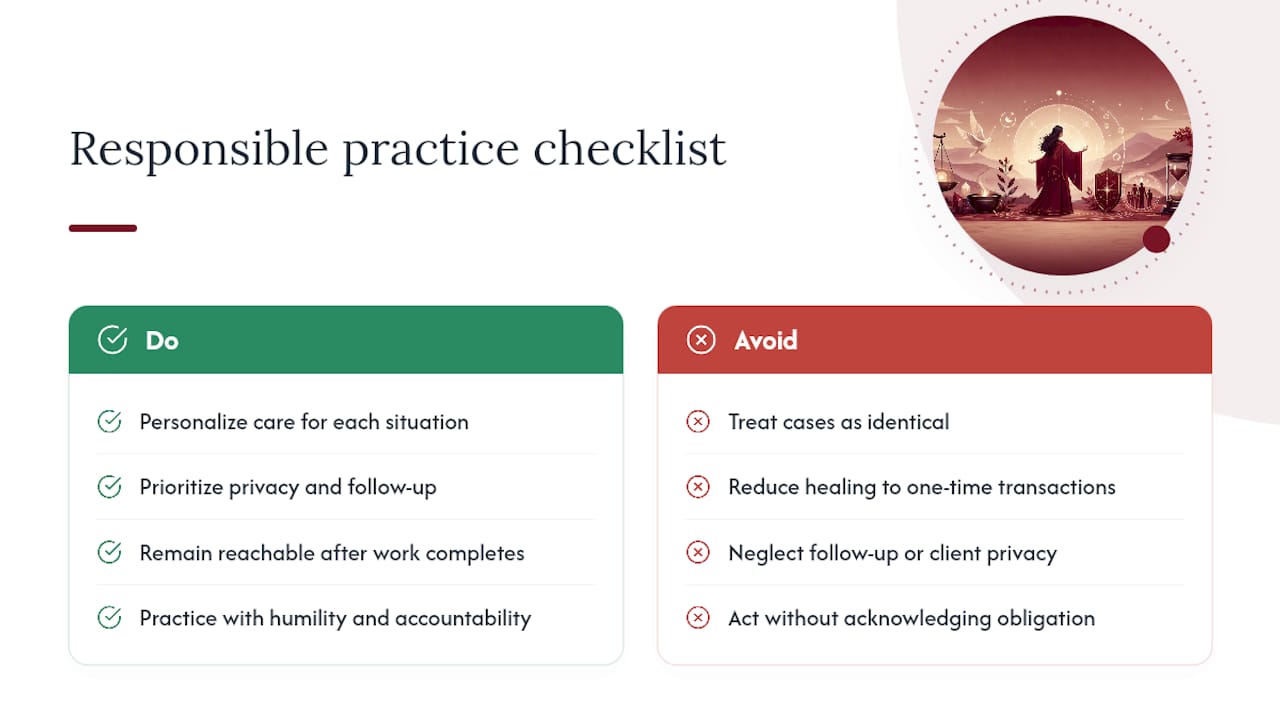
Forty years of West African-rooted spiritual healing work teaches you one thing above all: no two situations are the same, and treating them as if they are is where ethical practice breaks down. Personalization isn’t a marketing point. It’s what accountability actually looks like when you’re dealing with real people’s lives.
Privacy and follow-up matter just as much as the ritual itself, as emphasized in frameworks like the Triad Mind Cornerstone: Stage One that focus on holistic healing and responsibility. A working that helps someone reunite with an estranged partner or break a generational pattern only holds up ethically if the practitioner stays reachable afterward and treats the outcome as a shared responsibility, not a one-time transaction. Approach this work with humility. The power is real, and so is the obligation that comes with it.
— Psychic
Where Motherodessa Fits If You Choose Professional Help
If you’ve read this far and decided your situation needs an experienced hand rather than a solo attempt, that’s often the more responsible call, not a shortcut. Some practitioners build rituals around the specifics of individual situations instead of a one-size-fits-all script, which is exactly the kind of precision this article has argued for throughout.
Her work spans spiritual healing and clarity, protection and banishing, love and relationships, and money and abundance work, each one customized rather than pulled off a shelf. With more than 40 years of practice rooted in West African traditions, she brings the kind of accountability and privacy this article has walked through: clear scope, individualized method, and follow-up that treats your outcome as her responsibility too. If you’re weighing whether to move forward, start by browsing spiritual healing services to see what a personalized approach actually looks like before you commit.
Sources
For readers who want to go deeper on the frameworks referenced above: the Rule of Three entry covers the Wiccan cause-and-effect heuristic in more depth, Christopher Drysdale’s essay on power and magical ethics unpacks accountability as the core ethical demand, and the sacred-texts excerpt on coercive magic lays out the community-harm argument in full.
FAQ
Can spells actually harm other people?
Yes. Coercive or invasive magic, especially work that targets someone’s will without consent, carries real risk to the target, and long-standing Pagan writing on the subject argues it damages the practitioner and community too.
Is the Threefold Law real, or just a metaphor?
It functions more as a heuristic than a proven mechanism. The Rule of Three asks practitioners to weigh whether they’d accept a consequence amplified, which makes it a useful ethical gut check regardless of whether you take it literally.
Are binding spells ethical?
It depends on framing and safeguards. Some practitioners treat binding as legitimate self-defense against ongoing harm, while others see it as an infringement on autonomy, and most agree it should only be attempted with rigorous precautions already in place.
Do I need consent to cast a love spell?
Yes, if the spell targets a specific person’s feelings or choices. Ethical frameworks generally treat spells that override another person’s free will, including many love spells, as a violation of personal sovereignty.
When should I hire an experienced practitioner instead of casting alone?
Bring in outside experience for complex baneful work, generational curse patterns, or any situation with legal or safety stakes attached, since these carry consequences of what a single solo working can safely manage.