
A romantic reconnection ritual is defined as a brief, intentional interaction between partners that signals safety, priority, and presence. These moments, typically lasting 20–60 seconds, are not grand gestures. They are small, repeated actions that rebuild emotional closeness one exchange at a time. The Gottman Institute identifies rituals like the 6-second kiss and 10-second embrace as biological necessities, not optional extras. Understanding what does a romantic reconnection ritual involve gives couples a practical path back to each other, whether they are healing after distance or simply keeping love alive.
What does a romantic reconnection ritual involve?
A romantic reconnection ritual involves specific micro-moment behaviors that shift two people from disconnection to closeness. These are not elaborate ceremonies. They are short, repeatable actions with clear emotional purpose.
The most common ritual elements include:
- The 6-second kiss. Long enough to require presence, short enough to fit any schedule.
- The 10-second embrace. Physical contact that releases oxytocin and lowers cortisol, the body’s primary stress hormone.
- Sustained eye contact. Three to five seconds of direct eye contact signals “I see you” before words are exchanged.
- Brief verbal affirmations. Phrases like “I’m glad you’re here” or “I missed you today” anchor the moment emotionally.
- Reunion greetings. A deliberate pause when one partner arrives home, before phones, children, or tasks take over.
- Daily check-ins. A 20-minute non-logistical conversation focused on feelings, not schedules or problems.
The key constraint is content. Reconnection rituals exclude conflict resolution, bill discussions, and parenting logistics. Those conversations activate the nervous system’s threat response. A ritual works precisely because it is free of agenda.
Pro Tip: Design your ritual around the transition moment that already exists in your day. The commute home, the morning coffee, or the moment before sleep are natural anchors. Attach the ritual to an existing habit so it requires no extra willpower.

How do reconnection rituals regulate the nervous system?
Reconnection is primarily a physiological process. Nervous system regulation must happen before any meaningful cognitive or emotional exchange can succeed. This is the part most couples skip, and it explains why “we need to talk” conversations so often go sideways.
Co-regulation is the mechanism at work. When two people share physical proximity, synchronized breathing, and calm eye contact, their heart rates and stress responses begin to mirror each other. The body reads the partner’s calm as evidence of safety. That safety is what makes vulnerability possible.
“Real intimacy emerges when nervous systems co-regulate through presence, touch, and eye contact, not merely from talking.” — Empathi
PACT therapy, developed by Dr. Stan Tatkin, frames this as an “orientation moment.” The reunion greeting is not just polite. It is a biological reset that tells each partner’s nervous system: the threat is gone, connection is available. Skipping it and jumping straight into the evening’s demands keeps both people in a low-grade defensive state.
Reunion rituals should avoid logistical or problem-solving talk entirely. Keeping rituals content-light is not avoidance. It is physiological strategy. The nervous system cannot co-regulate and process conflict simultaneously. Couples who protect their rituals from agenda-driven talk report feeling safer and more emotionally present with each other over time.
Reconnection rituals also create what researchers describe as a biological ledger of safety. Each small, predictable deposit builds felt security. Couples cannot bank connection from a single vacation or anniversary dinner. Each moment stands alone and must be earned in real time.
What is a step-by-step plan for building reconnection rituals?
A 30-day, 3-stage approach gives couples a reliable structure for building rituals that actually stick. The stages move from foundation to novelty to review, matching the natural arc of how intimacy rebuilds.
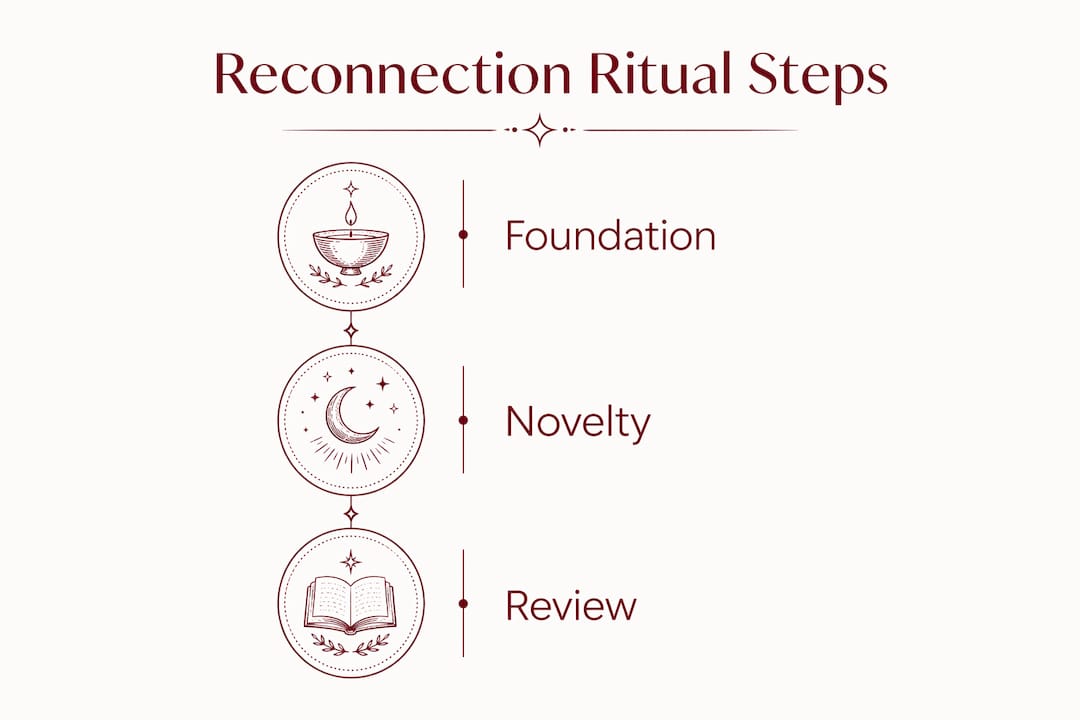
Stage 1: Foundation (weeks 1–2)
The first two weeks focus entirely on micro-habits. These are the smallest possible actions that signal presence and care. Phone-free dinners, a deliberate goodbye kiss each morning, and a two-minute check-in before sleep all qualify. The goal is not depth. The goal is consistency. Couples who try to go deep too fast often trigger the very defensiveness they are trying to dissolve.
Stage 2: Novelty (week 3)
Week three introduces one new element per day. This could be a question neither partner has asked before, a shared activity from early in the relationship, or a physical touch that has fallen away. Novelty activates the brain’s reward system and associates the partner with positive arousal rather than routine. The key is keeping the stakes low. A new question over dinner is enough.
Stage 3: Review (week 4)
The final week is a structured reflection. Couples identify which rituals felt natural, which felt forced, and what they want to carry forward. This is also the moment to name unmet needs honestly, in a calm state, not mid-conflict.
| Stage | Duration | Core activities | Expected effect |
|---|---|---|---|
| Foundation | Weeks 1–2 | Phone-free dinners, morning kiss, nightly check-in | Reduced defensiveness, increased felt safety |
| Novelty | Week 3 | New questions, shared activities, renewed touch | Positive emotional arousal, renewed curiosity |
| Review | Week 4 | Reflection on what worked, naming needs | Clarity, shared commitment, ritual refinement |
Patience is not optional here. Intimacy rebuilds over weeks and months, not days. Couples who expect a dramatic shift in week one often abandon the process before the nervous system has had time to respond.
What are the biggest myths about reconnection rituals?
The most damaging myth is that reconnection requires a grand gesture. A weekend away, a surprise dinner, or a heartfelt letter feels significant. But grand gestures are less important than daily, imperfect invitations. A partner who consistently turns toward small bids for connection builds more trust than one who plans elaborate events and ignores the daily texture of the relationship.
The second myth is that both partners must be equally committed from the start. One partner’s consistent effort can create a ripple effect. When one person shows up with warmth and presence repeatedly, the other partner’s nervous system begins to register safety. Engagement follows. Waiting for mutual buy-in before starting is the most common reason couples never begin.
Expert tips for sustaining rituals over time:
- Protect the ritual from logistics. If the check-in becomes a to-do list review, it stops working. Guard the content.
- Lower the bar deliberately. A 30-second hug counts. A two-sentence check-in counts. Imperfect and consistent beats perfect and rare.
- Repair agreements matter. Repair rituals agreed upon in calm moments create safe structures for vulnerability after conflict, reducing the fear of reconnecting after a fight.
- Track turning-toward moments. Notice when your partner reaches for connection, even subtly, and respond. That response is the ritual.
- Name the ritual. Couples who give their rituals a name, even something simple, report stronger adherence and shared meaning.
Pro Tip: If a ritual starts to feel like a chore, shrink it rather than skip it. A 6-second kiss instead of a 10-minute check-in still deposits into the safety ledger. Momentum matters more than magnitude.
If you are wondering whether your estranged partner is already reaching toward you, the signs your ex wants to reconnect are often subtle but readable once you know what to look for.
Key Takeaways
A romantic reconnection ritual works because brief, consistent, content-free moments of presence regulate the nervous system and rebuild felt safety faster than any single grand gesture.
| Point | Details |
|---|---|
| Rituals are physiological first | Nervous system co-regulation must happen before emotional depth is possible. |
| Duration is short by design | Effective rituals last 20–60 seconds; longer is not always better. |
| Content matters as much as action | Exclude logistics and conflict from rituals to preserve their safety signal. |
| Consistency beats perfection | Imperfect daily rituals outperform occasional grand gestures every time. |
| One partner can start alone | A single partner’s consistent effort creates a ripple that invites the other in. |
What I have seen rituals actually do to relationships
After working with couples across many different circumstances, the pattern I keep seeing is the same. The couples who reconnect are not the ones who had the most dramatic breakthroughs. They are the ones who showed up for the small moment, again and again, even when it felt awkward or one-sided.
The nervous system science resonates because I have watched it play out in real relationships. A partner who felt completely shut down will soften after weeks of consistent, low-pressure presence. Not because of a conversation. Because their body finally registered safety. That is not a metaphor. That is biology doing its work.
What I find most people get wrong is the timeline. They expect to feel reconnected within days. Real intimacy, the kind that holds under stress, takes months of deposits. The couples who understand that stop measuring progress by how a single evening felt and start measuring it by the direction they are moving.
My honest advice: start with one ritual, make it tiny, and protect it from everything else. The 6-second kiss at the door is not a small thing. Over months, it becomes the thing that holds the relationship together when everything else is hard.
— Psychic
Spiritual support for your reconnection path
Psychological rituals and spiritual practices are not opposites. For many people, the reconnection work feels deeper and more grounded when it is held within a spiritual framework.

Motherodessa has spent over 40 years working with individuals and couples navigating estrangement, lost passion, and the kind of distance that feels impossible to cross alone. Her love and relationships rituals are personalized to each situation, drawing on West African healing traditions that treat love as something sacred and worth protecting. The Return a Lover Ritual and the Passion and Flame Ritual address specific emotional and energetic barriers that daily micro-habits alone may not reach. If you are ready to add a deeper layer of support to your reconnection work, Motherodessa’s practice offers a private, customized path forward.
FAQ
What does a romantic reconnection ritual involve?
A romantic reconnection ritual involves brief, intentional actions like a 6-second kiss, a 10-second embrace, eye contact, and verbal affirmations that signal safety and presence to a partner. These moments last 20–60 seconds and are kept free of logistics or conflict.
How long does it take for reconnection rituals to work?
Intimacy rebuilds over weeks and months, not days. A 30-day phased approach, moving from foundational micro-habits through novelty and review, produces reliable results when practiced consistently.
Do both partners need to agree to start a reconnection ritual?
Mutual agreement is ideal but not required. One partner’s consistent effort creates a ripple effect that gradually invites the other partner’s engagement as their nervous system registers safety.
What should you avoid during a reconnection ritual?
Avoid logistical discussions, conflict resolution, and problem-solving during ritual moments. Keeping rituals content-light prevents defensive nervous system activation and preserves the emotional safety the ritual is designed to create.
What is the difference between a reconnection ritual and a reconnection ceremony?
A reconnection ritual is a daily or recurring micro-moment practice, such as a morning kiss or evening check-in. A reconnection ceremony is a more formal, one-time event designed to mark a turning point in the relationship, often with symbolic or spiritual elements.