
Spiritual assessment practices are systematic methods used to evaluate an individual’s beliefs, values, and sense of meaning to support personal growth and well-being. Tools like FICA, HOPE, FACT, and the Spirituality in Palliative Care Scale (SPCS) each take a different angle on this evaluation, and spiritual assessment practices compared side by side reveal real differences in depth, flexibility, and fit. Research shows that patients widely accept respectful spiritual inquiry, contradicting the common assumption that people resist these conversations. Choosing the right method depends on your goals, your spiritual tradition, and how much structure you need.
1. What are the most widely used spiritual assessment tools?
Spiritual assessment uses interviews, questionnaires, and observation conducted by interdisciplinary teams to evaluate beliefs, values, and sense of meaning. No single tool dominates every context. The four most recognized frameworks are FICA, HOPE, FACT, and the SPCS.
FICA stands for Faith, Importance, Community, and Address. It guides a practitioner through four direct questions: what you believe in, how much it matters, whether you belong to a spiritual community, and how you want your beliefs addressed in care. FICA works well as a first-pass screening tool because it is short and easy to remember.

HOPE covers Hope, Organized religion, Personal spirituality and practices, and Effects on care. It goes slightly deeper than FICA by separating personal spiritual practices from formal religious affiliation. That distinction matters for people who identify as spiritual but not religious.
FACT is a hybrid tool built for acute care settings where time is limited. It combines elements of FICA and HOPE into a faster format. Practitioners use it when a full interview is not possible but some spiritual data is still needed.
The SPCS (Spirituality in Palliative Care Scale) is a validated quantitative instrument. A 115-person study confirmed its three-factor structure: holistic collaborative care, faith-driven care, and emotional awareness. The SPCS is best suited for measuring spiritual competency in clinical or educational settings.
| Tool | Format | Best Use | Depth |
|---|---|---|---|
| FICA | 4-question mnemonic | General screening | Basic |
| HOPE | 4-domain interview | Personal vs. religious distinction | Moderate |
| FACT | Hybrid short form | Acute or time-limited care | Basic to moderate |
| SPCS | Validated scale | Clinical education, research | High |
2. How do structured vs. open-ended approaches differ?
Structured tools like FICA and HOPE follow a fixed sequence of questions. That consistency makes them easy to train on and quick to administer. The trade-off is rigidity. Strict adherence to scripts can damage rapport, and experienced practitioners prioritize adaptable, compassionate approaches over mechanical delivery.
Open-ended, patient-led methods start from a different premise. The practitioner opens with a broad invitation rather than a checklist. The “Open Invite” mnemonic, for example, begins with a question like “Do you have spiritual beliefs that are important to you?” Starting with open-ended questions increases comfort and supports autonomy. The person being assessed sets the pace and direction.
The practical difference shows up in what each method captures. Structured tools produce comparable data across individuals. Open-ended conversations surface nuance, personal meaning, and emotional texture that a checklist cannot reach. Neither approach is universally superior. The best spiritual evaluation technique matches the goal.
Pro Tip: If you are assessing your own spiritual growth rather than working with a practitioner, start with HOPE to identify your personal practices, then follow up with open journaling to capture what the structured questions miss.
3. What ethical principles govern spiritual assessments?
Ethical spiritual assessment rests on three principles: consent, respect for autonomy, and the avoidance of clinician bias. Clinicians must avoid imposing their own beliefs and must document assessments in ways that honor patient preferences and privacy. These are not optional courtesies. They are the foundation of trust.
Proselytizing is the most common ethical failure in spiritual assessment. A practitioner who steers the conversation toward their own tradition, even subtly, violates the person’s autonomy. The assessment stops being about the individual and becomes about the assessor. This is why training in spiritual assessment always emphasizes neutrality.
“Spiritual assessment must prioritize patient consent and autonomy to foster trust and meaningful dialogue.” — Faith and Whole-Person Healing
Documentation carries its own ethical weight. Notes should be concise, clinically relevant, and protective of privacy. They should record what the person expressed, not what the practitioner interpreted or preferred. That distinction matters enormously when assessment records become part of a broader care plan.
4. Quantitative vs. qualitative methods: what each one reveals
Quantitative spiritual assessment assigns numerical scores to beliefs and practices. The Royal Free Interview for Religious and Spiritual Beliefs is a strong example. People affiliated with a faith score significantly higher on spiritual belief measures, with a mean of 37.1 compared to 27.6 for general clinical groups. The Pearson coefficient of 0.41 (p < .0005, n = 228) confirms the correlation is statistically meaningful. That kind of data lets researchers compare groups and track change over time.
Qualitative methods work differently. They use interviews, observation, and open dialogue to capture meaning, story, and emotional experience. A score cannot tell you why someone’s faith shifted after a loss. A conversation can.
| Method | Strengths | Limitations |
|---|---|---|
| Quantitative scales | Comparable data, tracks change, supports research | Misses personal meaning and nuance |
| Qualitative interviews | Rich context, emotional depth, patient-led | Hard to compare across individuals |
| Mixed methods | Combines both strengths | Requires more time and skill |
Mixed-methods applications combine a validated scale with a follow-up conversation. The scale gives you a baseline. The conversation explains it. For personal spiritual growth evaluation, this combination is the most complete approach available.
5. How to choose the right spiritual assessment method for you
The right method depends on three factors: your goal, your setting, and your comfort with structure. If you want a quick snapshot of where you stand spiritually, FICA or HOPE takes less than ten minutes and requires no special training. FICA and HOPE are effective screening tools for non-professionals when adapted to individual situations.
If you are working with a spiritual counselor or healer, a one-on-one spiritual counsel session allows for a more fluid, qualitative approach. The practitioner can follow threads that a questionnaire would cut off. That flexibility is especially valuable when you are processing grief, a major life transition, or a crisis of meaning.
Cultural context shapes which tool fits. In multi-faith or cross-cultural environments, adaptable models that account for diverse spiritual expressions are necessary for accurate assessment. A tool built around Christian categories will not serve someone from a West African, Buddhist, or Indigenous tradition without significant adaptation.
Pro Tip: Before choosing a formal tool, write down three questions you most want answered about your spiritual life. Then pick the assessment method that addresses those specific questions rather than the one that sounds most official.
Here is a practical selection guide:
- Quick personal check-in: Use HOPE on your own, in writing.
- Working with a counselor: Request an open-ended, conversation-based session.
- Tracking growth over time: Use a validated scale like the SPCS at regular intervals.
- Cross-cultural or interfaith context: Choose an adaptable model and supplement with open dialogue.
- Acute spiritual crisis: Prioritize a qualified practitioner over any self-administered tool.
6. How the effectiveness of a tool depends on the practitioner
The effectiveness of spiritual assessment depends less on the specific instrument and more on the practitioner’s ability to adapt to the person’s needs and cultural context. A skilled practitioner using FICA with genuine curiosity will produce better results than a rigid clinician using the SPCS by the book. The tool is a starting point, not the destination.
Experienced practitioners also detect spiritual distress through non-verbal cues and patient affect. That skill requires emotional intelligence that no questionnaire can replicate. A person may score neutrally on a scale while showing clear signs of spiritual pain through body language, silence, or affect. Reading those signals is what separates a good assessment from a complete one.
For individuals assessing their own spiritual growth, this principle translates directly. Self-honesty matters more than the format you use. A personalized spiritual consultation with a practitioner who knows how to read what you are not saying will always outperform a solo questionnaire.
Key takeaways
The most effective spiritual assessment combines a structured tool like FICA or HOPE with an open, practitioner-led conversation that respects the individual’s beliefs, cultural context, and consent.
| Point | Details |
|---|---|
| Match tool to goal | Use FICA or HOPE for quick screening; use SPCS for tracking growth over time. |
| Prioritize consent and autonomy | Ethical assessment begins with permission and never imposes the assessor’s beliefs. |
| Combine methods for depth | Quantitative scales reveal patterns; qualitative conversations explain them. |
| Practitioner skill matters most | Adaptability and emotional intelligence outperform rigid script adherence. |
| Cultural fit is non-negotiable | Tools must be adapted for cross-cultural and interfaith contexts to be accurate. |
Why I trust conversation over checklists every time
I have seen people hand someone a FICA form and call it a spiritual assessment. The form comes back filled in, the boxes are checked, and nothing real was exchanged. That is not assessment. That is paperwork.
The most revealing spiritual evaluations I have witnessed start with silence and a single open question. What matters to you right now? Where do you feel supported? Where do you feel alone? Those questions open doors that FICA and HOPE can only knock on. Structured tools are useful maps, but maps are not the territory.
What concerns me about the trend toward clinical rigor in spiritual assessment is the risk of losing the human center. Spiritual distress does not always announce itself with words. It shows up in how someone holds their hands, whether they make eye contact, what they avoid saying. Emotional intelligence is the real assessment instrument. Everything else is scaffolding.
My recommendation is this: use structured tools to orient yourself, then set them aside and listen. The spiritual guidance practices that actually change people are the ones grounded in presence, not protocol. Assessment is not judgment. It is the beginning of a conversation about what you need and what is possible.
— Psychic
Motherodessa’s approach to spiritual healing and clarity
Motherodessa brings over 40 years of experience to spiritual healing rooted in West African traditions. Her work goes beyond assessment. She uses what she learns about a person’s specific situation to design rituals that address real needs, whether that involves love, protection, financial abundance, or breaking generational patterns.
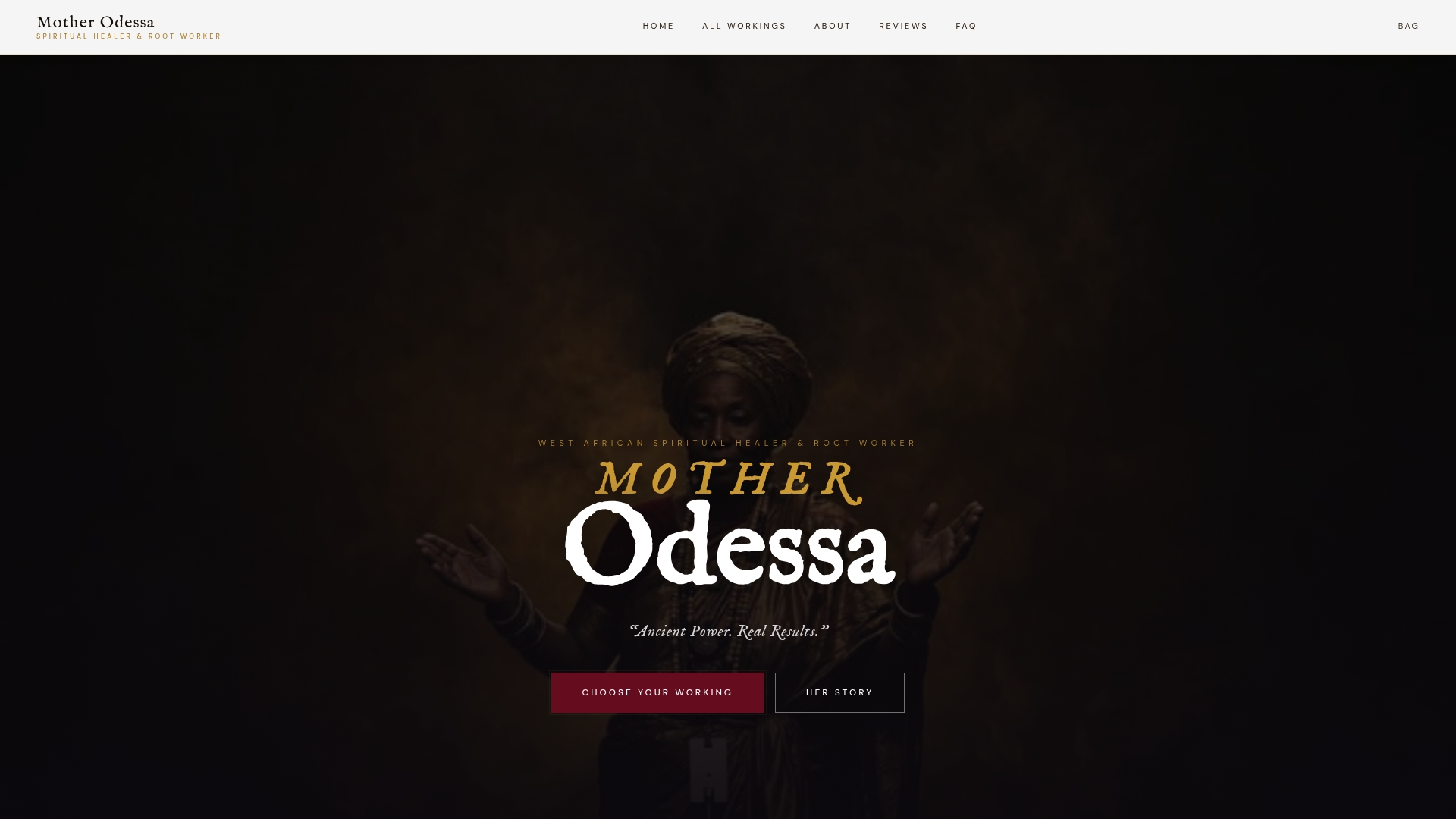
After completing a spiritual assessment, many people know what is blocking them but do not know what to do next. Motherodessa’s spiritual healing and clarity services provide that next step. For those drawn to ceremony-based healing, the Seven African Powers Ceremony is one of her most requested offerings. Every ritual is personalized. No two clients receive the same work, because no two spiritual situations are identical.
FAQ
What is the FICA spiritual assessment tool?
FICA stands for Faith, Importance, Community, and Address. It is a four-question screening tool used to identify a person’s spiritual beliefs and how those beliefs should be considered in their care.
How does HOPE differ from FICA?
HOPE separates personal spiritual practices from formal religious affiliation, making it more useful for people who are spiritual but not affiliated with an organized religion. FICA treats faith and community as linked; HOPE treats them as distinct.
Can I do a spiritual assessment on my own?
Yes. Tools like HOPE and FICA can be used for self-reflection without a practitioner. For deeper evaluation, working with a qualified spiritual counselor produces more complete results.
What is the Spirituality in Palliative Care Scale?
The SPCS is a validated quantitative instrument with a three-factor structure covering holistic care, faith-driven care, and emotional awareness. It is primarily used in clinical and educational settings to measure spiritual competency.
Why does cultural context matter in spiritual assessments?
Tools built around one religious tradition will produce inaccurate results when used with people from different backgrounds. Effective spiritual assessment adapts its language, questions, and assumptions to the individual’s actual spiritual framework.