
Spiritual needs assessment is the structured process by which experienced practitioners identify the emotional, energetic, and contextual factors shaping a seeker’s life before any ritual or guidance begins. Understanding how experienced spiritual healers assess needs reveals that this is never a single-question intake form. It is a disciplined, layered process combining direct verification, energy scanning, and collaborative dialogue. Practitioners like Motherodessa draw on decades of accumulated skill to read what most people cannot articulate about themselves. The accuracy of any ritual or healing work depends entirely on the quality of this initial assessment.
How experienced spiritual healers assess needs: the core process
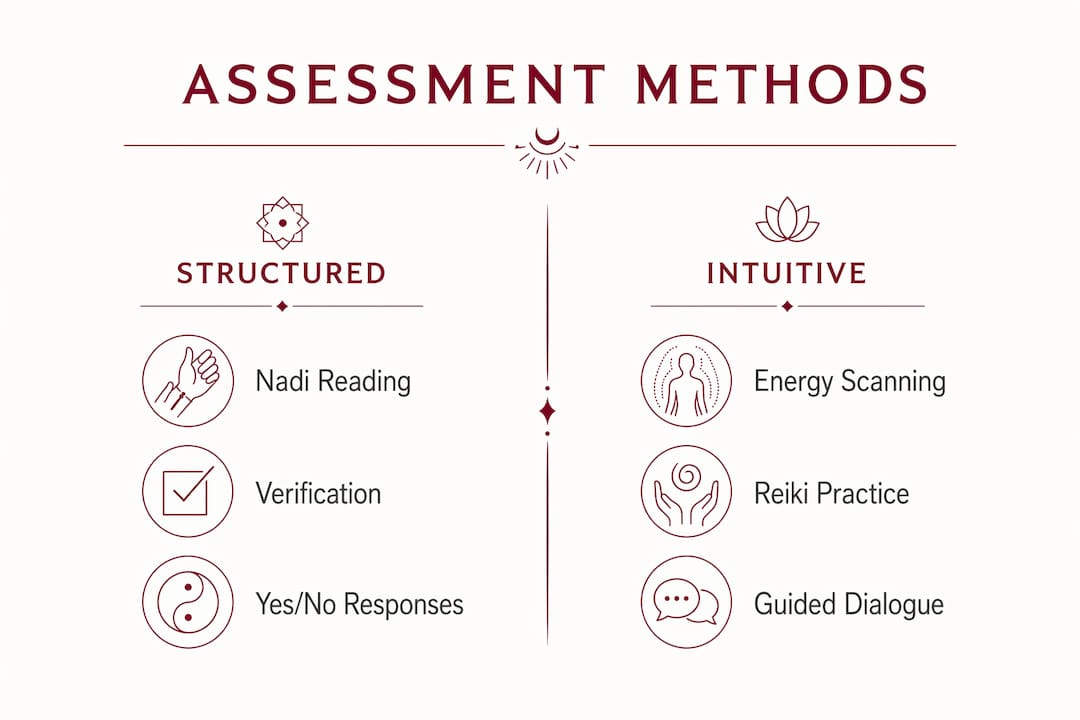
Experienced healers use a combination of structured verification, intuitive energy reading, and guided dialogue to build a complete picture of a seeker’s spiritual state. These methods are not interchangeable. Each serves a distinct diagnostic function, and skilled practitioners know when to use which approach.
The most structured of these methods appears in Nadi reading traditions. Nadi reading sessions use a strict verification method where seekers confirm or deny statements without volunteering additional information. This discipline is not arbitrary. It ensures that any match between the reader’s statements and the seeker’s reality reflects the practitioner’s skill, not the seeker’s prompting. The seeker’s role here is almost passive: a simple yes or no, nothing more.
Energy scanning, used widely in Reiki and related practices, works differently. Reiki practitioners use energy scanning and hand placements to sense imbalances in chakras and adjust treatment zones intuitively during sessions. This method requires the healer to maintain their own energetic clarity, since a depleted or blocked practitioner cannot accurately read another person’s field. Experienced healers treat self-preparation as a non-negotiable part of every session.

Guided dialogue rounds out the process. Spiritual assessment in counseling is a continuous, collaborative exploration that gathers psychological, emotional, social, and contextual factors to guide interventions. This means the healer is not just listening for surface complaints. They are mapping strengths, identifying risks, and locating the coping resources a seeker already possesses.
Key methods used in experienced healer consultations include:
- Nadi leaf verification: Seeker responds only yes or no to specific statements, preserving diagnostic integrity
- Reiki energy scanning: Hands or focused attention move across the body’s energy field to locate blockages or excess activity
- Structured spiritual tools: Frameworks like FICA (Faith, Importance, Community, Address) and HOPE (Sources of Hope, Organized religion, Personal spirituality, Effects on care) adapted from clinical spiritual care
- Collaborative intake dialogue: Open-ended questions and deep listening to surface goals, fears, and relational context
- Observation of nonverbal cues: Mental health intake assessments rely on structured interviews, nonverbal observations, and flexible questioning to uncover client state and risks
Pro Tip: If you are entering a Nadi reading or any structured verification session, practice saying only yes or no at home beforehand. The instinct to explain or add context is strong, and resisting it is a skill that directly improves the accuracy of your reading.
How do healers balance spiritual insight with ethical accountability?
Ethical clarity is not a soft concern in spiritual healing. It is the structural foundation that separates responsible practice from exploitation. Experienced practitioners set boundaries before the session begins, not after problems arise.
Pluralistic mental healthcare combining biomedical and traditional healing faces ethical ambiguity due to lack of harmonized governance and referral protocols. This finding matters because it names a real gap: when a healer operates alongside medical or psychological professionals, accountability lines blur without clear frameworks. Responsible practitioners address this by communicating their scope of practice explicitly and referring clients to other professionals when a need falls outside their expertise.
The steps experienced healers take to maintain ethical accountability follow a consistent pattern:
- Disclose scope of practice before any assessment begins, so the seeker understands what the healer can and cannot address
- Obtain informed consent for any documentation, recording, or sharing of session content
- Set referral thresholds in advance, identifying the types of concerns (acute mental health crises, medical emergencies) that require professional redirection
- Avoid overpromising outcomes, particularly around timelines for love, financial, or health-related rituals
- Document session notes with enough detail to track progress across multiple visits without compromising client privacy
“Clear communication about limitations and boundaries, as well as referral when appropriate, reflects responsible assessment practice among experienced spiritual healers.” — Risk and liability in collaborative mental healthcare
The role of energy reading in consultations also carries ethical weight. When a healer claims to sense something specific in a client’s field, that claim shapes the client’s perception of their own situation. Responsible practitioners frame energetic observations as information to consider, not verdicts to accept without question.
How do spiritual need assessments compare across healing traditions?
Different traditions approach the same diagnostic goal through radically different methods. Understanding these differences helps seekers choose the right type of session for their specific situation.
| Tradition | Primary assessment method | Seeker’s role | Key strength |
|---|---|---|---|
| Nadi reading | Leaf verification with yes/no responses | Passive confirmation | High structural accuracy when discipline is maintained |
| Reiki | Energy scanning and chakra sensing | Receptive, minimal input | Detects subtle energetic imbalances across multiple dimensions |
| Clinical spiritual care | FICA or HOPE framework interviews | Active dialogue | Integrates psychological and spiritual context systematically |
| West African traditions (e.g., Motherodessa) | Ritual diagnostics combined with direct consultation | Collaborative and responsive | Culturally rooted, addresses generational and relational patterns |
| Counseling-based spiritual assessment | Ongoing collaborative exploration | Highly participatory | Tracks change over time and adjusts interventions dynamically |
The contrast between passive and participatory models is significant. Nadi readings and Reiki sessions ask the seeker to receive rather than direct. Clinical and counseling-based assessments ask the seeker to contribute actively. West African healing traditions, as practiced by Motherodessa, blend both: the practitioner reads and diagnoses, but the seeker’s specific circumstances shape every ritual that follows. No two sessions produce the same outcome because no two people carry the same history.
Cultural roots strengthen spiritual work in ways that standardized tools cannot replicate. A framework like FICA captures religious affiliation and community support. It does not capture the weight of a generational curse, the energetic residue of a broken oath, or the protective significance of a specific ancestral lineage. Culturally grounded assessment methods hold space for these dimensions.
Pro Tip: Before booking a session, ask the practitioner directly: “What information do you need from me, and at what point in the session?” A clear answer tells you whether the healer uses a structured or open-ended assessment model, and helps you prepare accordingly.
What practical steps help seekers engage effectively in spiritual assessments?
The seeker’s preparation directly affects the quality of the assessment. Practitioners can only work with what they can access, and a seeker who arrives distracted, guarded, or unprepared limits what any healer can accurately perceive.
Concrete steps that improve your experience in spiritual healing assessments:
- Arrive with a clear primary concern. You do not need to have everything figured out, but knowing your single most pressing issue helps the healer orient the session efficiently.
- Practice disciplined restraint during verification stages. As minimizing client input during initial verification ensures diagnostic accuracy reflects the practitioner’s skill rather than client suggestion, your silence is an active contribution to the process.
- Take notes or record the session with permission. Complex readings contain layers of information that are impossible to absorb in real time. Reviewing notes afterward often reveals connections that were not obvious during the session.
- Hold your clarifying questions until the assessment phase ends. Interrupting a structured reading with context or corrections disrupts the practitioner’s process. Most experienced healers build in a dialogue phase specifically for your questions.
- Be honest about what has and has not worked before. Prior rituals, healing attempts, or spiritual practices are relevant data. Withholding this information is the equivalent of hiding your medical history from a doctor.
- Know when to book a follow-up. Assessment viewed as a dynamic and ongoing process that includes strengths and risk evaluations improves tailored spiritual guidance outcomes. A single session rarely captures everything. Scheduling a follow-up after initial rituals allows the healer to track what has shifted and adjust accordingly.
Learning how to schedule a spiritual healing session that works is itself a skill. The logistics of timing, intention-setting, and communication before you arrive shape the session before it begins.
Key takeaways
Experienced spiritual healers assess needs through structured verification, energy scanning, and collaborative dialogue, and the accuracy of any ritual depends on the quality of that assessment.
| Point | Details |
|---|---|
| Verification discipline matters | Nadi readings require yes/no responses only; adding context undermines diagnostic accuracy. |
| Energy scanning is practitioner-dependent | Reiki assessments require the healer’s own energetic clarity to function accurately. |
| Ethical boundaries protect both parties | Clear scope-of-practice disclosure and referral thresholds are marks of responsible practice. |
| Cultural grounding adds diagnostic depth | Traditions like Motherodessa’s West African methods capture generational and relational patterns that standardized tools miss. |
| Assessment is ongoing, not one-time | Dynamic, collaborative evaluation across multiple sessions produces more accurate and personalized guidance. |
What 40 years of assessment work actually teaches you
After four decades of working with seekers from across the world, I have come to believe that the most common mistake people make before a spiritual assessment is trying to help the healer. They arrive with explanations, backstory, and theories about what is wrong. They want to be understood, which is natural. But in the structured stages of a reading, that impulse works against them.
The discipline of staying quiet during verification is genuinely difficult. Most people have never been asked to receive information without responding to it. When a practitioner makes a statement that is exactly right, the instinct to say “yes, and here is why” is almost overwhelming. Resisting that instinct is what makes the reading accurate. I have seen sessions where a seeker’s eagerness to explain contaminated the entire verification phase, leaving both parties with a muddier picture than they started with.
What I have also learned is that ethical clarity is not a constraint on spiritual work. It is what makes deep work possible. When a seeker knows exactly what I can and cannot do, they stop holding back the information that actually matters. They stop testing me and start trusting the process. That shift is where real assessment begins. The 40 years of experience that Motherodessa brings to every session are not just years of practice. They are years of learning when to speak, when to listen, and when to refer.
Cultural awareness is the third pillar I would add to any honest account of spiritual assessment. A healer who does not understand the cultural weight of what a seeker carries cannot accurately read what they are seeing. Generational patterns, ancestral obligations, and community-level spiritual dynamics require a framework that goes beyond individual psychology. That is why rooted traditions produce assessments that standardized clinical tools simply cannot replicate.
— Psychic
How Motherodessa’s approach reflects expert assessment practices
Motherodessa’s spiritual healing services are built on the same principles this article describes: structured diagnosis before ritual, cultural depth that standardized tools cannot provide, and a commitment to personalization that means no two clients receive the same work. With over 40 years of experience rooted in West African healing traditions, Motherodessa conducts thorough spiritual diagnostics before recommending any ceremony or ritual. Whether you are seeking clarity on love, financial obstacles, or protection from generational patterns, the process begins with an honest, detailed assessment of your specific situation.
Explore Motherodessa’s spiritual healing services to find the right starting point, or review the Full Spiritual Diagnostic Reading for a comprehensive assessment session designed to map your needs before any ritual work begins.
FAQ
How do experienced spiritual healers assess needs in a first session?
Experienced healers typically begin with a structured verification or intake process, using yes/no confirmation, energy scanning, or guided dialogue to identify the seeker’s primary spiritual concerns before recommending any ritual or intervention.
What do spiritual healers assess during a consultation?
Healers assess emotional state, energetic imbalances, relational patterns, cultural or ancestral factors, and the seeker’s goals and coping resources. The specific focus depends on the tradition and the tools the practitioner uses.
Why is silence important during a Nadi reading assessment?
Disciplined restraint during verification prevents the seeker from inadvertently guiding the reader, ensuring that any accurate match reflects the practitioner’s skill rather than the seeker’s prompting.
How do spiritual assessment methods differ from clinical psychology tools?
Clinical tools like FICA and HOPE focus on religious affiliation, community support, and personal spirituality. Culturally rooted spiritual assessment methods also address generational patterns, ancestral obligations, and energetic dimensions that standardized frameworks do not capture.
How many sessions does a thorough spiritual assessment require?
One session rarely captures the full picture. Assessment as an ongoing process that tracks strengths and risks over time produces more accurate and personalized guidance than any single intake conversation.