
When you seek healing, you want someone who has been through it all. The assumption most people carry is simple: more years in practice means better results. But why 40 years experience matters in healing is actually a far more nuanced question. Raw time is not the same as deep skill. What truly separates a seasoned healer from someone who has merely been practicing a long time comes down to relational presence, adaptive wisdom, and the ability to hold another person through transformation without flinching.
Table of Contents
- Key takeaways
- Why 40 years experience matters in healing
- What decades of practice actually build
- Experience without reflection goes nowhere
- How experience shapes spiritual healing and ritual
- My perspective after four decades in this work
- Experience you can feel: Motherodessa’s ritual offerings
- FAQ
Key takeaways
| Point | Details |
|---|---|
| Experience shapes relational skill | Decades of practice build emotional attunement and the ability to repair trust when healing gets difficult. |
| Years alone don’t guarantee results | Research shows relational fit and alliance quality predict outcomes far more than calendar time. |
| Presence creates healing conditions | A veteran healer’s ritual authority shapes client expectations in ways that directly support transformation. |
| Reflective practice is the difference maker | Experienced healers who stay curious and self-aware consistently outperform those who become complacent. |
| Spiritual context amplifies experience | In ritual and spiritual healing, decades of practice deepen the trust and safety that transformation requires. |
Why 40 years experience matters in healing
Most people assume healing effectiveness scales linearly with time. Spend 40 years practicing and you must be 40 times better than someone in year one. The research tells a more complicated story, and understanding it actually makes the case for long-term healing professionals more compelling, not less.
The most consistent predictor of healing outcomes is something called therapeutic alliance. It refers to the quality of the bond between healer and client: trust, attunement, shared understanding of goals, and a felt sense of emotional safety. Alliance quality mid-therapy accounts for a significant portion of symptom reduction, independent of technique or method.
What this means is that the relational container matters as much as what happens inside it. A healer who creates genuine trust, who can read a person’s energy and respond with flexibility, delivers far more than one who simply applies a fixed method year after year.
“The quality of the bond is not fixed. It is co-constructed, fluid, and shaped moment to moment by the healer’s presence, responsiveness, and willingness to repair what breaks.”
That last point matters especially. Relational presence over rigid technique is what a qualitative study of psychotherapists identified as the core of effective alliance. Healers who rely on scripts and formulas plateau quickly. Those who remain present, flexible, and honest about ruptures in the relationship build something far more durable. That capacity deepens over decades, not over months.
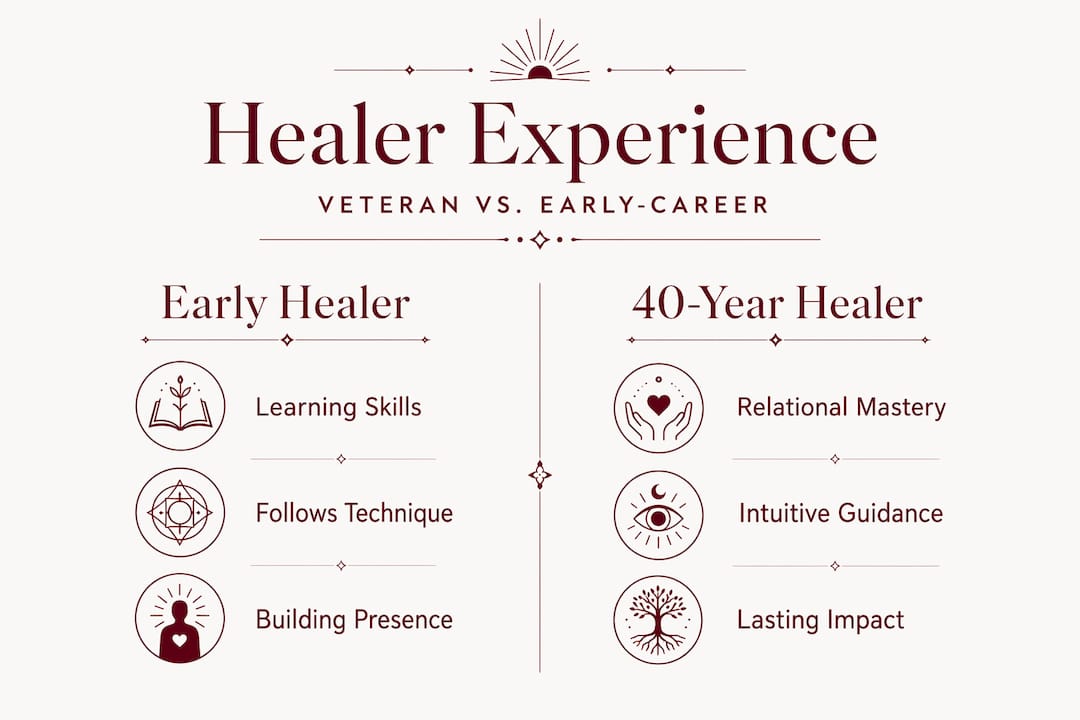
The uncomfortable truth is that years of practice alone show weak correlations with client benefit. Early-career healers can sometimes match experienced ones. But this finding actually sharpens the question. If years don’t automatically create effectiveness, what does long experience produce when it’s working correctly? The answer is what the next sections unpack.
What decades of practice actually build
The relational skills that drive healing outcomes are not things you learn from reading. They are things you earn through thousands of hours of sitting with people in pain, in confusion, in hope, and in resistance.
Consider what genuine emotional attunement looks like in practice. It is the ability to notice that a client’s words say “I’m fine” while their energy says “I’m terrified.” A newer healer might take the words at face value. A practitioner with decades of experience reads the whole picture and adjusts accordingly.
Here is what the research shows actually accumulates with long experience in holistic healing:
- Flexible relational style across healing phases. Therapist attentiveness matters more in advanced healing phases than in early ones. Experienced healers know when to hold structure and when to shift toward deeper relational presence. They do not apply the same approach from session one to session forty.
- Alliance repair skills. Every meaningful healing relationship hits ruptures. Moments when trust frays, when the client feels misunderstood, when the healer’s approach misses the mark. The ability to recognize a rupture, name it honestly, and repair it is something that builds through failure and reflection over years.
- Reading individual readiness. Spiritual healing especially requires that a practitioner gauge where a client is emotionally and spiritually before beginning deep work. Pushing too hard too soon damages the process. Experienced healers adapt closeness to a person’s individual attachment style and readiness, particularly with those who have difficulty trusting.
- Expectation management. Long-term practitioners understand that a client’s belief in the process shapes outcomes directly. Preparing someone well, setting honest expectations, and creating a sense of ritual authority all improve the conditions for transformation.
Pro Tip: When evaluating a healer’s experience, ask not just how many years they have practiced, but how they handle moments when the work gets difficult or a client feels stuck. The answer reveals far more than a number.
Real experience shows up in the small moments. It is the healer who pauses when something feels off. The one who says “let’s slow down” instead of pushing through. The one who can hold a client’s fear without absorbing it. These are not instincts you are born with. They are trained into you by decades of showing up.

Experience without reflection goes nowhere
Here is the part most people skip when they talk about the benefits of 40 years of practice. Long experience without a commitment to ongoing growth can actually create a different kind of problem. Some healers plateau. They find an approach that worked once, repeat it, and stop questioning.
Research is clear that growth mindset predicts outcomes more reliably than years logged. What separates truly effective long-term healing professionals from those who have simply been around a long time comes down to a few specific practices:
- Seeking feedback actively. Effective experienced healers ask clients how the work is landing. They notice when something is not working and change course rather than defend their method.
- Cultural humility and adaptation. Healing is deeply personal and culturally situated. A practitioner who stops learning about the people they serve loses effectiveness regardless of how many years they hold.
- Ethical sensitivity that deepens over time. Relational challenges over decades develop a healer’s reflexivity, ethical sensitivity, humility, and adaptive engagement. This is moral and relational wisdom that cannot be rushed.
- Willingness to sit with uncertainty. Experienced healers are less threatened by not knowing. They hold ambiguity without rushing the client to a resolution that serves the healer’s comfort more than the client’s growth.
Pro Tip: Before working with any long-practicing healer, look for evidence they are still learning. Do they speak about their work with curiosity or with certainty alone? The most effective practitioners carry both.
The experience in holistic healing that produces real transformation is not passive accumulation. It is active, self-questioning, and willing to be changed by the people it serves. A healer who has spent 40 years doing that kind of work is genuinely rare.
How experience shapes spiritual healing and ritual
Spiritual healing operates on a different register from conventional therapeutic work. The elements at play include the healer’s ritual authority, the quality of their presence, the energetic field they create, and the client’s willingness to enter into a state of readiness and trust. These factors are not incidental. They are the mechanism.
Consider how experience shapes these elements specifically:
| Element | Early-career healer | Veteran healer (40+ years) |
|---|---|---|
| Ritual presence | Still developing authority and confidence | Projects natural authority that calms and centers clients |
| Trust-building pace | May rush or over-explain | Knows when to speak and when to hold silence |
| Energetic attunement | Relies heavily on learned technique | Reads the client’s energy intuitively and adjusts in real time |
| Handling resistance | May take it personally or push through | Recognizes resistance as information and works with it |
| Creating expectancy | Limited ability to shape client belief | Shapes readiness and expectation skillfully, enhancing outcomes |
The healer’s presence, authority, and ritual context shape patient expectations and readiness to heal. This is not mere psychology. It is a real physiological and spiritual mechanism. When a person feels genuinely held by someone whose authority they trust, their body and spirit respond differently than when they feel uncertain or guarded.
This is why the wisdom from decades of healing is not abstract. It shows up in the room. It shows up in how a healer enters, how they begin, how they pace the work, and how they close a ritual in a way that leaves the client integrated rather than raw.
“Experienced spiritual healers better create trust-rich environments that support beneficial expectancy effects, enabling transformation that would not be possible in a less anchored relational space.”
Early trust-building in healing may not produce immediate visible results, but it builds the foundation for profound later change. A veteran healer understands this and does not panic when transformation takes time. That patience itself is a form of mastery.
Spiritual healing practices rooted in traditions like those of West African cosmology carry additional layers of depth. The rituals, the lineage knowledge, the understanding of how spiritual forces move through a person’s life, all of this compounds with experience. An energy clearing practice performed by someone with 40 years of hands-on ritual experience is simply not the same as one performed by someone in their second year.
My perspective after four decades in this work
I have sat with thousands of people across four decades. What I know now that I did not know early on is how much my own presence does the work. Not my technique. Not the specific ritual components. My presence.
In my early years, I thought effectiveness meant doing everything correctly. Getting the elements right, reciting the words precisely, following the tradition as I had been taught. And those things matter. But I have seen how the same ritual can produce a shallow result or a life-changing one depending on whether the person in front of me feels genuinely held.
What I have learned about how experience shapes healing is that ruptures are not failures. When a client loses trust, when something I do lands wrong, when the energy in a session breaks down, that moment is an invitation. Working through it honestly, rather than covering it over, often produces the deepest healing. I would not have known that in year five. I only know it because I have lived it repeatedly.
I have also become more humble over time, not less confident. I carry more questions now than I did at the beginning. That is not weakness. That is what 40 years of real practice produces when you stay honest with yourself. Trust in experienced healers should not come from blind authority. It should come from the quality of their presence and their willingness to keep growing.
— Psychic
Experience you can feel: Motherodessa’s ritual offerings
When you spend time with the research on why experience shapes healing, one thing becomes clear. The results people seek from spiritual transformation require a practitioner whose skills go far deeper than learned techniques. They require someone whose presence itself has been refined through decades of real work.
Motherodessa brings over 40 years of West African healing tradition to every ritual she performs. From the Full Spiritual Restoration Ceremony to the Spiritual Cleansing Bath Ritual, each offering is personalized to your specific situation. No two rituals are the same because no two people are the same. If you are ready to work with someone whose depth of experience you can feel from the first moment, explore the Seven African Powers Ceremony and see what decades of genuine mastery look like in practice.
FAQ
What makes 40 years of healing experience different from 10?
Forty years of experience builds advanced relational skills, including alliance repair, emotional attunement, and the ability to read individual readiness, that research shows take decades of intentional practice to develop. A seasoned practitioner recognizes what a newer one is still learning to see.
Does more experience always mean better healing outcomes?
Not automatically. Research shows years alone predict weak correlations with client benefit. Experience only translates to superior outcomes when it is paired with ongoing reflection, feedback, and genuine relational presence.
Why does presence matter so much in spiritual healing?
A healer’s presence and ritual authority directly shape a client’s expectations and readiness to heal, which are real mechanisms in transformative outcomes. Experienced spiritual healers create trust-rich environments that support deeper, lasting transformation.
How do experienced healers handle difficult moments in a session?
Veteran healers recognize relational ruptures as information rather than failure. Relational presence and rupture repair skills develop over time and are among the most powerful predictors of healing effectiveness.
What should I look for when choosing a long-practicing spiritual healer?
Look for evidence of ongoing learning, cultural humility, and the ability to personalize their approach to your situation. Years of practice matter most when they have been spent in active reflection, not simply repetition.