
Reopen communication after a breakup only when three conditions are met: genuine emotional readiness, a consent-first approach, and clearly defined new boundaries. That is the whole decision rule. If any one of those three is missing, you’re not ready yet, and reaching out will likely make things harder, not easier. The good news is that all three are assessable right now. Check your readiness honestly, draft a short neutral message, and decide whether ritual support from a practitioner like Motherodessa belongs in your process.
- Consent-first: Your ex does not owe you a reply. Consent-first outreach reduces desperation, signals maturity, and raises the chance of a calm response.
- Emotional readiness: A minimum of 30 days no-contact for shorter relationships, 60–90 days when the breakup was painful or escalated.
- Boundary script: One short, low-friction message. No confessions, no guilt, no demands.
Table of Contents
- Are you ready to reach out after the breakup?
- Consent-first outreach: what it means and how to do it
- Exact first-message templates, timing, and follow-up rules
- West African reconnection rituals: what they are and how they work ethically
- What to expect from ritual work: timeline, outcomes, and privacy
- How to choose a trustworthy ritual practitioner
- Motherodessa: approach, experience, and what to expect
- How to avoid slipping back into old dynamics
- Address the underlying issues before you reach out
- Rebuilding trust gradually after reopening communication
- Setting realistic goals for renewed communication
- The role of self-improvement during the no-contact period
- Key Takeaways
- The ethics behind reconnection work
- Motherodessa’s ritual services for reconnection
- Useful sources and further reading
Are you ready to reach out after the breakup?
The most honest question isn’t “what should I say?” It’s “why do I want to say it?” Relationship expert Logan Ury recommends curiosity over fear-based rules: shift from “I need to fix this” to “I want to understand what changed.” That single reframe cuts defensive reactions on both sides.
Run through these prompts before you do anything else:
- Can you genuinely imagine a full life without this person, even if you’d prefer not to?
- When you picture them, is your emotional state calm or still raw?
- Is your motive clarity and mutual curiosity, or relief from loneliness? Reaching out from fear or to prove something signals you need more time.
- Have the core issues that caused the breakup actually changed, or are you hoping contact will change them?
On timing: no-contact duration isn’t a countdown to hit. Thirty days is a floor for shorter relationships. Sixty to ninety days is more realistic after longer or more painful splits. Complex co-parenting situations often need 8–12 weeks before communication can be productive. The marker isn’t the calendar; it’s whether you can think about the person without your nervous system spiking. You can also check signs your ex wants to reconnect to calibrate whether the timing is mutual.
Consent-first outreach: what it means and how to do it

“Consent-first” is not a soft suggestion. It’s a framing shift that changes the entire tone of your message. When you write knowing your ex owes you nothing, the desperation drains out of the language. What’s left is a message that’s easy to respond to, or easy to ignore without guilt.
Dos:
- Keep it short, warm, and genuinely low-stakes.
- Use asynchronous channels (text, email, DM) so they can respond on their own terms. Calls and in-person contact are too intense for a first reach-out.
- Leave the door open without pushing through it.
Don’ts:
- No long confessions or emotional processing dumps.
- No guilt language (“you owe me this conversation”).
- No public contact (social media comments, tagging, mutual-friend relays).
Sample consent-first lines you can adapt:
- “Hey, I’ve been thinking of you. No pressure at all, but I’d love to catch up if you’re open to it.”
- “I hope you’re doing well. I’m not looking to rehash anything — just wanted to say hi and see how you’re holding up.”
Pro Tip: Before you hit send, take three slow breaths and wait ten minutes. If the message still feels right after that pause, it’s probably not fear-driven.
Exact first-message templates, timing, and follow-up rules
The first message functions as a temperature check, nothing more. Keep it 20–40 words, ask nothing that demands an immediate decision, and don’t force a particular emotional response.
- Temperature-check text: “Hey [name], hope things are good with you. Been a while — just wanted to reach out and say hi. No pressure to respond.”
- Short email (when texting isn’t an option): “Hi [name], I’ve been thinking about you and wanted to check in. I’m not looking to complicate anything — just genuinely hoping you’re well.”
- One-sentence neutral DM: “Hey, saw something that reminded me of you. Hope you’re doing well.”
Timing rules:
- Send Tuesday through Thursday, between 5:00 PM and 7:30 PM. That window avoids the emotional noise of Sunday nights and late weekend evenings, when people are either winding down anxiously or socially overstimulated.
- If no reply arrives within 48–72 hours, pause completely. One brief follow-up is acceptable after 10–14 days. If that also goes unanswered, stop.
- Sample no-response language: “I understand if you need space. I won’t reach out again — take care.” That preserves your dignity and leaves the door open on their terms.
West African reconnection rituals: what they are and how they work ethically
West African spiritual traditions approach reconnection not as a forced reversal but as an energetic clearing. The goal is to shift the emotional field around a situation, support personal clarity, and invite mutual openness. Three core service types from Motherodessa’s love and relationships offerings address this directly:
- Return a Lover Ritual: A personalized ceremony using ancestral petitions, offerings, and prayer to invite the energetic conditions for reunion. Designed for situations where genuine love remains but circumstances or miscommunication created distance.
- Seven African Powers Ceremony: Calls on seven Orishas (divine forces in West African Yoruba tradition) to clear obstacles, restore harmony, and open pathways for renewed connection. Particularly suited when multiple life areas feel blocked simultaneously.
- Love & Relationships ritual offerings: A broader collection of targeted rituals for specific relational needs, from healing emotional wounds to strengthening existing bonds.
Ethical framing matters here. Ritual work respects free will. It supports your clarity and energetic state; it does not override your ex’s autonomy. Spiritual intervention works alongside your personal growth, not instead of it.
Before purchasing any ritual service, confirm:
- You are not under a restraining order or explicit no-contact request. Ritual work must never be used to circumvent legal or stated boundaries.
- Your goal is genuine reconnection, not control.
- You can accept any outcome, including silence.
What to expect from ritual work: timeline, outcomes, and privacy
| Dimension | Realistic expectation |
|---|---|
| Energetic shift | Days to a few weeks after ritual delivery |
| Emotional clarity | Often noticeable within the first week |
| Social reconnection | Weeks to months; varies by situation |
| Guaranteed reunion | Not offered; no ethical practitioner guarantees this |
| Privacy | All work is confidential; no public disclosure |
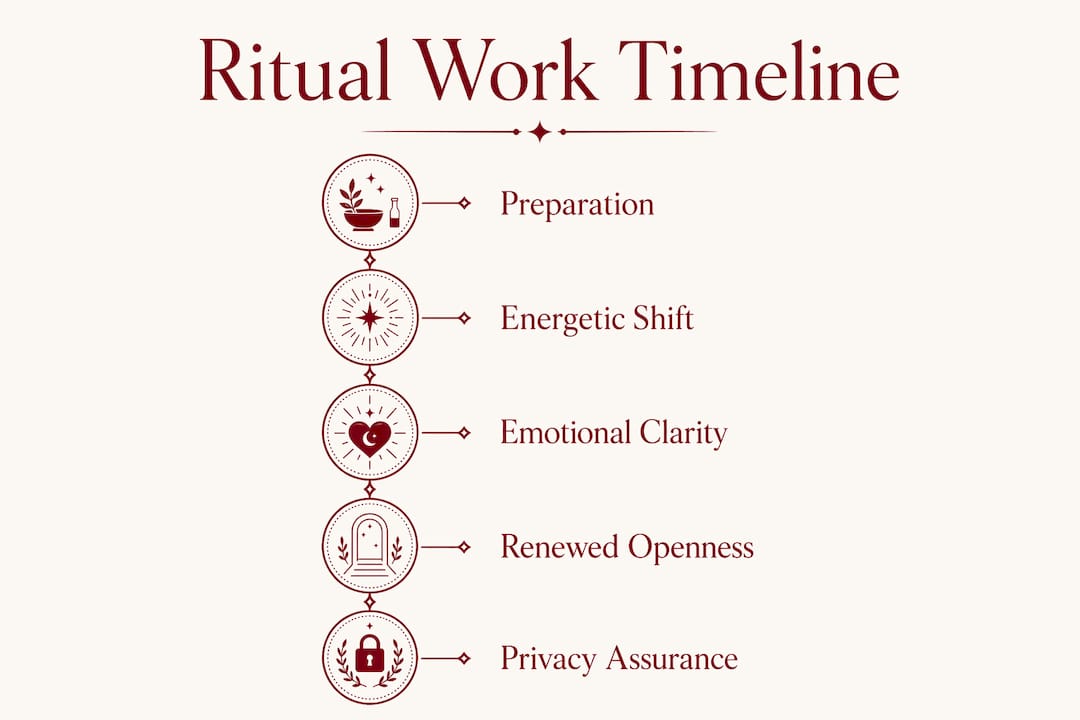
Ritual work commonly produces increased personal clarity, a calmer emotional tone, and a sense of renewed openness. What it will not reliably produce is forced consent or a guaranteed reunion. If you want to understand the process in more depth, Motherodessa’s guide on what a reconnection ritual involves walks through each stage.
How to choose a trustworthy ritual practitioner
Ask any practitioner these questions before committing:
- How do you approach consent and free will in your ritual work?
- What is your privacy policy for client information?
- Can you explain your process from intake to delivery?
- What is your experience specifically with West African traditions?
- What is your refund or reassessment policy if outcomes are unclear?
Red flags to walk away from:
- Guaranteed outcomes (“I will make your ex return in 7 days”).
- Pressure to bypass your ex’s stated wishes.
- Vague process descriptions with no intake or customization.
- Only public social proof, no private client history.
- Any request to do something that crosses a legal boundary.
When safety, abuse history, or co-parenting logistics are involved, a licensed therapist should be part of the picture alongside any spiritual work.
Motherodessa: approach, experience, and what to expect
Motherodessa’s process follows four stages: intake (understanding your situation in detail), customized ritual design (selecting the appropriate ceremony, offerings, and ancestral petitions), ceremony and delivery (a digital written report delivered to you), and aftercare and follow-up. The privacy and customization policy means your information is never shared, and the ritual is built around your circumstances, not a template. Client case studies document outcomes across a range of reconnection situations.
How to avoid slipping back into old dynamics
Reconnection is not restoration. Therapists are consistent on this: the goal is a new, healthier dynamic with clearer boundaries and intentional communication, not a return to what existed before. The old dynamic broke. Going back to it produces the same result.
Practical ways to hold that line: name the patterns you want to change before you reconnect, not after. Write them down. Agree explicitly on communication norms early (how often, through which channels, about what topics). If you notice yourself slipping into old reactive patterns, pause the conversation and return when you’re regulated.
Address the underlying issues before you reach out
Recognizing what actually broke the relationship is the work that makes reconnection possible. Was it a communication breakdown? A trust rupture? Misaligned expectations? Underlying patterns often run deeper than the specific incident that ended things.
Spend time in the no-contact period doing honest self-assessment. What was your role in the dynamic? What would you do differently? Verywell Mind’s guidance from licensed couples therapist Kate Engler, LMFT, CST, emphasizes self-reflection on reactive patterns and what each person is still holding onto. That work is not optional prep. It’s the foundation.
Rebuilding trust gradually after reopening communication
Trust doesn’t return in a conversation. It accumulates through consistent, small actions over time. After the first message lands and a dialogue opens, keep early interactions light and low-stakes. Don’t rush toward the big relationship conversation. Let familiarity rebuild first.
When deeper conversations do happen, active listening matters more than making your case. Reflect back what you hear before you respond. Ask questions like “What was the hardest part of this for you?” rather than defending your own position. Verywell Mind’s Engler frames it well: give the other person plenty of time to feel understood before you bring your own issues to the table.
Setting realistic goals for renewed communication
The first goal is not getting back together. The first goal is a calm, mutual exchange. That’s it. Keeping the scope narrow at the start prevents the pressure that shuts conversations down.
From there, goals can expand gradually: re-establishing comfort, then honest dialogue about what changed, then a shared decision about what, if anything, you’re both building. Each stage requires the previous one to be stable first. Rushing from “first text” to “are we back together?” collapses the process and usually ends it.
The role of self-improvement during the no-contact period
The no-contact period is not dead time. It’s the period where the actual work happens. Return to interests you set aside. Rebuild friendships. If therapy is accessible, use it. The version of you that reaches out should be genuinely different from the version that was in the relationship, not just calmer on the surface.
Self-improvement during this period also serves a practical function: it gives you something real to bring to a reconnection. When you reach out from a place of genuine growth rather than need, the message reads differently, and the conversation that follows tends to go differently too.
Key Takeaways
Reopening communication after a breakup works when readiness, consent, and new boundaries are all present before the first message is sent.
| Point | Details |
|---|---|
| Assess readiness first | Wait at least 30–90 days (30 for shorter relationships, 60–90 for longer or more painful splits) and confirm your motive is curiosity, not fear or loneliness. |
| Use consent-first language | Keep the first message 20–40 words, low-stakes, and free of guilt or demands. |
| Follow the timing window | Send Tuesday–Thursday, 5:00–7:30 PM; wait 48–72 hours before reassessing. |
| Address root issues | Identify and work on the patterns that caused the breakup before reaching out. |
| Motherodessa ritual support | The Return a Lover Ritual and Seven African Powers Ceremony offer ethically framed, personalized spiritual support for the reconnection process. |
The ethics behind reconnection work
Reconnection work, whether practical or spiritual, only holds meaning when it begins with respect. Consent is not a formality. It’s the foundation that makes any renewed connection worth having. Ritual work in the West African tradition has always understood this: you cannot force what must be freely given. What ceremony can do is clear the internal noise, support your own emotional regulation, and create the conditions where genuine openness becomes possible. That’s a meaningful contribution. It’s also the limit of what any honest practitioner will claim. The outcome belongs to both people involved, and any practitioner who tells you otherwise is not working in this tradition’s spirit.
Motherodessa’s ritual services for reconnection

Motherodessa brings over 40 years of West African tradition-based practice to every ritual she designs. For readers working through a reconnection, the Return a Lover Ritual and Seven African Powers Ceremony are the two most directly relevant services. Each is built around your specific situation, delivered as a private digital report, and designed with no two ceremonies alike. Your information stays completely confidential. No public disclosure, no shared case details.
If you’re ready to explore what ritual support looks like for your situation, browse the full love and relationships collection or visit the spiritual healing services page to find the right starting point.
Useful sources and further reading
- First Contact After No Contact: A Science-Based Guide — RegainLove’s detailed breakdown of message length, timing windows, and follow-up rules.
- How to Reconnect After a Relationship Break — Verywell Mind, featuring licensed therapist Kate Engler, LMFT, CST, on self-reflection and trust rebuilding.
- Should I Text My Ex? — Lucen’s guide to motive assessment before reaching out.
- How to Start Talking to Someone Again After a Breakup — Practical consent-first framing and tone guidance.
- Getting Back With an Ex: Logan Ury’s Perspective — HuffPost piece on shifting from fear-based to curiosity-based reconnection.
- How to Reconnect With Your Ex: A Consent-First Guide — Relatio’s step-by-step guidance on no-contact duration and readiness markers.
- Back for Good: How to Reconnect After a Breakup — ModernMom on building a new dynamic rather than restoring the old one.