
Spiritual intervention is defined as the deliberate use of prayer, ritual, meditation, or sacred ceremony to shift the emotional and energetic conditions within a relationship. Research confirms that why spiritual intervention helps relationships goes far deeper than surface-level communication fixes. A study of 254 married Christians found that faith increases couple resilience through forgiveness as a core mediator. That finding matters because it shows spiritual practice does not just improve mood. It rewires how partners respond to each other after hurt. Practices rooted in West African traditions, attachment theory, and neuroscience all point to the same conclusion: soul-level healing produces results that behavioral fixes alone cannot.
How does spiritual intervention foster forgiveness and emotional resilience in couples?
Forgiveness is the single most powerful mechanism through which spiritual intervention improves relationships. Psychological research shows that partner-focused prayer enhances forgiveness and cooperation more effectively than positive thinking alone. That distinction is significant. Positive thinking keeps the mind occupied. Prayer redirects attention outward, toward the partner’s wellbeing, which reduces the self-protective defensiveness that blocks forgiveness.
Neuroscience supports this further. Brain scans reveal that meditation and prayer increase blood flow to bonding-related brain regions while lowering stress hormones. Lower cortisol means less reactivity. Less reactivity creates space for genuine listening, which is the foundation of emotional safety in any relationship.

Spiritual practices also reduce vengefulness. Praying for a partner, even after serious relational hurt, reduces self-centered reactivity and lowers conflict levels. The internal shift happens first in the individual, then ripples outward into the relationship dynamic.
Key mechanisms spiritual intervention activates in couples:
- Forgiveness acceleration: Prayer and ritual lower the emotional charge around past hurts faster than verbal processing alone.
- Reduced vengefulness: Spiritual focus on the partner’s wellbeing crowds out the impulse to retaliate.
- Emotional regulation: Shared spiritual practices train the nervous system to respond calmly rather than react impulsively.
- Increased empathy: Spiritual attunement builds the capacity to feel what a partner feels, not just understand it intellectually.
Pro Tip: Focus your spiritual practice on your own internal state, not on changing your partner. Self-regulation is the actual mechanism. When you shift internally, the relational dynamic shifts with you.
Spiritual intervention reaches the places that conversation cannot. When a person prays for their partner with genuine selflessness, they are practicing love as an action, not just a feeling. That practice, repeated consistently, rebuilds trust from the inside out.
What specific spiritual practices effectively support relationship healing?
Spiritual healing for couples works through a range of practices, each targeting a different layer of relational damage. The most widely used include partner-focused prayer, joint meditation, chakra balancing, visualization of healing, and sacred ceremony. Each practice works through a distinct mechanism, but all share one feature: they shift attention from conflict to connection.
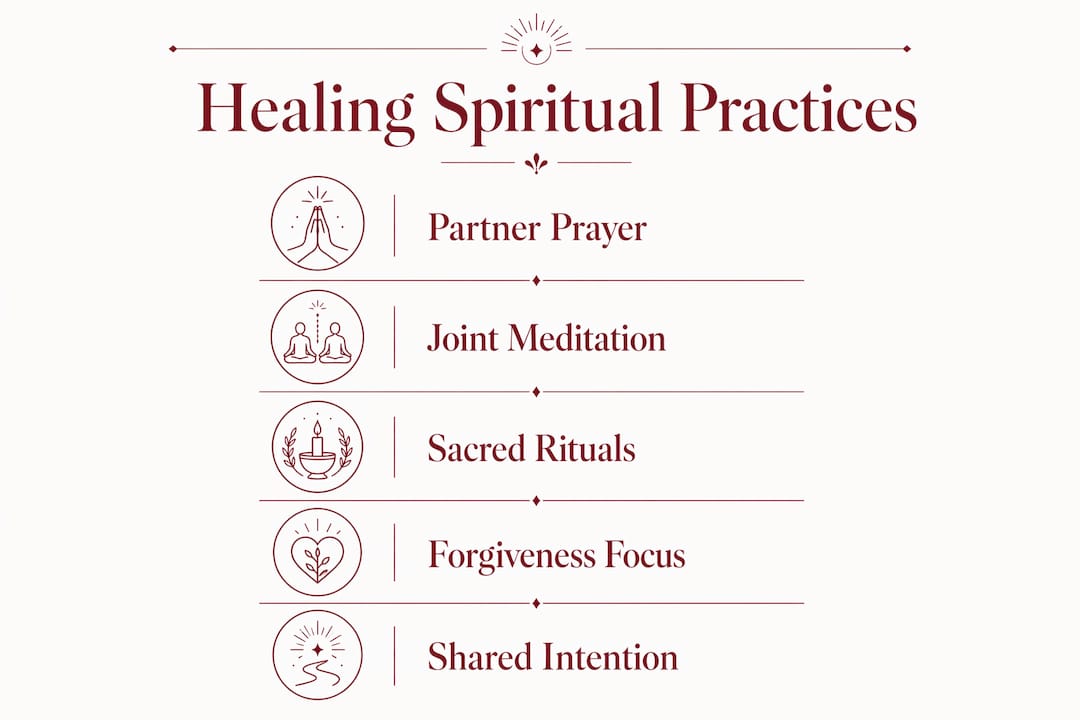
Shared spiritual activity creates what researchers call a “sacred partnership.” When two people engage in a spiritual practice together, they build a shared reference point beyond their individual grievances. That shared reference point becomes an anchor during conflict. Instead of two people fighting to win, they become two people oriented toward the same larger purpose.
Spiritual healing for couples addresses emotional residue that verbal communication often misses. Unspoken hurt, blame patterns, and emotional withdrawal all live below the level of language. Ritual, prayer, and meditation reach those layers directly.
| Practice | Mechanism | Primary Benefit |
|---|---|---|
| Partner-focused prayer | Redirects attention to partner’s wellbeing | Accelerates forgiveness and reduces resentment |
| Joint meditation | Synchronizes nervous systems | Builds emotional safety and calm presence |
| Chakra balancing | Clears energetic blockages in the body | Restores emotional openness and receptivity |
| Sacred ceremony | Creates shared meaning and commitment | Reinforces bond and marks healing milestones |
| Healing visualization | Rewires mental associations with the relationship | Replaces fear-based patterns with love-based ones |
Intention is everything in spiritual practice. Rituals performed with the goal of controlling a partner’s behavior consistently fail. Practices performed with the intent of offering love freely, without attachment to a specific outcome, consistently produce results. The difference is not subtle. It is the entire foundation of effective spiritual healing.
Pro Tip: Start with five minutes of joint meditation before any difficult conversation. Synchronized breathing alone reduces physiological arousal and makes productive dialogue far more likely.
How do spiritually integrated interventions differ from traditional couples therapy?
Traditional couples therapy typically involves weekly 50-minute sessions focused on communication patterns and behavioral change. Spiritually integrated programs operate on a different scale entirely. Spiritually integrated couples intensives run from 1 to 5 days, blending attachment theory, neuroscience, and spiritual practice into an immersive healing experience. That concentrated format addresses acute crises, including infidelity and emotional abandonment, in ways that weekly sessions rarely reach.
The core difference is depth. Traditional therapy works at the behavioral level. Spiritually integrated approaches work at the soul level, addressing the emotional safety that makes behavioral change sustainable. Integrating spiritual practices with counseling yields deeper results than behavioral methods alone because it targets the underlying emotional wound, not just the symptom.
Consider two common scenarios:
- Infidelity recovery: A couple in weekly therapy learns communication scripts. A couple in a spiritually integrated intensive experiences guided ritual, prayer, and somatic healing that processes the trauma at a neurological and spiritual level simultaneously.
- Emotional abandonment: Traditional therapy identifies the pattern. Spiritual integration addresses the fear of vulnerability underneath the pattern, using practices that build genuine emotional safety rather than behavioral compliance.
| Feature | Traditional weekly therapy | Spiritually integrated intensive |
|---|---|---|
| Session length | 50 minutes weekly | 1–5 days immersive |
| Primary focus | Behavioral and communication patterns | Soul-level emotional safety |
| Crisis suitability | Moderate | High (infidelity, abandonment) |
| Spiritual component | Absent or minimal | Central to the method |
| Long-term resilience | Moderate | Stronger with spiritual integration |
The research is clear. Blending spiritual practices with structured therapy enables couples to move beyond surface behaviors to deep emotional safety, improving long-term relationship success. That outcome is not achievable through behavioral scripts alone.
What misconceptions should couples avoid with spiritual intervention?
The most damaging misconception about spiritual intervention is that it works as a tool for controlling a partner. Practitioners are direct on this point: spiritual rituals used to coerce outcomes consistently fail. The spiritual dimension of a relationship responds to love offered freely, not to manipulation dressed in sacred language.
A second common mistake is expecting immediate partner change. Spiritual intervention works by shifting the individual first. The relational healing that follows is a natural consequence of that internal shift, not a guaranteed result on a fixed timeline. Couples who approach spiritual practice with patience and detachment consistently report better outcomes than those who treat it as a quick fix.
Pitfalls to avoid:
- Controlling intent: Using prayer or ritual to force a specific outcome from a partner undermines the practice entirely.
- Bypassing communication: Spiritual healing works with honest conversation, not instead of it. Avoiding difficult dialogue while relying solely on ritual leaves the behavioral layer unaddressed.
- Impatience: Soul-level healing takes time. Expecting visible results within days creates frustration that blocks the very openness the practice requires.
- Neglecting self-work: Spiritual intervention requires the practitioner to examine their own patterns, not just the partner’s.
Pro Tip: Approach your spiritual practice with the question “How can I become more loving?” rather than “How can I change my partner?” That single shift in framing changes everything about the results you experience.
How can couples sustain spiritual growth and healing long term?
Sustained spiritual growth in a relationship requires consistent shared practice, not occasional effort during crises. Couples who build regular spiritual routines, whether daily prayer, weekly meditation, or monthly ceremony, maintain a relational foundation that absorbs conflict without fracturing. Rekindling spiritual connection is not a one-time event. It is an ongoing practice of choosing each other at the soul level.
Building a shared spiritual vision gives a relationship direction beyond day-to-day logistics. Couples who articulate what they are building together, not just what they are managing, report stronger emotional attunement and greater resilience during difficult seasons. That shared vision becomes the “why” that sustains commitment when circumstances are hard.
Practical ways to sustain spiritual growth as a couple:
- Daily check-in ritual: Spend five minutes each morning in shared silence, prayer, or intention-setting before the day begins.
- Monthly ceremony: Mark each month with a small ritual that honors the relationship, such as lighting a candle together and naming one thing you are grateful for in each other.
- Seasonal review: Every three months, assess which spiritual practices are working and which need to evolve with your current life stage.
- Shared reading: Study spiritual or philosophical texts together and discuss how the ideas apply to your relationship.
- Professional support: When life transitions, grief, or major conflict arise, seek a spiritually integrated counselor rather than waiting for the crisis to deepen.
Romantic reconnection rituals formalize the commitment to healing and growth in a way that everyday conversation cannot. Ceremony marks change. It tells the nervous system that something real has shifted, which reinforces the emotional safety both partners need to stay open.
Key Takeaways
Spiritual intervention strengthens relationships by shifting individuals internally through forgiveness, self-regulation, and shared sacred practice, producing relational healing that behavioral methods alone cannot reach.
| Point | Details |
|---|---|
| Forgiveness is the core mechanism | Partner-focused prayer accelerates forgiveness faster than positive thinking or communication scripts alone. |
| Neuroscience confirms the effect | Spiritual practices lower stress hormones and increase bonding brain activity, creating biological conditions for emotional safety. |
| Intent determines outcome | Rituals performed with selfless love produce results; those aimed at controlling a partner consistently fail. |
| Intensives outperform weekly therapy for crises | Spiritually integrated programs lasting 1–5 days address infidelity and abandonment at a depth weekly sessions rarely reach. |
| Sustained practice builds lasting resilience | Regular shared spiritual routines, not occasional effort, create the relational foundation that absorbs conflict without fracturing. |
What I have learned from watching spiritual intervention work in real relationships
After years of witnessing couples arrive in states of profound disconnection and leave with restored bonds, I hold one conviction firmly: spiritual intervention reaches the layer of a relationship that no amount of clever conversation can touch. The soul of a relationship is not built from communication techniques. It is built from the quality of love two people are willing to offer each other, even when it is hard.
What surprises most couples is that the healing rarely starts with the relationship itself. It starts with one person becoming willing to shift. That willingness, expressed through prayer, ritual, or ceremony, creates a change in the energetic field between two people. The partner feels it before they can name it. Walls come down not because someone argued them down, but because the love became undeniable.
The research on forgiveness as a mediator in spiritual practice confirms what practitioners have observed for generations. Selflessness is not a soft idea. It is the most powerful relational force available to any couple. Pair that with practical communication work and consistent shared ritual, and you have a foundation that can hold through almost anything.
My honest advice: do not wait for the relationship to reach crisis before seeking spiritual support. The couples who thrive are the ones who treat spiritual practice as maintenance, not emergency medicine.
— Psychic
Motherodessa’s spiritual healing services for your relationship
Relationships carry weight that ordinary effort cannot always lift. Motherodessa brings over 40 years of experience in West African spiritual traditions to the specific challenges couples face, from emotional distance and broken trust to the need for deep reconciliation.

Motherodessa’s Love & Relationships collection offers personalized rituals designed for your exact situation. No two ceremonies are the same because no two relationships are the same. Whether you are seeking to restore a fractured bond or deepen an existing connection, the spiritual healing services available through Motherodessa address both the visible and invisible layers of relational pain. Every ritual is conducted with full confidentiality and shaped entirely around your circumstances.
FAQ
What is spiritual intervention in a relationship?
Spiritual intervention is the use of prayer, ritual, meditation, or sacred ceremony to shift the emotional and energetic conditions within a relationship. It works by fostering forgiveness, reducing defensiveness, and creating the internal conditions for genuine healing.
Does prayer actually improve relationship satisfaction?
Research on 254 married couples confirms that partner-focused prayer increases satisfaction by fostering forgiveness as a mediator between faith and relational resilience. The effect is stronger than positive thinking alone.
How is spiritual healing different from couples therapy?
Traditional therapy focuses on behavioral and communication patterns in weekly sessions. Spiritually integrated approaches address soul-level emotional safety through immersive programs that blend attachment theory, neuroscience, and sacred practice.
Can spiritual intervention help after infidelity?
Spiritually integrated intensives are specifically designed for acute crises like infidelity. They combine trauma-informed methods with spiritual practice to process hurt at both a neurological and soul level, producing deeper recovery than behavioral work alone.
How do I know if I need personalized spiritual help?
Signs include persistent emotional distance, recurring conflict patterns that communication has not resolved, and a sense that the relationship needs healing beyond what practical effort can provide. Recognizing when you need help is the first step toward meaningful change.