
A petition paper ritual centers on one handwritten sheet of paper that carries a single, focused intention, written in present tense as though it’s already happening. The core rule almost every tradition agrees on is to focus on one clear movement per paper, then sign and date to anchor your commitment. From there, you burn it, place it under a candle, or carry it, depending on whether you’re drawing something toward you or releasing it.
TL;DR:
- Use plain, biodegradable paper like kraft or Bible page, and handwrite your petition in a dedicated pen to enhance intention.
- Write the petition in one clear, present-tense sentence focused solely on the desired outcome, avoiding any backstory or multiple requests.
- Tear the paper instead of cutting, fold toward your body for receiving, and dress with matching oils or powders before sealing with wax or spoken intention.
- Activate the petition by burning, placing under a candle, putting in a honey jar, carrying in a mojo bag, or placing it on an altar, depending on your situation and safety considerations.
- After the ritual, burn, bury, or scatter the petition as a way to release the intention, and consider professional guidance for complex or high-stakes cases.
Table of Contents
- What Materials Do You Need to Prepare a Petition Paper?
- How Do You Word a Petition for Ritual Work?
- How Do You Fold and Charge a Petition Paper?
- What Are the Best Ways to Activate a Petition Paper?
- How Should You Dispose of a Petition Paper After the Ritual?
- Do Timing and Astrology Affect a Petition Paper Ritual?
- What Mistakes Weaken a Petition Paper Ritual?
- Where Do Petition Rituals Come From, and How Do Traditions Differ?
- What Do 40 Years of Practice Teach About Petition Papers?
- A Practitioner’s Note on Humility and Petitioning
- When Should You Consider a Practitioner-Led Petition Ritual?
- Sources
What Materials Do You Need to Prepare a Petition Paper?
Paper choice matters more than most beginners assume. Brown kraft paper or butcher paper is the traditional standard in Hoodoo practice, prized because it’s plain, biodegradable, and free of bleach or dye that might interfere with the working. A page torn from an old Bible carries its own layered symbolism in Hoodoo petition traditions, where the paper doubles as scripture and spiritual contract. Plain white paper works fine too, especially for beginners who don’t have easy access to kraft stock.
A few practical notes before you write anything:
- Use a dedicated pen reserved only for ritual writing, never a pen you use for bills or grocery lists.
- Handwrite the petition rather than typing it. The physical act of forming the words by hand is part of the working itself.
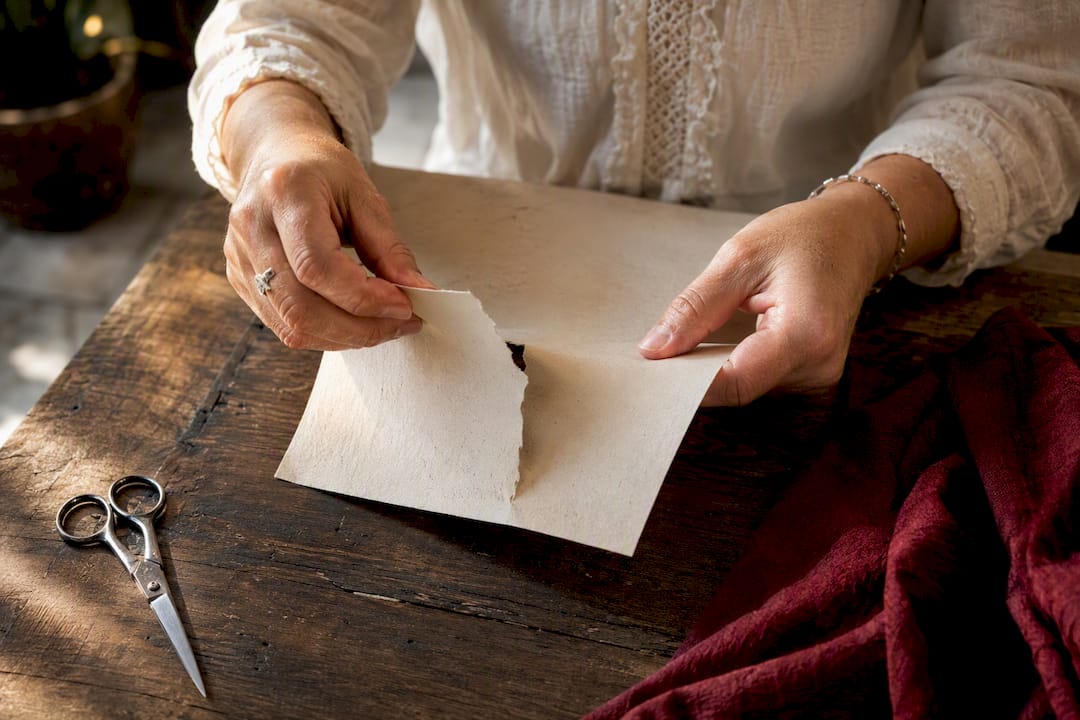
- Tear the paper by hand instead of cutting it with scissors, since many practitioners believe metal blades “cut” the intention before it has a chance to take shape.
- Clear your workspace of clutter and, if you keep a cleansing spray or florida water on hand, pass it lightly over the table before you sit down.
If you’re sourcing kraft paper in bulk, look for stock that carries FSC certification so the material itself isn’t working against your intention to bring good things into the world.
How Do You Word a Petition for Ritual Work?
Present-tense, directional language is the backbone of effective petition writing. Instead of “I want a new job,” write “I have secured a job that pays me well and treats me with respect.” The difference isn’t cosmetic. Present-tense phrasing keeps your attention locked on the outcome rather than the lack, which is exactly what a petition is designed to do: narrow focus and stabilize intention into something you can act on.
The single biggest trap beginners fall into is writing a petition that reads like a diary entry, listing frustrations about the problem instead of stating the intended resolution. Keep the paper focused on the outcome, not the backstory.
Here’s a simple structure to follow:
- Write the intention in one or two present-tense sentences.
- Add a target line if the working involves another person or situation (“for,” “to,” or “regarding”).
- Sign your full name beneath the text.
- Date it in the corner, using the day’s date, not a symbolic one.
Sample phrasing for common workings:
- Love: “[Name] and I are reunited in a relationship built on honesty and mutual respect.”
- Money: “I receive steady income that covers my needs and grows my savings.”
- Protection: “I am shielded from harm, and negative energy cannot reach me or my home.”
Pro Tip: Write the petition three times on the same sheet if the tradition you’re following calls for repetition. Three is a common number in folk magic, but one clean, well-worded sentence beats three rushed, vague ones.
How Do You Fold and Charge a Petition Paper?
Tearing and folding are where intention becomes physical gesture. Traditional practice favors tearing over cutting, and the direction you tear or fold carries meaning: toward your body draws something in, away from your body sends something out or off.
Once the paper is torn to size, folding follows the same logic:
- Fold toward yourself, usually in three folds, for love, money, or healing you want to receive.
- Fold away from yourself for banishing, protection, or anything you want gone.
- Dress the folded paper with a few drops of oil, a pinch of powder, or a light pass through incense smoke, matching the correspondence to the goal (rose oil for love, cinnamon for money, and so on).
- Seal the fold with a drop of wax, a strip of tape, or simply by speaking your intention aloud over it three times.
None of these gestures are decorative. They’re how you tell your own subconscious, and whatever spiritual forces you’re working with, exactly what direction the energy is meant to travel.
What Are the Best Ways to Activate a Petition Paper?
Activation is the step that turns a written statement into an active working, and the method you choose should match both your intention and your living situation.
- Burning: Light the petition from a candle flame over a fireproof dish, never over carpet or near curtains, and let it burn completely to ash.
- Candle placement: Dress a candle in a fitting color and oil, set it on top of the folded petition, and let it burn down completely while you recite the petition once daily.
- Honey jar: Slip the petition into a jar of honey along with sweetening ingredients like sugar or cinnamon for workings meant to soften someone’s feelings toward you.
- Mojo bag: Fold the petition small and carry it in a flannel bag along with a few supporting herbs or curios, kept on your person for as long as the situation is active.
- Altar placement: Leave the petition on your altar under a fixed object, checking in and re-reading it weekly until the outcome resolves.
Renters or anyone without safe access to open flame can lean on the candle, honey jar, or mojo bag options instead of burning. Documented practitioner guidance treats all of these as legitimate activation pathways, not lesser substitutes for fire.
How Should You Dispose of a Petition Paper After the Ritual?
Closure matters as much as the opening. Once a petition resolves, whether it worked out or you’ve decided to let it go, common practitioner guidance recommends burning or burying it, or tearing it into small pieces and scattering them outdoors.
- Burn a fulfilled petition as a gesture of gratitude and release.
- Bury an unresolved one at a crossroads or beneath a tree if you’re ending the working without a clear outcome.
- Keep a short ritual journal noting the date, the intention, and what happened, so patterns across your workings become visible over time.
If your petition names another person, get honest with yourself about consent. Working on someone else’s free will, especially around love or coercion, crosses an ethical line that most serious practitioners won’t touch.
Pro Tip: If you promised something in the petition, “I will give thanks with an offering,” write that promise down separately and follow through. Broken promises to spirit are one of the fastest ways to stall your own practice.
Do Timing and Astrology Affect a Petition Paper Ritual?
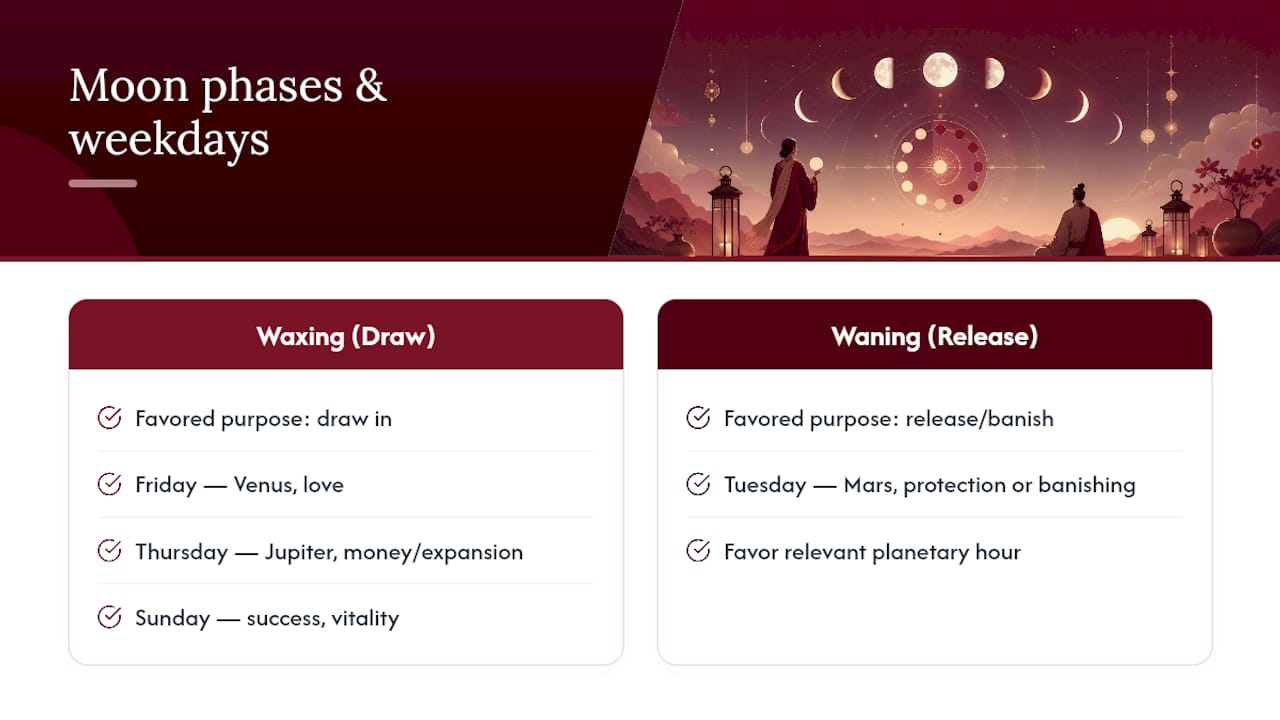
Moon phases and planetary days are common overlays for petition work, traditionally enhancing intention. Waxing moon phases are often favored for petitions meant to draw in something, while waning moon phases suit banishing or releasing work.
Day-of-the-week correspondences layer on top of that. Friday is tied to Venus and love workings, Thursday to Jupiter and money or expansion, Tuesday to Mars and protection or aggressive banishing work, and Sunday to success and vitality in many folk traditions. Some practitioners also work around specific hours, favoring the hour ruled by the relevant planet rather than just the day.
None of this overrides the core mechanics of a well-written petition. A rushed, vague petition timed perfectly under a full moon still underperforms a specific, present-tense petition written on an ordinary Wednesday. Timing sharpens intention that’s already clear. It doesn’t replace clarity you skipped.
What Mistakes Weaken a Petition Paper Ritual?
The most common mistake is stacking multiple requests onto one sheet. A single petition asking for a new job, a healed relationship, and extra money at the same time splits your focus three ways and weakens all three outcomes. Practitioners who emphasize containment treat one movement per petition as close to a hard rule, not a suggestion.
Other recurring errors include:
- Writing in past or future tense instead of present tense, which keeps the outcome feeling distant rather than already unfolding.
- Describing the problem in detail instead of the resolution, which reinforces the very thing you’re trying to move past.
- Skipping the signature and date, which leaves the petition without the personal anchor that makes it a commitment rather than a wish.
- Choosing an activation method that doesn’t match your living situation, like planning an open burn in an apartment with a strict smoke detector and no ventilation.
- Forgetting fire safety basics entirely: always burn over a heatproof dish, keep water nearby, and never leave a burning petition unattended.
- Using herbs or oils in activation without checking for skin sensitivity or fire hazard, since some resins and powders flare or smoke heavily when burned.
Where Do Petition Rituals Come From, and How Do Traditions Differ?
Petition papers trace largely to Black American Hoodoo, a practice that blends West African spiritual traditions with Christian prayer and Indigenous influence, treating the written petition as something close to a spiritual contract. Historical scholarship on petitioning more broadly frames the act of drafting and signing a written request as a formal exercise of agency, whether the petition is addressed to a court, a king, or a spirit.
Modern witchcraft and folk magic have adapted the core structure while varying the details. Some traditions specify ink color by intention, others fold in fours instead of thirds, and some address ancestors or specific spirits by name rather than writing to the universe in general. If you’re borrowing a technique from a tradition outside your own, a little research into its origin and a clear acknowledgment of where it comes from goes a long way toward practicing respectfully rather than just helping yourself to the aesthetics.
What Do 40 Years of Practice Teach About Petition Papers?
Four decades of West African rooted spiritual work teaches one lesson above all others: containment wins over ambition. A petition asking for one clear thing, worded plainly and signed with intention, consistently outperforms an elaborate multi-page request trying to fix an entire life at once.
Hand tearing versus cutting isn’t superstition dressed up as ritual. It’s a discipline that forces you to slow down and stay present with the paper instead of rushing through the mechanics. Readers working through complex situations, custody disputes, generational patterns, matters involving another person’s free will, are usually better served pairing their own petition work with a practitioner-led ritual built around their specific circumstances rather than a general template.
A Practitioner’s Note on Humility and Petitioning
Petitioning works best as a relationship, not a transaction. One petition I’ve seen echoed across years of practice: a person writing to reconcile with an estranged parent, worded plainly, followed by a small kept promise once the reunion happened. The humility in that follow-through mattered as much as the words on the paper.
— Psychic
When Should You Consider a Practitioner-Led Petition Ritual?
Writing your own petition works well for everyday intentions: a little extra money, a calmer week, a small protective boundary. But some situations carry more weight than a solo candle and a torn sheet of kraft paper can hold, especially when generational patterns, legal complications, or another person’s free will are involved.

A bespoke ritual gives you something a DIY petition can’t: a working built entirely around your specific situation, activated by an experienced practitioner, and handled with the privacy you’d expect from any serious spiritual consultation. That personalization, not a template or a generic script, is the real difference between doing this alone and having someone shape the working around your circumstances. If your petition touches on reuniting with someone you love, Mother Odessa’s Return a Lover Ritual is built specifically for that kind of reconciliation work. For anything broader, from protection to abundance to clarity on a decision you can’t shake, start by browsing the full spiritual healing collection and choosing the working that matches what you’re actually facing.
Sources
- How to Write a Petition for Ritual Work
- What is Petition Paper in Hoodoo?
- Magical Petitions - Witchipedia
- Scholarly essay on the practice of petitioning