
Cycle breaking is defined as the deliberate interruption of harmful emotional, behavioral, and relational patterns passed down through generations. You can stop repeating family cycles. Research confirms that generational trauma is probabilistic, not destiny, meaning your past does not lock you into a fixed future. The clinical term for this process is “earned secure attachment,” and it is achievable regardless of what your childhood looked like. What it requires is awareness, sustained practice, and the right tools.
Why do family cycles keep repeating?
Family cycles repeat because early relational experiences wire the nervous system before you have words for what is happening. When a caregiver is frightening, absent, or inconsistent, the brain encodes that relational template as the default. Under stress, that template activates automatically, which is why you can find yourself reacting to your partner or child in ways that mirror your own parents, even when you swore you never would.
Attachment theory explains this clearly. The patterns formed in infancy, whether secure, anxious, avoidant, or disorganized, shape how you seek closeness, handle conflict, and regulate emotion in every relationship that follows. These patterns are not personality traits. They are learned survival strategies.

The biological layer adds another dimension. Secure attachment and psychotherapy produce epigenetic changes that promote resilience across generations. That means healing is not just psychological. It is biological. The body carries the record of what happened, and the body can also carry the record of recovery.
Shame compounds the problem. When you react in a way you recognize from your own upbringing, the shame that follows can feel paralyzing. Recognizing these reactions as nervous system responses, not character flaws, is the shift that makes repair possible. You are not broken. You are running old programming.
Understanding why unhealthy patterns repeat in families also helps you stop taking the repetition personally. The cycle predates you. That context does not remove responsibility. It removes self-blame, which is what actually frees you to act.
What tools do you need to break family patterns?
Breaking family patterns requires more than willpower. The following tools form the foundation of effective cycle-breaking work.
-
Trauma-informed therapy. Approaches like EMDR (Eye Movement Desensitization and Reprocessing), somatic therapy, and AEDP (Accelerated Experiential Dynamic Psychotherapy) are specifically designed to process stored trauma at the body level, not just the cognitive level. Many therapists offer 30-minute consultations to assess fit before committing to ongoing work.
-
Autobiographical coherence. This means developing the ability to tell your life story in an integrated, honest way, including the painful parts, without either dismissing them or being overwhelmed by them. Coherent narrative development is one of the strongest predictors of secure attachment for both you and your children.
-
Emotional literacy. Cycle breakers must learn to feel emotions that were previously unsafe to experience, including anger, grief, and ambivalence. Tools like the Change Triangle (developed by therapist Hilary Jacobs Hendel) offer a structured way to identify and move through core emotions rather than suppressing them.
-
Boundaries within relationships. Boundaries within relationships, not estrangement, are the primary method for successful cycle breaking in most families. Structured boundary setting protects you while keeping the door open for healthier connection.
Pro Tip: When searching for a therapist, ask specifically whether they have training in intergenerational trauma and attachment. A general therapist may be helpful, but one with this specialization will move the work forward faster.
The table below maps each tool to its primary function in the cycle-breaking process.
| Tool | Primary function |
|---|---|
| EMDR or somatic therapy | Processes stored trauma held in the body |
| Autobiographical coherence | Builds integrated self-narrative and secure attachment |
| Emotional literacy (Change Triangle) | Develops capacity to feel and regulate core emotions |
| Boundary setting | Protects you within relationships without requiring estrangement |
How do you actually break family cycles, step by step?
Cycle breaking is not a single event. It is a sustained practice. The steps below reflect how the process actually unfolds over time.
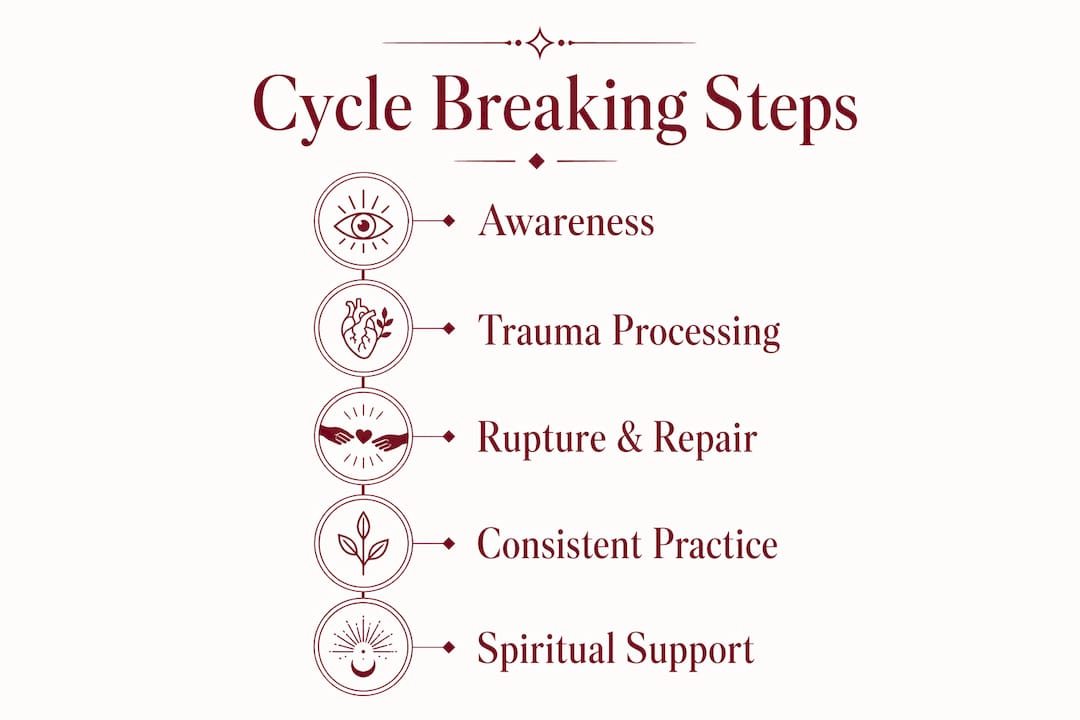
Step 1: Build awareness without self-blame. Name the patterns you inherited. Write them down. Acknowledge where they came from without making yourself the villain of the story. The goal is clarity, not punishment.
Step 2: Begin trauma processing. Work with a trauma-informed therapist to process the experiences that encoded those patterns. This is where healing the family tree becomes concrete rather than abstract. Expect this phase to take time.
Step 3: Practice rupture and repair. You will make mistakes. You will slip into old patterns. The research is clear: rupture and repair, not perfection, is the mechanism through which children learn that relationships survive misattunement. Every repair you make is a lesson in relational resilience.
Step 4: Model new behavior consistently. Boundaries, honest communication, and emotional regulation are not just things you practice in therapy. They are things you practice in the kitchen, in the car, and in the middle of a disagreement. Consistency over time is what rewires the nervous system.
Step 5: Track your progress. Journaling or a simple weekly check-in with yourself creates a record of growth. Cycle breaking can feel invisible from the inside. A written record shows you how far you have actually come.
“Individuals with difficult childhoods who process their history integratively parent as securely as those with good childhoods. Processing history, not history itself, predicts secure parenting.” Simply Psychology, 2026
That finding reframes everything. Your past is not a sentence. It is material to work with.
- Celebrate small repairs, not just big breakthroughs.
- Accept that progress is not linear.
- Reach out to a therapist, support group, or trusted friend when the work feels too heavy to carry alone.
- Use family pattern interruption rituals as a complement to psychological work, not a replacement for it.
What challenges should you expect when ending generational trauma?
Ending generational trauma is emotionally demanding work. Knowing the obstacles in advance makes them less likely to derail you.
The most common challenge is fatigue. Cycle breakers face triple labor: improvising without an internal blueprint, overriding live inherited responses, and managing family system pushback. That combination is genuinely exhausting. Building a support network is not optional. It is part of the work.
Family systems resist change. When you start setting boundaries or responding differently, your family may label you as difficult, dramatic, or disloyal. This is a predictable feature of family systems, not evidence that you are doing something wrong. The system is protecting its own stability. Your job is to protect your growth.
- Shame spirals: When you catch yourself repeating a pattern, shame can flood in fast. Separate the behavior from your identity. You did a harmful thing. You are not a harmful person. That distinction keeps you in the repair mindset rather than the collapse mindset.
- Nervous system reactivity: Stress will trigger old responses. This is biology, not failure. Grounding techniques, breathwork, and somatic practices help regulate the nervous system in the moment.
- Isolation: Cycle breaking can feel lonely, especially when your family does not understand or support the changes you are making. Seek community with others doing similar work.
Pro Tip: When family pushback feels overwhelming, return to your “why.” Write one sentence about what you want your children or future relationships to look like. Read it when the resistance feels too loud.
Family secrets and shame often fuel the hardest cycles to break. Naming what has been hidden, even just to yourself or a therapist, removes a significant amount of its power.
Key Takeaways
Breaking family cycles requires processing your history integratively, practicing rupture and repair consistently, and building boundaries within relationships rather than relying on estrangement.
| Point | Details |
|---|---|
| Generational trauma is not destiny | Earned secure attachment is achievable regardless of childhood adversity. |
| Nervous system patterns drive repetition | Early relational templates activate under stress, making awareness the first step. |
| Coherent narrative predicts secure parenting | Processing your history, not the history itself, determines how you parent. |
| Rupture and repair beats perfection | Consistent repair after mistakes teaches relational resilience to you and your children. |
| Boundaries within relationship work best | Structured boundary setting protects you while maintaining healthier family connection. |
What I have learned from walking this road
Cycle breaking is the hardest work I have ever witnessed people do. There is no map for it. You are building the road as you walk it, which means every step requires more energy than it would for someone who inherited a healthier template. That is not fair. It is also true.
What I have found, working with people across decades of this kind of healing, is that the ones who sustain change are not the ones who never slip. They are the ones who repair quickly and without excessive self-punishment. They treat a bad moment as data, not as proof that they are beyond help.
The loneliness of this work is real. When you change, the people around you may not celebrate it. Some will resist it. Building a community of people who understand what you are doing, whether through therapy groups, spiritual community, or trusted friends, is not a luxury. It is what keeps the work alive.
Compassion toward yourself is not softness. It is the mechanism. You cannot heal what you cannot face, and you cannot face what you are too ashamed to look at. Awareness and self-compassion are not opposites of accountability. They are what make accountability possible.
— Psychic
Spiritual support for your cycle-breaking work
Psychological tools are powerful. Spiritual support can work alongside them to address what therapy alone sometimes cannot reach: the energetic residue of generational wounds.

Motherodessa has spent over 40 years helping people clear the energetic patterns tied to family trauma, using personalized rituals rooted in West African tradition. Her spiritual healing collection addresses generational blockages directly, while her love and relationships rituals support the healthier family dynamics you are working to build. For those navigating family pushback and needing stronger energetic protection, her protection and banishing rituals offer a layer of support that complements the boundary work you are already doing. Every ritual Motherodessa performs is personalized. No two situations are the same, and neither are the solutions.
FAQ
What does it mean to stop repeating family cycles?
Stopping family cycles means consciously interrupting harmful emotional and behavioral patterns passed down through generations. It requires awareness, trauma processing, and consistent practice of new responses.
Can you really break generational trauma on your own?
Self-awareness is a strong starting point, but processing trauma integratively typically requires professional support. Trauma-informed therapists using approaches like EMDR or somatic therapy significantly accelerate the process.
How long does it take to break family patterns?
There is no fixed timeline. Cycle breaking is a sustained practice rather than a one-time event, and progress depends on the depth of the trauma, the consistency of the work, and the support available.
What if my family resists my efforts to change?
Family systems naturally resist disruption. Cycle breakers often face pushback and labeling from family members. Maintaining boundaries within the relationship, rather than full estrangement, is the most effective long-term approach for most people.
Does spiritual healing help with generational trauma?
Spiritual practices can complement psychological work by addressing the energetic and ancestral dimensions of family patterns. Motherodessa’s personalized rituals, rooted in West African tradition, are designed to support this kind of deep, layered healing.