
A business altar is a purposeful sacred workspace designed to support your entrepreneurial intentions, focus, and success. More specifically, it is a dedicated physical space where symbolic objects, ritual tools, and personal items work together as what practitioners call “sacred technology.” This business altar setup guide covers every step you need, from choosing your first candle to maintaining weekly rituals that compound over months. Entrepreneurs across cultures, from Vietnamese shop owners to West African traders, have used intentional altar spaces to anchor their focus and signal their goals to themselves daily. The practice is less about mysticism and more about creating a consistent environmental cue that keeps your business vision front and center.
What tools and materials do you need for a business altar?
A business altar requires a small set of core items, each chosen for its symbolic alignment with prosperity, clarity, and protection. You do not need an elaborate collection to start. A focused selection of meaningful objects outperforms a cluttered display every time.

The table below covers the most common altar elements and what each one represents:
| Element | Symbolic Purpose |
|---|---|
| Green candle | Attracts financial prosperity and growth |
| Citrine or pyrite stone | Clarity, confidence, and wealth magnetism |
| Coins or currency | Physical representation of abundance |
| Incense (frankincense, cinnamon) | Clears stagnant energy, activates intention |
| Deity or figurine | Protective and guiding presence |
| Fresh herbs (basil, mint) | Draws money and new opportunity |
| Written intention | Anchors your specific business goal |
Beyond these basics, specific practices call for additional materials. A business success jar spell, for example, uses a sealed glass jar filled with herbs, coins, and a written intention to sustain prosperity energy between active ritual sessions. This kind of setup works well alongside a permanent altar because it holds a specific goal in focus for weeks at a time.
Personalizing your altar items matters more than following a generic list. A graphic designer might place a small sketchbook or a favorite pen on the altar. A financial advisor might add a printed copy of a client milestone. Altars redirect attention through visual anchoring and embodied memory, meaning the objects you choose should carry personal significance, not just symbolic convention.
Pro Tip: Start with three to five items maximum. A simple altar you engage with daily beats an elaborate one you ignore.
How do you set up a business altar step by step?
Placement is the first decision, and it shapes everything else. Choose a location that is accessible, clean, and free from heavy foot traffic. Avoid placing your altar directly facing a bathroom or in a cluttered corner where energy stagnates.
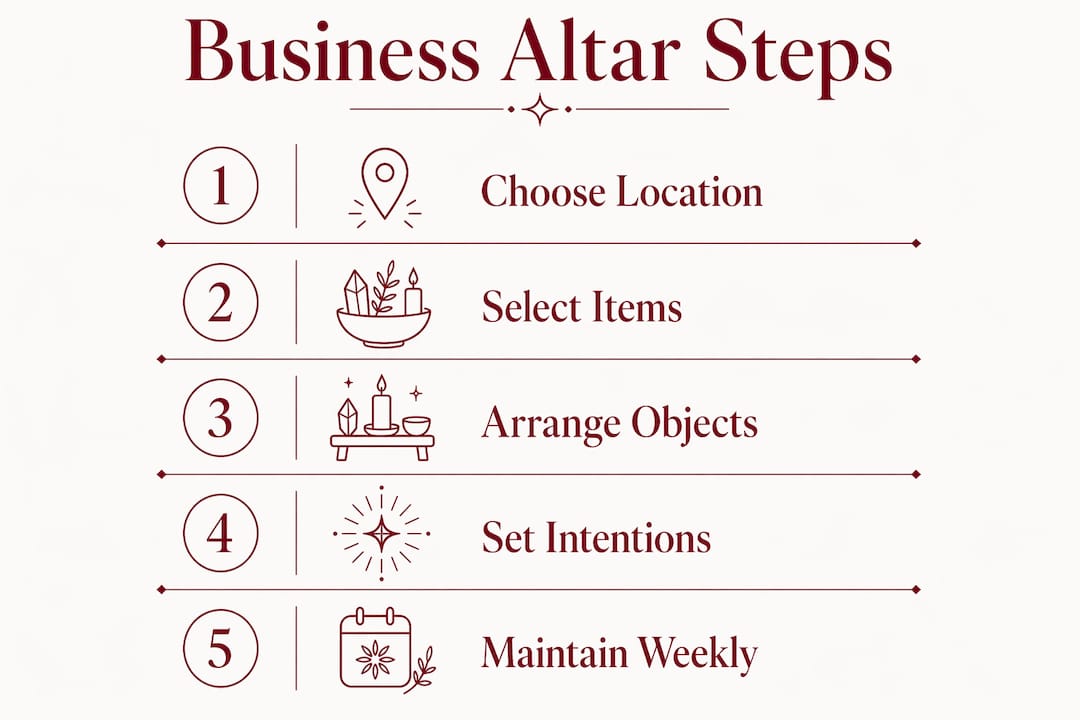
Feng Shui guidance recommends placing wealth deities 3–9 meters from the office entrance, with an altar height of approximately 1,688 millimeters for balanced energy flow. That height roughly corresponds to a standard bookshelf or credenza, which makes this guideline practical for most home offices. The altar should rest against a solid wall, not a glass partition or open space, to provide energetic support.
Follow these steps to assemble your altar with intention:
- Clear the surface. Wipe it down with saltwater or a clean cloth. Physical cleanliness signals readiness.
- Set your foundation layer. Place a cloth, tray, or mat as the base. Choose a color that matches your intention: green or gold for wealth, white for clarity.
- Position your central anchor. This is your most meaningful object, whether a deity figure, a framed business goal, or a significant personal item. Place it at the back center.
- Add candles. Set them to the left and right of the central anchor. Green candles work for financial growth; white candles work for general clarity and protection.
- Place stones and coins. Arrange them in front of the candles. Citrine and pyrite are the most widely used stones for business focus.
- Add herbs or incense. Fresh basil or a cinnamon stick placed near the front draws opportunity. Light incense at the start of each session to activate the space.
- Place your written intention. Write your specific business goal on paper and fold it toward you. Slide it under the central anchor or place it beneath a stone.
- Activate the altar. Light the candles, speak your intention aloud, and spend two to three minutes visualizing your goal as already achieved. This step is non-negotiable. An unactivated altar is just decoration.
Vietnamese business altars follow a similar logic: the God of Wealth sits on the left, the Earth God on the right, and the altar requires daily cleaning and fresh offerings to prevent stagnation. The principle translates directly. Consistency and cleanliness are what keep the space energetically active.
For ongoing maintenance, schedule a weekly session of at least 30 minutes. Regular altar maintenance produces noticeable momentum shifts within 4–6 weeks, with compounding effects building over 3–6 months. That timeline mirrors what many entrepreneurs report when they commit to any consistent daily practice, spiritual or not.
Pro Tip: Keep a small journal near your altar. Write one business intention before each session and one observation after. Patterns emerge faster than you expect.
What mistakes should entrepreneurs avoid with a business altar?
The single most damaging mistake is treating your altar as decoration. Treating a business altar as “set and forget” stops its effectiveness entirely. The altar works because you interact with it, not because it sits on a shelf.
Watch for these specific pitfalls:
- Leaving offerings to spoil. Fresh flowers, fruit, or food left past their prime create stagnant energy. Replace offerings every two to three days.
- Misaligning symbols with your industry. Civil wealth figures suit finance and creative industries, while military-style deity figures suit competitive or partnership-heavy sectors. Using the wrong symbol can suppress rather than attract the energy you want.
- Placing the altar in a cluttered or low-energy space. A corner piled with boxes, or a surface shared with unrelated clutter, dilutes the altar’s focus. The space around it matters as much as the objects on it.
- Skipping the activation step. Placing objects without spoken intention or candle lighting leaves the altar inert. Activation is the practice, not the setup.
- Neglecting to adapt the altar over time. Your business changes. Your altar should reflect those changes. A launch-phase altar looks different from a scaling-phase altar.
A business altar that is never tended is a wish that is never spoken. The ritual of care is the ritual itself. Consistency is what separates a sacred workspace from a shelf of objects.
Pro Tip: Set a recurring calendar reminder for your weekly altar session. Treat it with the same priority as a client meeting.
How do you customize your business altar for your industry and style?
No two business altars should look identical, and that is by design. The 4 Ps framework treats altar design like a marketing strategy: product (your intention), price (your investment of time and energy), place (the altar’s physical function), and promotion (how you activate and share that intention with the universe). This framework gives entrepreneurs a useful mental model for building an altar that actually reflects their work.
Customization starts with your industry:
- Finance and consulting: Use gold coins, a small abacus or calculator, citrine, and civil wealth deity figures. Avoid military symbols, which can introduce conflict energy into negotiation-heavy work.
- Creative industries (design, writing, art): Include tools of your craft, a small mirror for self-reflection, and orange or yellow candles for creative energy.
- Competitive sectors (sales, law, real estate): Military-style protective figures, red candles for drive, and iron or obsidian stones for strength and boundary-setting.
- Service-based businesses: Fresh flowers, a small bowl of water for flow, and green candles for steady client attraction.
Personal items with embodied memory add a layer of power that generic altar objects cannot replicate. A business card from your first client, a photo from your first successful project, or a handwritten note from a mentor all carry specific energy tied to real achievement. Altars built with personally meaningful objects create stronger behavioral anchors than those assembled from a shopping list.
Seasonal adaptation also matters. Many entrepreneurs refresh their altars at the start of each quarter to align with new business goals. A launch phase calls for bold, expansive symbols: large candles, open bowls, and outward-facing figurines. A consolidation phase calls for grounding elements: stones, earth tones, and closed or protective symbols. You can find personalized ritual guidance that helps you match your altar practice to your specific business cycle.
Balancing spiritual intention with practical workspace integration is the final piece. Your altar does not need to dominate your desk. A corner of a bookshelf, a windowsill, or a dedicated tray on a side table all work. The altar should feel like a natural part of your workspace, not a separate world you visit reluctantly.
Key Takeaways
A business altar works through consistent, intentional engagement, not through passive display. Entrepreneurs who maintain weekly altar rituals and adapt their setup to their business phase see the strongest results.
| Point | Details |
|---|---|
| Start with intention | Choose 3–5 meaningful objects aligned with your specific business goals. |
| Follow placement principles | Place your altar against a solid wall, away from clutter, at a comfortable working height. |
| Activate every session | Light candles and speak your intention aloud at every altar visit. |
| Maintain weekly | Spend at least 30 minutes weekly on altar care to build compounding momentum over 4–6 weeks. |
| Adapt as you grow | Refresh altar elements each quarter to reflect your current business phase and goals. |
Why your altar is really a daily energy management tool
Most articles treat a business altar as a one-time setup project. That framing misses the point entirely. After working with entrepreneurs and small business owners on spiritual practices for decades, the pattern is clear: the altar is not the ritual. The daily act of showing up to it is.
What I have observed is that entrepreneurs who struggle with focus and momentum rarely lack strategy. They lack a consistent anchor point for their intention. The altar solves that problem in a way that a to-do list or a vision board cannot. It engages the senses, the body, and the subconscious simultaneously. When you light a candle and speak your goal aloud, you are not performing magic in the theatrical sense. You are training your nervous system to treat that goal as real and present.
The mistake I see most often is abandoning the altar after the first month when results feel slow. Business altar rituals compound over 3–6 months, much like compound interest. The first few weeks feel quiet. Then something shifts. A client calls. An opportunity appears. The altar did not create those events. Your sharpened focus and consistent intention did. The altar was the tool that kept you aligned long enough to receive them.
Adapt your altar as your business evolves. A stagnant altar reflects a stagnant mindset. When you land a major client, add something to the altar to honor that win. When you pivot your business model, update the symbols to match. The altar should feel alive because your business is alive. Treat it that way, and it will serve you for years.
— Psychic
Motherodessa’s rituals to deepen your altar practice
A well-maintained altar creates the foundation. Targeted spiritual rituals build on that foundation and accelerate results.
Motherodessa brings over 40 years of experience in West African spiritual traditions to every ritual she performs. Her money and abundance rituals are designed to complement active altar work, adding a layer of personalized spiritual support that generic practices cannot match. For entrepreneurs dealing with financial blocks or stalled growth, the debt clearing and release ritual addresses the energetic roots of financial stagnation directly. Every ritual Motherodessa offers is customized to your specific situation. No two clients receive the same approach, and every session is handled with complete privacy.
FAQ
What is a business altar?
A business altar is a dedicated sacred workspace where intentionally chosen objects, candles, and symbols support your entrepreneurial focus and financial goals. It functions as an environmental cue that anchors your intentions and reduces mental scatter during your workday.
How often should I maintain my business altar?
Weekly maintenance sessions of at least 30 minutes are the standard recommendation. Consistent weekly care produces noticeable momentum shifts within 4–6 weeks and compounding effects over 3–6 months.
Where is the best place to put a business altar?
Place your altar against a solid wall, away from the bathroom and high-traffic areas. Feng Shui principles recommend a height of approximately 1,688 millimeters and a distance of 3–9 meters from the main entrance for optimal energy flow.
Can I set up a business altar in a home office?
A home office works well for a business altar. A corner of a bookshelf, a dedicated tray on a side table, or a windowsill all provide suitable space. The key requirement is that the surface stays clean and the altar receives daily attention.
What items should I avoid placing on a business altar?
Avoid broken objects, items with negative associations, and symbols misaligned with your industry type. Misaligned wealth symbols can suppress rather than attract prosperity energy. Also remove any offerings that have spoiled, as stale energy undermines the altar’s purpose.