
To align business with abundance means embedding your core values directly into your operations, decisions, and daily behaviors so that financial prosperity becomes a natural outcome rather than a distant goal. Most entrepreneurs treat abundance as a feeling to chase. The more effective approach is to treat it as a system to build. That system starts with values, runs through decision-making, and gets reinforced by mindset. This guide shows you exactly how to build it, step by step, using frameworks drawn from values-based leadership research and abundance psychology.
How to align business with abundance through core values
The foundation of any abundance-aligned business is a clear set of values that actually govern behavior. Not values on a wall. Not aspirational statements in a pitch deck. Values that shape who you hire, how you price, and which clients you turn away.
Embedding values into business policies and governance makes a business more coherent, decisive, and durable under pressure. That coherence is what creates long-term prosperity. When your team knows what you stand for, they make better decisions faster, and you spend less time firefighting.
Dr. Maya Faison, writing through the Tory Burch Foundation, recommends a specific starting point: identify the one area of misalignment causing the most financial, reputational, or personal cost right now. A full overhaul is overwhelming. One focused correction builds momentum.
Here is how to operationalize your values from day one:
- Identify your top three values. Write them as behaviors, not nouns. “Integrity” is vague. “We decline work that conflicts with our client’s long-term interest” is operational.
- Map each value to a business process. Hiring criteria, pricing decisions, vendor selection, and performance reviews should all reflect your stated values.
- Audit your incentives. If your bonus structure rewards speed but your stated value is quality, you have a misalignment that will cost you.
- Communicate values in onboarding. New team members should understand your values as decision rules, not company slogans.
Pro Tip: Write your top value as a single sentence that starts with “We always…” or “We never…” Post it where your team makes daily decisions. That one sentence will do more work than a full values document.
How do you build a values-based decision filter?
A decision filter is a short sequence of questions you apply to any significant business choice. Its purpose is to remove guesswork and keep your decisions aligned with your stated values, even when you are under pressure.

Andreas Pettersson frames values alignment as an operating system designed to remove founder bottlenecks. The filter must be specific enough that even new hires can apply it without escalating to you. If your team still needs your approval on every judgment call, your filter is not specific enough.
Build your decision filter using these four steps:
- Ask the alignment question first. “Does this decision reflect our stated values?” If the answer is no, stop. Do not rationalize exceptions unless the business faces existential risk.
- Identify the trade-offs. Every decision has costs. Name them explicitly. “Accepting this client means delaying our product launch by six weeks.” Naming trade-offs prevents regret and keeps decisions honest.
- Apply your priority order. When two values conflict, which one wins? You need a ranked list. Without it, pressure will decide for you.
- Test for scalability. Hand the filter to your newest team member. Ask them to apply it to a recent decision. If they reach a different conclusion than you would, the filter needs more specificity.
Pro Tip: Run a monthly “decision review” with your leadership team. Pick three recent decisions and run them back through the filter. This builds the habit and catches drift before it becomes culture.
Structures that reinforce the filter include weekly team check-ins where decisions are reviewed against values, and quarterly planning sessions where the filter itself gets updated based on what you learned.
What mindset shifts sustain an abundance-aligned business?
An abundance mindset in business is not positive thinking. It is responsibility-driven behavior that rejects fear and scarcity in favor of trust, collaboration, and long-term relationship building. That distinction matters. Passive optimism produces nothing. Responsibility produces results.
The contrast with a scarcity mindset is concrete. A scarcity mindset hoards clients, avoids referrals to peers, and underprices out of fear. An abundance mindset refers clients who are not the right fit, collaborates with competitors on shared problems, and prices based on value delivered.
“Abundance requires expanding who you are before what you have. Mindset shifts create opportunity reception rather than denial.”
Research published on Phys.org in 2026 found that entrepreneurs with a growth mindset about money behaviors adapt to setbacks by actively seeking solutions rather than getting discouraged. Believing that your financial habits and skills can improve leads to more effective problem-solving under stress. That is not a soft finding. It directly affects recovery speed after a bad quarter.
The psychological building blocks for this mindset are well documented. Research on motivational psychological capital identifies four elements that support sustained entrepreneurial performance:
- Hope: The belief that multiple paths exist to your goal
- Self-efficacy: Confidence in your ability to execute
- Resilience: The capacity to recover and keep moving after setbacks
- Optimism: Expecting good outcomes while preparing for obstacles
Building these four qualities is not accidental. It requires daily practice.
Pro Tip: Start each workday with one sentence: “Today I will create value for [specific person or client].” This shifts your focus from receiving to contributing, which is the behavioral core of an abundance mindset.
How do you audit your business for real abundance alignment?
Measuring alignment turns values from aspirational to operational. Without measurement, you are guessing. With it, you are managing.
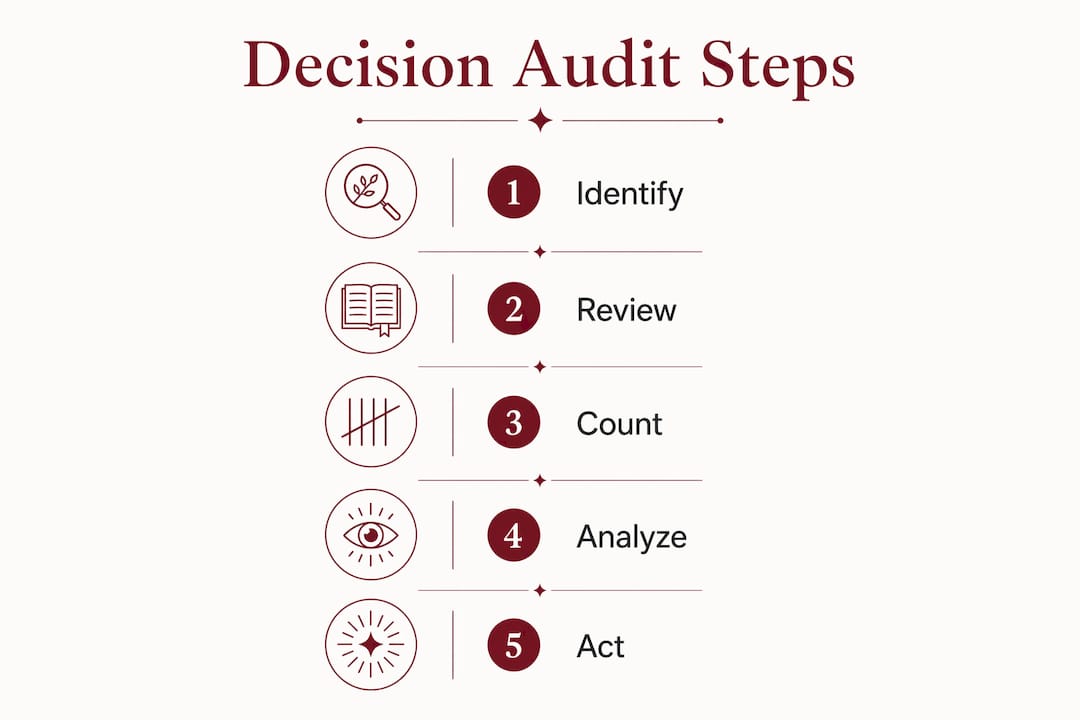
Quarterly decision audits are the most direct tool. Review your top ten decisions from the past quarter. Count how many reflect your stated values. If fewer than 50% do, your values are aspirational, not operational. That threshold is the line between culture and decoration.
Here is a practical audit framework:
| Audit Area | What to Measure | Correction Action |
|---|---|---|
| Hiring decisions | % of hires who passed a values-based interview | Add behavioral interview questions tied to each core value |
| Decision alignment | % of key decisions matching stated values | Run monthly decision reviews with leadership |
| Team feedback | Anonymous survey scores on values lived vs. stated | Hold quarterly open forums to discuss gaps |
| Incentive structure | Whether bonuses reward values-aligned behavior | Redesign metrics to include values-based performance |
Anonymous surveys reveal what formal reviews miss. Team members will not tell you directly that your values are not lived. They will tell a survey. Run one every six months and ask one direct question: “Name one decision in the last 90 days that contradicted our stated values.”
The answers will be uncomfortable. That discomfort is the point. Businesses that combine values-based leadership with analytical decision-making produce ethical, efficient execution. The compass tells you where to go. The audit tells you whether you are actually going there.
Which pitfalls block business abundance alignment?
The most common obstacles to creating an abundant business are predictable. Knowing them in advance lets you design around them.
- Incentive contradictions. Compensation and recognition structures that reward outcomes contradicting your stated principles will override your intentions every time. If you say you value client relationships but pay commissions only on new sales, your team will neglect existing clients.
- Founder bottleneck. When every significant decision routes through you, your values system is not scalable. Andreas Pettersson’s operating system framework exists specifically to solve this. A good decision filter removes you from the loop on routine choices.
- Scarcity traps. Fear of competition, reluctance to share knowledge, and underpricing all signal scarcity. They also reinforce it. Each scarcity behavior closes a door that an abundance behavior would open.
- Values as marketing. Posting your values on your website without embedding them in operations is not alignment. It is branding. The difference shows up in how your team behaves when no one is watching.
Pro Tip: During growth phases, revisit your decision filter every 90 days. What worked at five employees may not work at twenty. The filter should grow with the business, not stay frozen at its founding version.
Recognizing these pitfalls early is what separates businesses that sustain prosperity from those that plateau. If you notice any of these patterns, treat them as signals, not failures. They are data pointing to where your system needs adjustment.
Key takeaways
Aligning your business with abundance requires embedding values into operations, building a scalable decision filter, and practicing responsibility-driven behaviors that replace scarcity with trust.
| Point | Details |
|---|---|
| Values must be operational | Write values as behavioral rules and map them to hiring, pricing, and incentive structures. |
| Decision filters scale alignment | Build a four-question filter specific enough for new hires to apply without founder input. |
| Abundance mindset is behavioral | Replace scarcity habits with trust, collaboration, and long-term relationship investment daily. |
| Audits turn aspiration into action | If fewer than 50% of key decisions reflect your values, those values are not yet operational. |
| Incentive design is non-negotiable | Misaligned compensation structures will override good intentions faster than any mindset work. |
What i have learned about values and abundance in business
Most entrepreneurs I work with come in believing abundance is something you attract. They are waiting for the right moment, the right client, or the right energy. What I have found, consistently, is that abundance is something you build. It shows up after you do the structural work.
The biggest misconception I see is treating values as a communications exercise. Entrepreneurs write beautiful mission statements and then run their businesses on completely different rules. The gap between stated values and lived behavior is where scarcity lives. Closing that gap is where prosperity begins.
What actually moves the needle is starting small and being ruthlessly specific. One value. One process. One decision filter. That is enough to start. The abundance rituals for business owners I recommend always begin with clarity, not complexity.
The entrepreneurs who sustain abundance are not the ones with the best strategies. They are the ones who keep returning to their values when pressure pushes them away. That commitment, practiced daily, is what makes prosperity durable. If you are experiencing what feels like a spiritual dry spell in your business, the root cause is almost always a values gap, not a market gap.
— Psychic
How Motherodessa supports your path to business abundance
Operational systems and mindset work are powerful. Sometimes, though, the blocks to financial abundance run deeper than strategy. That is where Motherodessa’s work begins.

With over 40 years of experience in West African spiritual healing traditions, Motherodessa offers personalized rituals designed specifically for entrepreneurs seeking financial clarity and prosperity. No two rituals are the same. Each one is built around your individual situation, your specific blocks, and your goals. For entrepreneurs ready to clear what strategy alone cannot reach, the Money and Abundance Ritual is a direct starting point. Explore the full Money and Abundance collection to find the right support for where you are right now.
FAQ
What does it mean to align business with abundance?
To align business with abundance means embedding your personal and organizational values into every operational process, from hiring to pricing to decision-making, so that financial prosperity becomes a consistent outcome rather than a random result.
How do i start building an abundance mindset as an entrepreneur?
Start by identifying one scarcity behavior you repeat under pressure, such as underpricing or avoiding referrals, and replace it with a trust-based alternative. Research on psychological capital shows that building hope, resilience, self-efficacy, and optimism directly supports sustained entrepreneurial performance.
How often should i audit my business for values alignment?
Run a decision audit quarterly. Review your top ten decisions and count how many reflect your stated values. Fewer than 50% alignment means your values are aspirational rather than operational.
Why do incentive structures matter for business abundance?
Incentive structures determine what behavior your team actually produces. When compensation rewards outcomes that contradict your stated values, pressure will override intention every time, regardless of how strong your culture statements are.
What is a values-based decision filter?
A values-based decision filter is a short sequence of questions applied to significant business choices to keep decisions aligned with your core values. It must be specific enough for new hires to apply independently, without escalating to the founder.