
Testimonials are curated statements from real clients that serve as direct indicators of healer effectiveness by documenting lived experiences and transformative outcomes. Understanding why testimonials indicate healer effectiveness matters because spiritual healing operates in a space where clinical trial data rarely exists, making peer accounts the most accessible form of evidence. Services backed by testimonials show a 270% higher purchase likelihood compared to those without them. That number reflects something deeper than marketing math. It shows how powerfully human beings rely on other people’s experiences when navigating unfamiliar territory, especially in healing.
Why testimonials indicate healer effectiveness
Testimonials work because human beings are wired to learn from other people’s experiences. This is social proof in action: when someone sees that others have benefited from a healer’s work, their brain interprets that as a reliable signal of safety and value. 92% of people trust peer recommendations over brand or practitioner marketing. That trust gap explains why a healer’s own claims carry far less weight than a client’s unprompted story.
Several psychological mechanisms drive this effect:
- Social proof: People default to the choices of others when they are uncertain. A healer with dozens of detailed client accounts signals that the path is well-traveled and worth taking.
- Narrative psychology: Stories activate more areas of the brain than plain facts. A testimonial describing how someone felt before and after a ritual creates emotional engagement that a service description never can.
- The halo effect: When a client reports one strong positive outcome, readers tend to assume the healer is skilled across the board. One compelling story casts a wide positive light.
- The bandwagon effect: Reading multiple accounts of similar results reinforces the belief that the healer’s methods genuinely work, regardless of individual variation.
- Mirror neurons: When you read a vivid account of someone else’s relief or breakthrough, your brain partially simulates that experience. This creates empathy and a felt sense of possibility.
“Testimonials function as social mirrors. When a potential client reads about someone who shared their exact fear or situation and found relief, the brain does not just process information. It rehearses hope.”
88% of consumers trust testimonials as much as personal recommendations from friends. That level of trust is not accidental. It reflects the deep human instinct to learn from lived experience rather than abstract promises.
What makes a testimonial genuinely reliable?

Not all testimonials carry equal weight. The difference between a trustworthy account and a hollow one comes down to specificity and context. Generic praise like “she changed my life” tells you almost nothing. A testimonial that describes the healer’s communication style, the structure of the ritual, and the specific shift the client noticed afterward tells you a great deal.
| Testimonial type | What it signals |
|---|---|
| Specific and process-focused | Healer communicates clearly and delivers structured, intentional work |
| Outcome-focused with context | Client experienced a real shift and can describe the before and after |
| Generic praise only | Limited insight into the healer’s actual approach or reliability |
| Claims of absolute cures | Ethical red flag; may indicate overstated or misleading representation |
| Addresses challenges honestly | Higher credibility; shows the healer handles complexity, not just easy wins |
Narrative testimonials that describe specific processes, such as how a healer responded to anxiety or adapted a ritual to a client’s situation, outperform generic praise in building trust. Specificity signals that the experience was real and the healer was genuinely present.
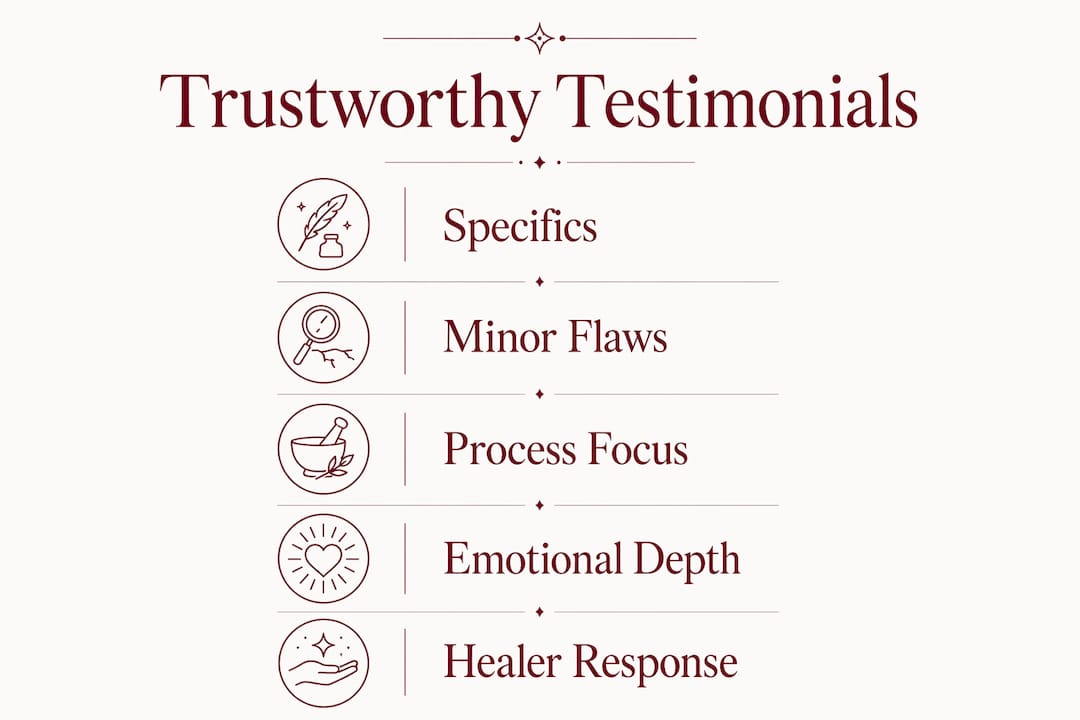
Testimonials with minor imperfections or acknowledged challenges build more trust than uniformly perfect praise. A perfect score often triggers skepticism. Accounts that include a moment of uncertainty or a process that required patience feel more honest and therefore more credible.
Pro Tip: When reading testimonials, look for accounts that describe what happened during the process, not just the result. A client who explains how the healer listened, adapted, and followed up is giving you far more useful information than one who simply says the experience was “amazing.”
Testimonials are also snapshots. They capture a moment of emotional or symptomatic relief but rarely include follow-up context, such as whether the improvement lasted or whether other factors contributed. Use them to understand the client experience, not as clinical proof of outcomes.
How do testimonials connect to the placebo effect and real healing?
The placebo effect is not a trick. It is a biological mechanism driven by expectation, social cues, and ritual context. When a person believes healing is possible and sees credible evidence that others have experienced it, the body shifts into a state that supports recovery. Stress hormones drop. The nervous system relaxes. Immune function improves. Testimonials contribute directly to this process by acting as social signals that prime the body for healing.
Credible healer authority amplifies this effect. When a practitioner is presented as experienced, respected, and backed by real client accounts, the expectation of benefit increases. That expectation is not passive. It activates measurable physiological changes. Motherodessa’s 40+ years of experience in West African spiritual traditions creates exactly this kind of credible authority, and her client testimonials reinforce it with documented human experience.
The connection between testimonials and healing works through several channels:
- Expectation activation: Reading that others healed shifts a client’s internal state from doubt to openness, which the body registers as a signal to lower its defenses.
- Ritual reinforcement: Testimonials that describe structured rituals add weight to the healer’s process. The body responds to perceived order and intention.
- Reduced anxiety: Knowing others have navigated the same process successfully lowers the fear response, which itself is a barrier to healing.
- Authority confirmation: When a healer’s approach is consistently validated by multiple independent accounts, the client’s trust in the process deepens before the work even begins.
Ethical use of testimonials matters here. Practitioners must avoid testimonials that imply absolute medical cures. Overstated claims undermine the credibility they are meant to build and expose both the healer and the client to harm. The most trustworthy healers focus testimonials on the process and the relational experience rather than miraculous outcomes.
How should you use testimonials when choosing a spiritual healer?
Testimonials are tools for evaluation, not verdicts. Used well, they help you understand how a healer works, how they treat clients, and whether their approach fits your situation.
- Prioritize process over results. Look for testimonials that describe how the healer communicated, how the ritual was structured, and how the client felt during the experience. Results matter, but process tells you more about consistency.
- Check for healer responsiveness. 41% of people trust providers more when they actively respond to both positive and negative feedback. A healer who engages with all types of client feedback signals professional commitment, not just marketing.
- Look for variety in the accounts. A collection of testimonials that covers different situations, such as relationship healing, financial abundance, and generational patterns, shows range. It suggests the healer adapts their work rather than applying a single formula.
- Balance testimonials with other signals. Consider the healer’s years of practice, their transparency about methods, and their approach to client confidentiality. Testimonials are one layer of evidence, not the whole picture.
- Avoid overreliance on dramatic stories. A single extraordinary account of a miraculous outcome is the least reliable type of testimonial. Consistent, moderate, and specific accounts across many clients carry far more weight.
Pro Tip: If a healer’s testimonials all sound identical in tone and structure, treat that as a signal worth noticing. Authentic client accounts vary in voice, detail, and emotional register because real people describe experiences differently.
45% of people look specifically at how providers respond to feedback when making decisions. That responsiveness is itself a form of testimonial. It shows you how the healer behaves when the work is done.
Key Takeaways
Testimonials indicate healer effectiveness because they combine social proof, narrative psychology, and biological priming to create trust that no marketing claim can replicate.
| Point | Details |
|---|---|
| Social proof drives trust | 92% of people trust peer accounts over practitioner marketing, making testimonials the primary credibility signal. |
| Specificity separates reliable from hollow | Process-focused testimonials reveal more about healer skill than generic praise or outcome-only claims. |
| Placebo effect is real and social | Testimonials prime the body for healing by activating expectation and reducing fear before work begins. |
| Healer responsiveness signals quality | Healers who engage with all feedback, positive and critical, demonstrate professional integrity. |
| Use testimonials as one layer | Balance client accounts with healer experience, transparency, and ethical standards for a full picture. |
What I’ve learned about testimonials after decades in this work
Testimonials are the most honest form of evidence available in spiritual healing, and also the most easily misread. I have seen clients dismiss powerful accounts because they sounded “too good,” and I have seen others accept dramatic claims without asking a single question. Both responses miss the point.
The accounts that matter most are the ones where a client describes feeling genuinely heard. Not fixed overnight. Not transformed by magic. Heard, supported, and guided through something they could not navigate alone. That is what effective healing looks like from the inside, and that is what the best testimonials capture.
Healers carry an ethical responsibility in how they present client experiences. Accuracy matters more than drama. A testimonial edited for clarity and honesty strengthens credibility far more than an unverified claim of miraculous results. The healers I respect most are the ones who let their clients speak plainly, without embellishment.
My honest advice: read testimonials the way you would read a letter from a trusted friend. Notice the tone, the detail, and what the person chose to emphasize. Then trust your intuition about whether the healer’s approach fits what you actually need.
— Psychic
Motherodessa’s healing work, reflected in real client experiences
Motherodessa has served clients across the globe for over 40 years, and the testimonials she has received reflect the full range of what spiritual healing can address.
Clients describe reunited relationships, broken generational curses, and restored financial flow. These accounts are not polished marketing copy. They are specific, varied, and grounded in real situations. Motherodessa’s approach to spiritual healing is built on personalization. No two rituals are identical because no two situations are the same. If you are ready to see what client experiences say about her work, her full collection of rituals, including the Health & Healing Ritual and Seven African Powers Ceremony, is available with client feedback that speaks for itself.
FAQ
Why do testimonials carry more weight than a healer’s own claims?
Peer accounts are trusted by 92% of people over practitioner marketing because they come from someone with no financial stake in the outcome. That independence is what makes them credible.
What should I look for in a spiritual healer’s testimonials?
Look for specificity about the process, the healer’s communication style, and how the client felt during the experience. Generic praise tells you little. Detailed, process-focused accounts tell you a great deal.
Can testimonials actually influence physical healing outcomes?
The placebo effect is a documented biological mechanism activated by expectation and social cues. Testimonials that build trust and reduce anxiety create real physiological conditions that support healing.
How can I tell if a testimonial is trustworthy?
Accounts with minor imperfections, honest acknowledgment of challenges, and specific process details build more trust than uniformly perfect praise. Skepticism toward flawless five-star accounts is well-founded.
Should I rely on testimonials alone when choosing a healer?
Testimonials are one layer of evidence. Balance them with the healer’s years of experience, their transparency about methods, and how they handle client privacy and feedback before making a decision.