
When you share something deeply personal with a healer, you need to know it stays protected. Understanding how healers maintain client confidentiality is not as straightforward as with a licensed therapist or doctor. Spiritual healers operate in a space where legal mandates are often absent, yet the ethical responsibility to protect what clients share is just as serious. This guide breaks down the real frameworks, practical methods, and common pitfalls so you know exactly what privacy protections to expect and what questions to ask before your first session.
Table of Contents
- Key takeaways
- How healers maintain client confidentiality: the legal framework
- Practical confidentiality practices that build client trust
- Therapists vs. spiritual healers: comparing confidentiality standards
- Common pitfalls healers face in protecting client privacy
- My perspective on confidentiality as the foundation of healing
- Experience healing with privacy at Motherodessa
- FAQ
Key takeaways
| Point | Details |
|---|---|
| Legal mandates often don’t apply | Most spiritual healers are not bound by HIPAA, but strong healers adopt equivalent privacy standards. |
| Informed consent is the foundation | A signed agreement that spells out confidentiality terms sets clear expectations before any session begins. |
| Confidentiality has legal limits | Mandatory reporting laws and duty-to-warn rules can override confidentiality in specific, serious situations. |
| Scope creep is a real risk | Healers who drift into emotional analysis face higher confidentiality exposure and ethical breaches. |
| You have the right to ask | Clients should always ask about privacy policies, data storage, and session boundaries before sharing sensitive information. |
How healers maintain client confidentiality: the legal framework
Many people assume spiritual healers are held to the same legal privacy standards as psychiatrists or doctors. They are not. Most spiritual healers are not legally required to comply with HIPAA, the federal law that governs health data privacy for licensed medical providers. That said, the absence of a legal requirement does not mean privacy is optional. It means the ethical standard has to carry the weight instead.
Here is where it gets more nuanced. Even without HIPAA coverage, healers are not operating in a legal vacuum. Two specific legal obligations apply broadly:
- Mandatory reporting laws: All U.S. states require practitioners to report suspected child, elder, or dependent adult abuse to authorities. Failing to do so can result in misdemeanor or felony charges. A healer who learns of abuse during a session must report it, regardless of any confidentiality promise made.
- Duty to warn: Approximately 31 U.S. jurisdictions require disclosure when a client poses a credible, specific threat of harm to an identifiable third party. This traces back to the landmark Tarasoff ruling and its variants across state law.
- Minimum necessary disclosure: Even when a mandatory disclosure is legally required, disclosure must be limited to only what is strictly necessary. Sharing more than the situation demands is itself a violation of ethical practice.
These are not technicalities. They are real situations that come up, and a healer who has not thought through these boundaries in advance is unprepared to serve you safely.
Pro Tip: Before booking a session, ask your healer directly: “Under what circumstances would you break confidentiality?” A thoughtful, specific answer tells you more about their professionalism than any testimonial.
Practical confidentiality practices that build client trust
Knowing what a healer is legally required to do only tells part of the story. The day-to-day client confidentiality practices that actually protect your privacy are built into how a responsible healer structures their entire practice. Here is what that looks like in concrete terms:
-
Signed informed consent agreements: Before the session begins, a well-prepared healer presents a written agreement that explains exactly what information will be collected, how it will be stored, who might see it, and what the limits of confidentiality are. A signed consent form that spells out privacy boundaries is a best practice across spiritual healing modalities, not just therapy.
-
Secure digital record keeping: Client notes should be stored in password-protected systems, ideally encrypted. This matters even for healers who keep minimal records. A name, phone number, and session notes constitute personal data that deserves real protection.
-
Private session environments: In-person sessions should take place in rooms where conversations cannot be overheard. Sound machines near doors, closed windows, and dedicated spaces all signal that the healer takes physical privacy seriously.
-
Encrypted communication tools: Email and standard SMS are not secure for sensitive health-related conversations. Responsible healers use encrypted messaging apps or secure client portals for any communication that involves personal details about a client’s situation.
-
Clear upfront communication: Ongoing communication about confidentiality boundaries improves client comfort and reduces misunderstandings. This is not a one-time disclosure. It is a recurring part of how the healer-client relationship stays healthy and transparent.
The healer-client relationship privacy depends on structure, not just good intentions. Without these systems in place, even the most well-meaning healer can accidentally expose client information through carelessness.
Pro Tip: Ask your healer what platform or tool they use to store your contact information and session notes. If they cannot answer clearly, that is a red flag about how seriously they take your data.
Therapists vs. spiritual healers: comparing confidentiality standards
This comparison surprises most people. The differences are real, but the similarities in ethical commitment are stronger than you might expect.
| Area | Licensed therapist | Spiritual healer |
|---|---|---|
| Legal mandate | HIPAA required; strict federal rules apply | Not legally required to comply with HIPAA |
| Mandatory reporting | Legally required in all states | Morally and often legally required by state law |
| Record-keeping rules | Formal documentation standards; psychotherapy notes stored separately for added legal protection | No federal standard; best practice is to adopt HIPAA-style storage |
| Client rights | Formal right to access, correct, and delete records | Depends on healer policy; no federal guarantee |
| Ethical commitment | Enforced by licensing boards | Self-governed; relies on personal ethics and professional community |
| Consequences for breach | License revocation, lawsuits, federal penalties | Reputational damage, civil liability, loss of client trust |
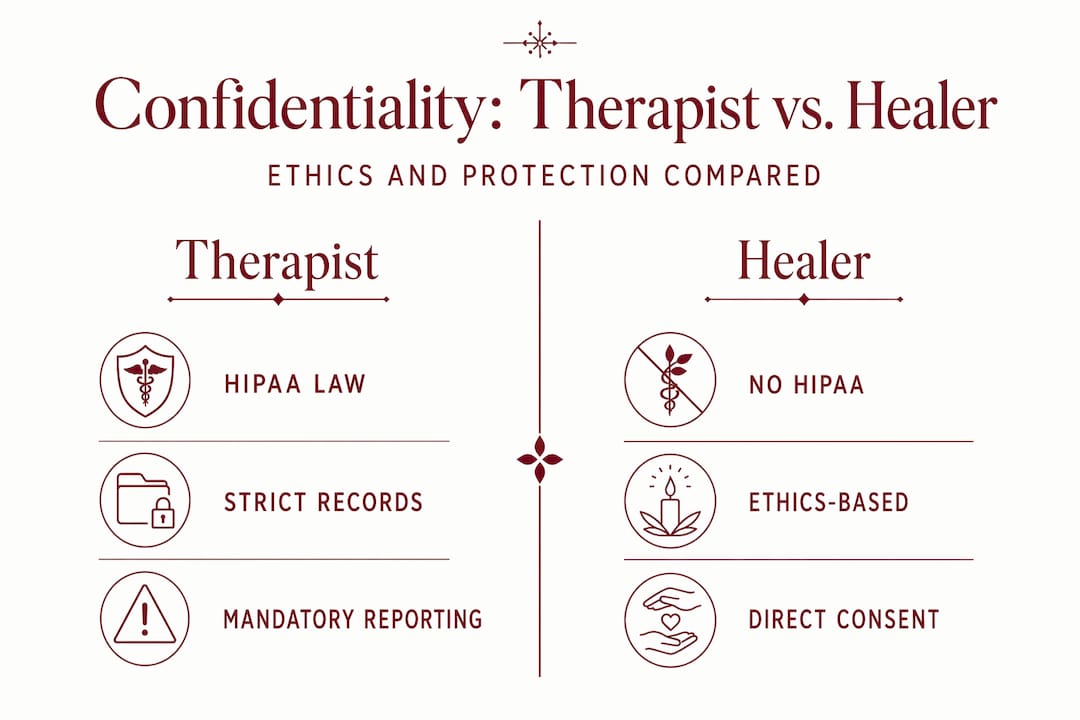
What this table reveals is that the ethical obligation of confidentiality in healing is identical on both sides. The mechanism for enforcement is what differs.
There are things you should specifically ask any spiritual healer before you open up about sensitive matters:
- Do you have a written privacy policy?
- How long do you retain session notes, and how are they stored?
- Who else, if anyone, has access to my information?
- Have you received any training on confidentiality or ethics in healing practice?
These are not confrontational questions. They are the kind a professional healer welcomes, because it shows you are a client who takes the relationship seriously.
Common pitfalls healers face in protecting client privacy
Even healers with the best intentions run into situations that put confidentiality at risk. Knowing these patterns helps you recognize whether a healer you are working with has genuinely thought through their ethical guidelines.
-
Scope creep into emotional analysis: When healers drift from their specific modality into informal therapy, they enter territory they are not trained to handle. Staying within scope protects both client and healer. A healer who starts interpreting your childhood trauma without credentials is not just crossing a therapeutic line. They are increasing the risk that sensitive disclosures are mishandled.
-
Casual disclosure in community settings: Spiritual healing often happens in communities where the healer and client may know mutual friends or attend the same events. A passing comment about “a client going through a hard time” breaks confidentiality even without naming anyone, especially in a small community.
-
Virtual session vulnerabilities: Remote healing sessions require encrypted platforms and private environments on both ends of the call. A healer conducting sessions from a coffee shop or using a standard video call without a waiting room feature is exposing your session to unnecessary risk.
-
Emotional entanglement without boundaries: Ethical boundaries function as containers that keep healing work safe. When a healer becomes personally invested in a client’s outcome to the point of sharing their story with others out of concern, that is still a confidentiality breach, even if the intention was care.
-
Lack of ongoing training: Privacy standards evolve. Healers who completed training years ago and have not revisited ethics may be unaware of current expectations around digital privacy, remote sessions, or mandatory reporting updates.
Pro Tip: If a healer ever references another client’s situation, even without a name, treat it as a warning sign. What they share about others, they will eventually share about you.
My perspective on confidentiality as the foundation of healing
I have been working in spiritual healing for over 40 years, and the one thing I have seen make or break a practice is not skill or spiritual knowledge. It is trust. You cannot do deep work with someone who is watching the door.
What most practitioners overlook is that confidentiality is not just a policy you post on a website. It is something you build into every detail of how you operate: the room you work in, the tools you use to communicate, the way you hold yourself at community events. The spiritual dimension of healing requires that clients bring their whole truth into the space. That only happens when they genuinely believe it will stay there.
I have also seen well-meaning healers underestimate how much maintaining professional boundaries protects the client. When a healer steps outside their role and into emotional interpretation or personal advice, the client’s private disclosures become fuel for conversations they never consented to. Adopting a deliberate confidentiality framework is not about becoming cold or clinical. It is about creating a space sacred enough that real healing can happen. My spiritual shield working practice, for example, begins with establishing clear energetic and personal boundaries for exactly that reason.
— Psychic
Experience healing with privacy at Motherodessa
At Motherodessa, every ritual begins with a commitment to your privacy. With over 40 years of experience and a practice rooted in West African healing traditions, Mother Odessa treats every client’s story with the kind of discretion that makes genuine transformation possible.
Whether you are seeking clarity, protection, or renewal, Motherodessa’s approach to confidentiality in healing means your situation stays between you and her. No two sessions are the same, and no details are shared beyond the sacred space of the work itself. Explore the Full Spiritual Restoration Ceremony for a confidential, deeply personalized healing experience, or review Motherodessa’s privacy choices to understand how your information is protected from the start.
FAQ
What laws govern healer-client confidentiality?
Most spiritual healers are not covered by HIPAA, but mandatory reporting laws in all 50 states still require them to report suspected abuse. Duty-to-warn obligations apply in approximately 31 jurisdictions if a client poses a credible threat of harm.
Can a healer share what I tell them in a session?
Not without your consent, except in legally mandated situations such as reporting suspected abuse or warning an identified person of a credible threat. Responsible healers explain these limits in writing before the session begins.
What should I look for in a healer’s privacy policy?
Look for written documentation of how your information is stored, who has access to it, and what specific situations would require disclosure. A healer who cannot provide this in writing has not built a real confidentiality framework.
Are virtual healing sessions private?
They can be, but only if the healer uses encrypted communication platforms and conducts sessions from a private location. Remote healing sessions carry unique privacy risks, and clients should ask directly about the platform and environment the healer uses.
How is a spiritual healer’s confidentiality different from a therapist’s?
Licensed therapists operate under strict federal and state legal requirements with formal enforcement mechanisms. Spiritual healers operate under ethical self-governance. The moral commitment is the same. The accountability structure differs significantly.