
To understand your spiritual path is to identify the recurring inner orientation that consistently energizes you, then test it through honest reflection and culturally respectful practice. That’s the whole thing. Everything else is method.
Your immediate next step: spend 10 minutes writing down three moments in the last year when you felt most like yourself. Not happiest — most yourself. That list is your first map. If you want a more structured starting point, Motherodessa’s Spiritual Healing & Clarity service offers an introductory consultation built around your specific situation, not a template.
A few things worth knowing before you go further:
- Your Life Path Number (calculated from your birth date) offers a directional orientation, not a job prescription — useful as one lens among several.
- Spiritual clarity rarely arrives as a single revelation. It accumulates through repeated signals you learn to recognize.
- Motherodessa’s approach pairs ancestral West African frameworks with your personal circumstances, so no two rituals are identical.
Table of Contents
- What does being on a spiritual path actually feel like?
- How West African–rooted rituals can clarify your path
- Practical exercises to gain clarity this week
- How to choose a West African spiritual practitioner responsibly
- What happens after a ritual, and how to integrate it
- Why Mother Odessa’s experience and approach matter
- Key Takeaways
- The path asks for patience, not perfection
- Ready for personalized ritual work with Motherodessa?
What does being on a spiritual path actually feel like?
Most people don’t recognize they’re on a spiritual path until they’re already deep into it. The early signs are easy to dismiss: a persistent restlessness that career changes don’t fix, recurring dreams or symbols that follow you across years, a pull toward certain people or work that defies practical logic. Synchronicities — meaningful coincidences that cluster around a decision or question — tend to intensify.
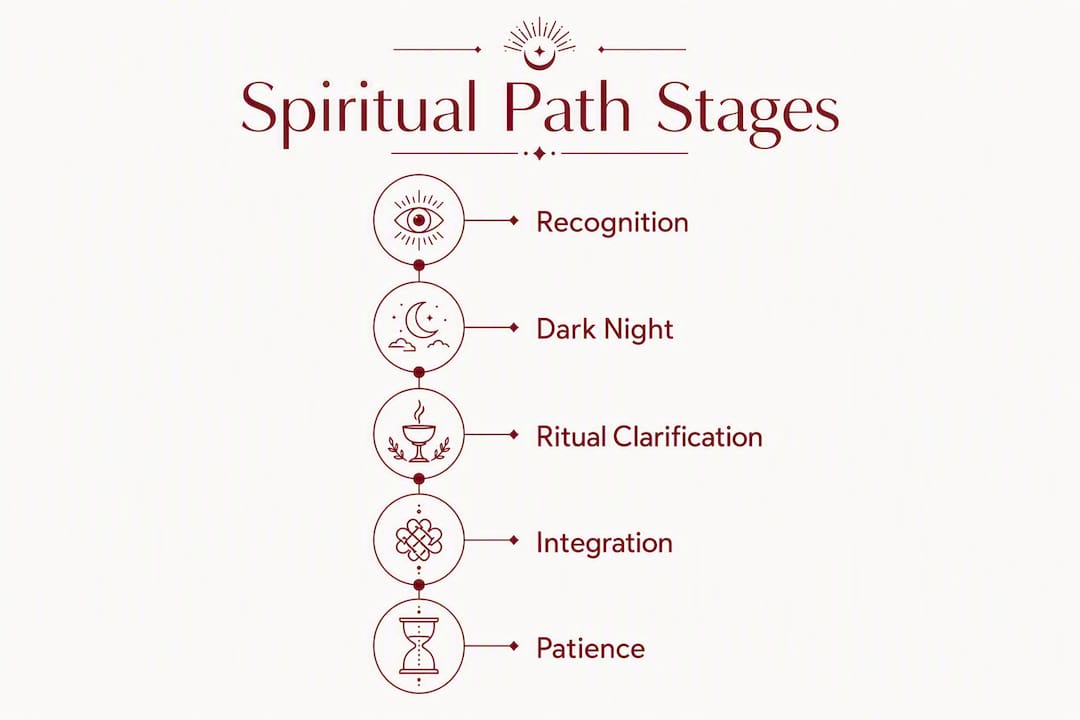
Spiritual awakening follows recognizable stages: ordinary waking, the call to awaken, the dark night, integration, and rooted presence. Most people get stuck between the dark night and integration, mistaking the difficulty for failure.
The dark night of the soul is not a detour from the spiritual path. It is the path. Uncertainty and disorientation during this stage are signs of genuine integration, not collapse.
The dark night phase feels like losing your footing — old certainties dissolve before new ones form. That’s normal. Rushing past it tends to produce what practitioners call performative spirituality: the appearance of growth without the inner shift.
Pro Tip: Apply radical honesty here. Ask yourself which signals have persisted across multiple years and life circumstances, and which appeared only during stress. Lasting signals point toward your actual path; stress-reactive ones point toward coping.
How West African–rooted rituals can clarify your path
West African spiritual traditions don’t treat ritual as decoration. Each ceremony serves a functional purpose: clearing interference, anchoring intention, aligning with ancestral guidance, or opening channels that habitual thought patterns keep closed. The cultural roots of these practices matter — they carry centuries of tested methodology, not aesthetic symbolism.
Different ritual forms address different needs:
- Spiritual cleansing baths remove energetic residue from past trauma, broken relationships, or generational patterns that cloud your perception of your own direction.
- Seven African Powers ceremonies call on multiple ancestral forces simultaneously, useful when a situation involves overlapping obstacles (love, money, and protection at once).
- Offerings and ancestral alignment work reconnect you with lineage wisdom, which often surfaces clarity about purpose that personal reflection alone cannot reach.
Rituals reveal what already exists within you. They do not prescribe a new identity — they remove the interference that prevents you from seeing the one you already have.
Customization is what separates effective ritual work from generic practice. As authenticity research confirms, spiritual growth must illuminate rather than prescribe. A practitioner who designs every ceremony around your specific birth details, current circumstances, and stated intention is doing something categorically different from one who runs the same ritual for every client.
Approach these traditions with humility. Consent and cultural respect aren’t optional courtesies — they’re part of what makes the work function.
Practical exercises to gain clarity this week
You don’t need a practitioner to start. These four steps build a foundation that makes any later ritual work more effective.
- Values inventory. List your five non-negotiable values — not aspirational ones, the ones you actually live by. Then check whether your current daily life reflects them. The gap between stated values and lived behavior is where most people’s path confusion originates.
- 10-minute radical-honesty journal. Write without editing. Prompt: “If no one would judge me and money were irrelevant, I would spend my time doing ___.” Career and life-purpose research consistently shows that radical honesty is the bridge between knowing your values and building a life around them.
- Life Path Number prompt. Calculate your Life Path Number (add all digits of your birth date down to a single digit or master number). Numerology frameworks work best as a cross-reference, not a verdict — compare what it surfaces against what your journal already revealed.
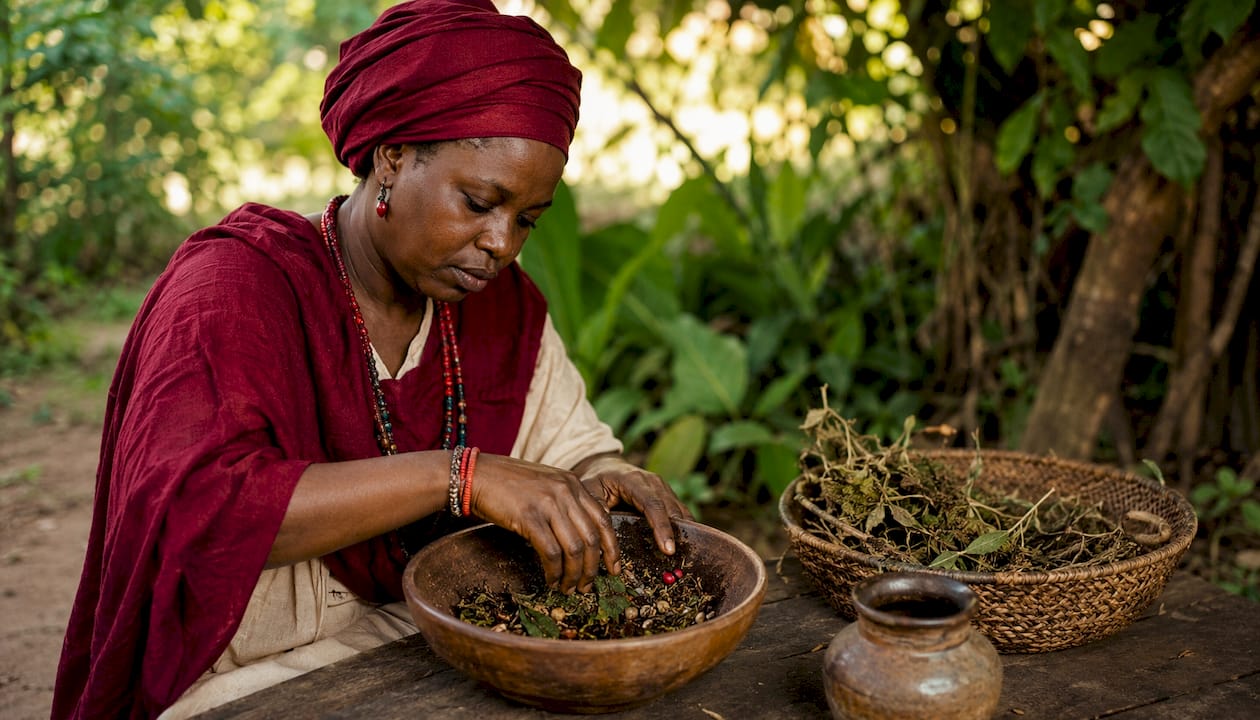
- Beginner cleansing micro-ritual. Fill a bowl with clean water. Add a pinch of sea salt and a few drops of an oil you associate with calm (lavender works). Set a clear, single-sentence intention aloud. Sit with it for five minutes. This isn’t ceremonial-grade work, but it trains the habit of intentional focus that deeper ritual requires.
Safety and ethics checklist before you go further:
- Never attempt curse removal or binding work without a trained practitioner.
- If spiritual distress is intersecting with depression, anxiety, or trauma, work with a mental-health professional alongside any spiritual practice.
- Cultural humility means learning before borrowing — read about the traditions you’re engaging with.
- Test whether a practice is giving reliable information by checking for repeatability: does the same exercise produce consistent emotional clarity across multiple sessions?
How to choose a West African spiritual practitioner responsibly
The right practitioner changes the outcome. The wrong one wastes your time and money, and occasionally causes harm.
| What to evaluate | What to look for | Red flag |
|---|---|---|
| Lineage and training | Clear explanation of tradition and how they learned it | Vague or evasive about background |
| Customization process | Asks detailed questions about your situation before designing anything | Same ritual offered to everyone |
| Privacy policy | Explicit about what information stays confidential | Asks you to share sensitive details publicly |
| Realistic outcomes | Describes likely shifts, not guaranteed results | Promises instant or permanent fixes |
| Follow-up support | Offers integration guidance after the ceremony | Disappears after payment |
Ask directly: “How do you customize this ritual for my situation?” A practitioner who can answer that specifically — referencing your birth details, the nature of your obstacle, and the ancestral forces relevant to your case — is doing genuine work.
A practitioner worth trusting will tell you what they cannot do as clearly as what they can. Certainty about outcomes is a sales technique, not a spiritual credential.
Timeline expectations: most ritual work unfolds across weeks, not hours. A typical arc runs from intake consultation through ritual design, ceremony, and a follow-up integration period. Costs vary by service complexity; consultation formats differ significantly from full ceremonial work.
What happens after a ritual, and how to integrate it
Ritual results are rarely dramatic on day one. What most people notice first is subtle: a decision becomes easier, a relationship shifts in tone, a recurring anxiety quiets. Major life changes, when they come, tend to follow weeks of these smaller signals.
Watch for these short-term indicators that the work is active:
- Emotional clarity on a question that previously felt stuck
- Unexpected opportunities appearing in the area you focused on
- Dreams that reference the ritual’s theme
- A reduction in the specific interference (conflict, financial block, fear) you addressed
Integration checklist for the weeks after a ceremony:
- Journal daily for at least two weeks, noting any shifts — even minor ones.
- Maintain the lifestyle anchors your practitioner recommends (dietary, behavioral, or environmental).
- Avoid major disruptive decisions in the first week; let the energetic shift settle.
- If distress increases rather than decreases, consult a mental-health professional. Ritual work and therapy are not mutually exclusive, and some emotional material that surfaces needs clinical support.
- Schedule a follow-up session if the original obstacle resurfaces or if new layers emerge.
Ritual is not a one-time cure. Integration and follow-up practices are what convert a ceremony into lasting change. Clearing subconscious limiting beliefs takes sustained attention, not a single intervention.
Why Mother Odessa’s experience and approach matter
Credentials in West African spiritual practice aren’t issued by institutions — they’re demonstrated through lineage, longevity, and results. Mother Odessa brings 40+ years of active practice rooted in West African traditions, with a client record that includes reuniting estranged couples, removing generational curses, and resolving persistent financial and protection obstacles.
Every ritual I design begins with your specific situation. The ceremony you receive has never been performed for anyone else, because no one else has your exact circumstances, history, and need.
Her spiritual healing services address the full range of practical life issues:
- Spiritual Cleansing Bath Ritual — clears energetic interference and resets your baseline.
- Seven African Powers Ceremony — multi-ancestral ceremonial work for complex, overlapping obstacles.
- Money & Abundance Ritual — targeted work for financial blocks and abundance alignment.
- Protection & Banishing — removes hostile spiritual interference and establishes protective boundaries.
Privacy is structural, not incidental. The information you provide for ritual customization stays between you and Mother Odessa. No public testimonials are required, no group ceremonies, no shared details. What’s needed for a custom ritual: your full name, birth date, a clear description of your situation, and your specific intention.
Key Takeaways
Understanding your spiritual path requires honest self-reflection, recognition of the stages you’re moving through, and culturally respectful practices that clarify rather than prescribe your direction.
| Point | Details |
|---|---|
| Path clarity is cumulative | Signals accumulate over time; lasting ones across multiple years point toward your actual direction. |
| Dark nights are part of growth | The five-stage awakening model places the dark night before integration, not outside the path. |
| Customization drives ritual effectiveness | No two rituals should be identical; your birth details, circumstances, and intention shape the design. |
| Integration extends the benefit | Daily journaling and follow-up sessions convert ceremony into lasting change. |
| Motherodessa’s approach | 40+ years of West African lineage-based practice, fully customized rituals, and a privacy-first model for practical life issues. |
The path asks for patience, not perfection
People often come to spiritual work expecting a clear answer delivered quickly. What they find instead is that the path keeps asking better questions. That’s not a failure of the process — it’s the process working correctly.
What I’ve seen across decades of this work is that the seekers who benefit most aren’t the ones who arrive with the most certainty. They’re the ones willing to sit with what surfaces, honor the cultural traditions they’re engaging with, and follow up after the ceremony rather than treating it as a transaction.
If you’re at the beginning, start with the journaling exercise in this article. If you’ve already done the inner work and you’re ready for ceremonial support, reach out. The consultation is where we figure out together what your situation actually calls for — not what a generic ritual promises.
Ready for personalized ritual work with Motherodessa?
Forty years of West African lineage-based practice, fully customized to your situation. No two ceremonies are the same because no two people arrive with the same history, obstacle, or need.
Motherodessa’s services cover the full range of practical spiritual needs: clearing and cleansing, ancestral alignment, financial abundance, love and reconciliation, and protection from hostile interference. Every order begins with an intake process that shapes the ritual design around your specific circumstances. The result you receive is a digital written report of your personalized ceremony, delivered privately.
Browse the full spiritual healing catalog to find the service that fits your situation, or go directly to the Money & Abundance or Protection & Banishing collections if you know where your focus lies. Select your service, complete the intake, and Motherodessa handles the rest.
Useful sources and further reading
| Resource | What it covers |
|---|---|
| Spiritual Healing & Clarity – Motherodessa | Full catalog of Mother Odessa’s personalized ritual services |
| Seven African Powers Ceremony – Motherodessa | Multi-ancestral ceremonial work for complex obstacles |
| Spiritual Awakening Stage Finder – InMotiVise | Five-stage model for locating your current phase |
| How to Discover Your Spiritual Path – Maria Shriver | Authenticity and limiting-belief frameworks |
| Life Path Number Meanings – Numerology.com | Directional numerology as a complementary orientation tool |
| How to Start Your Spiritual Journey – Kirsti Formoso | Foundational habits: journaling, intention, stillness |
| BetterUp: I Don’t Know What to Do With My Life | Radical honesty and values-to-action frameworks |
This article is general information, not professional spiritual, psychological, or medical advice. For mental-health concerns that arise during spiritual work, consult a licensed mental-health professional.