
Prosperity energy in commerce is defined as the combination of surplus energy availability and knowledge-driven efficiency that enables businesses to grow, compete, and generate lasting value. This concept goes far beyond paying utility bills. The role of prosperity energy in commerce shapes pricing decisions, investment capacity, supply chain resilience, and long-term market positioning. Business owners who treat energy as a strategic variable rather than a fixed overhead gain a measurable edge over those who do not. This article connects 2026 data, economic frameworks, and practical strategy to show you exactly how energy fuels or limits your commercial success.
How does the role of prosperity energy in commerce affect business margins?
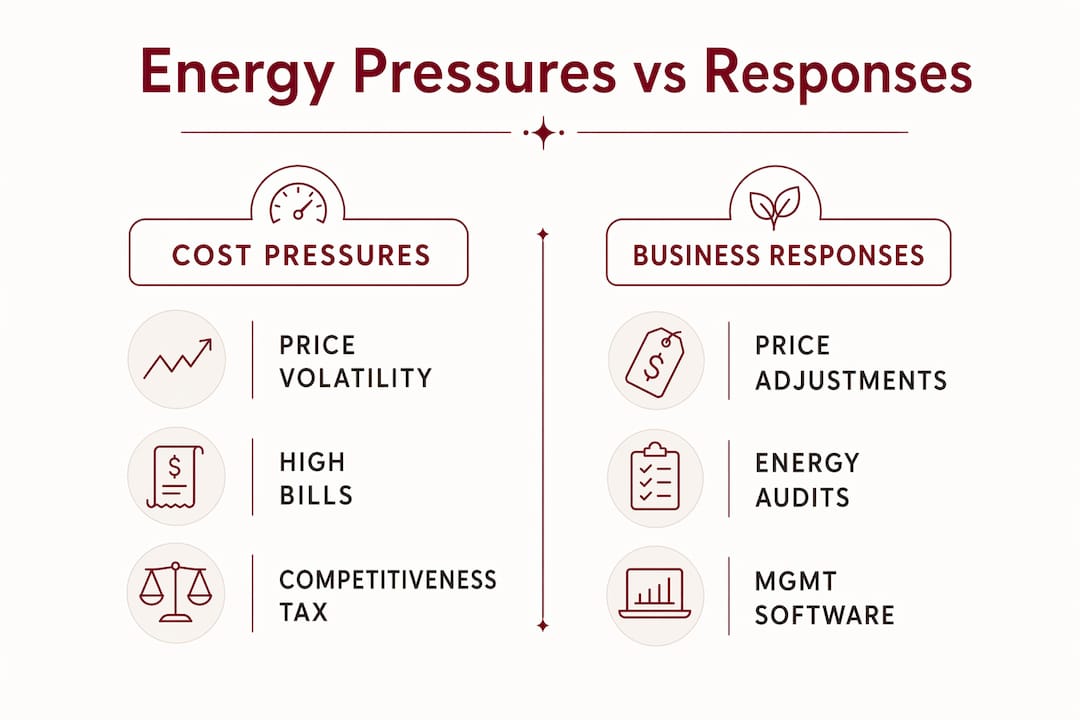
Energy costs are the primary driver of higher trading costs for businesses. 85% of business leaders identify energy expenses as their top cost pressure, with 37% actively cutting energy usage to protect margins and 32% adjusting pricing in response to fuel and energy volatility as of april 2026. That means one in three businesses has already changed what they charge customers because of energy costs alone.
The pressure is not limited to one region or sector. Energy is the most widespread barrier to global business growth in 73 out of 118 countries surveyed. That figure reframes energy from a local operational concern into a global competitive factor.
High energy bills function as a tax on competitiveness. Energy UK experts describe volatile energy costs as a direct brake on business investment, slowing capital allocation and weakening long-term planning. When you cannot predict your energy bill next quarter, you cannot confidently commit to hiring, expansion, or new equipment.
Key energy cost pressures and business responses
| Cost Pressure | Business Response |
|---|---|
| Fuel and energy price volatility | Adjusting product or service pricing |
| Rising operational overhead | Cutting energy consumption across facilities |
| Supply chain disruption | Diversifying suppliers and logistics partners |
| Reduced investment capacity | Deferring capital expenditure or scaling back growth plans |
| Weakened profit margins | Renegotiating contracts and locking in fixed-rate energy deals |
Pro Tip: Audit your energy spend by business function, not just by total bill. Knowing which operations consume the most energy lets you target reductions where they protect margins most.
What is the connection between prosperity energy and productive knowledge?
Prosperity does not come from energy alone. True economic prosperity requires surplus energy available beyond basic operational needs, combined with what economists call “productive knowledge.” Productive knowledge is the organized application of information, skills, and systems that turns raw energy into value rather than waste.
The American Enterprise Institute frames this relationship clearly:
Prosperity arises when surplus energy is multiplied by productive knowledge. Energy times information drives economic complexity, enabling innovation and the kind of growth that compounds over time rather than burning out.
This insight has direct commercial implications. A business that consumes large amounts of energy without applying knowledge to improve processes will see diminishing returns. A business that pairs efficient energy use with data intelligence, process design, and skilled teams can grow output while reducing energy dependency.
The practical benefits of combining energy efficiency with productive knowledge include:
- Lower cost per unit of output as processes become more efficient
- Reduced exposure to energy price shocks through lower baseline consumption
- Faster innovation cycles because resources are not absorbed by waste
- Stronger margins that fund reinvestment in growth rather than covering overhead
- Greater resilience when energy markets become volatile
Companies that have applied this model show measurable results. Businesses emphasizing sustainable energy transitions grow green revenues twice as fast as conventional revenue streams and have achieved a 12% reduction in emissions alongside 20% overall business growth in early 2026. That combination of lower emissions and higher revenue is the clearest evidence that knowledge-driven energy use creates prosperity rather than constraining it.
How does prosperity energy influence market growth and competitive advantage?
Energy stability creates the conditions for market expansion. Businesses that secure predictable, affordable energy supplies can plan further ahead, price more competitively, and absorb market shocks without cutting growth programs. Those operating in volatile energy environments spend management time on crisis response rather than opportunity capture.

Asia’s energy investment trajectory illustrates the scale of this dynamic. Morgan Stanley projects a $5.5 trillion energy investment supercycle across Asia over the next five years, targeting energy security and infrastructure expansion. The potential total reaches $9 trillion when power generation, grid upgrades, and energy storage are included. Regions that build energy security attract business investment. Regions that do not lose it.
Inclusive energy models also drive regional prosperity more effectively than dependence on global commodity markets. The African Energy Chamber demonstrates that empowering local SMEs, women-owned businesses, and youth enterprises through inclusive energy supply chains builds economic resilience that volatile global commodities cannot match. Local value creation compounds. Commodity dependence does not.
Practical strategies for harnessing prosperity energy as a competitive advantage in trade:
- Lock in energy price stability. Fixed-rate contracts or power purchase agreements reduce exposure to spot market swings and make financial planning more reliable.
- Invest in on-site generation. Solar panels, battery storage, or combined heat and power systems reduce grid dependency and lower long-run costs.
- Advocate for energy policy. Businesses that engage with regulators and industry bodies on energy security policy gain influence over the conditions that shape their cost base.
- Build inclusive supply chains. Sourcing from local, energy-efficient suppliers reduces logistics costs and supports regional market stability.
- Track green revenue growth. Measure revenue from products and services tied to sustainable energy practices separately, so you can see where growth is accelerating fastest.
Pro Tip: Green revenue tracking is not just a reporting exercise. Businesses that measure it separately allocate resources more effectively and identify their fastest-growing market segments sooner.
What practical steps optimize prosperity energy for lasting commerce benefits?
The most common mistake business owners make is treating energy as a simple overhead. Many owners miss energy’s strategic impact on supply chain stability and profit margins by focusing only on the monthly bill rather than the broader business correlations. Shifting that mindset is the first and most important step.
Treating energy as a strategic variable means asking different questions. Instead of “How do I reduce this bill?” ask “How does my energy profile affect my pricing power, my supply chain reliability, and my capacity to invest?” Those questions lead to better decisions.
Practical steps for optimizing prosperity energy in your business:
- Baseline your consumption. Map energy use by department, process, and time of day before making any changes. You cannot manage what you have not measured.
- Integrate energy risk into financial planning. SMEs that integrate energy risk into their financial models are better positioned to scale without being derailed by cost spikes.
- Set reduction targets tied to margin goals. A 10% reduction in energy intensity directly improves margin without requiring a single new sale.
- Invest in energy monitoring technology. Real-time consumption data reveals waste patterns that quarterly billing never shows.
- Review energy contracts annually. Market conditions shift. A contract that was competitive two years ago may now be costing you more than necessary.
- Scenario plan for energy price shocks. Model the impact of a 20% energy cost increase on your margins and cash flow before it happens, not after.
The energy-prosperity paradox is real for SMEs. You need reliable, low-cost energy to scale, but volatile markets constrain the cash flow you need to invest in energy security. Breaking that cycle requires treating energy as a capital allocation decision, not just an operating expense.
Pro Tip: Use energy management software that integrates with your accounting system. Seeing energy cost per unit of revenue in real time changes how quickly leadership responds to inefficiency.
Key Takeaways
Prosperity energy drives commercial growth when businesses treat energy as a strategic asset, combine it with productive knowledge, and build resilience against price volatility.
| Point | Details |
|---|---|
| Energy costs shape margins | 85% of business leaders cite energy as the top driver of higher trading costs in 2026. |
| Knowledge multiplies energy value | Surplus energy paired with productive knowledge creates innovation-driven, compounding growth. |
| Sustainable transitions accelerate revenue | Companies leading energy transitions grow green revenues twice as fast as conventional streams. |
| Energy stability enables planning | Predictable energy supply lets businesses invest, hire, and expand with confidence. |
| SMEs must manage energy risk actively | Integrating energy risk into financial planning protects scalability and cash flow resilience. |
What I have learned about energy and business prosperity after 40 years
Most business owners I have worked with over the decades share one blind spot. They see energy as something that happens to them, not something they can shape. They open the bill, wince, and move on. That reaction costs them more than the bill itself.
The businesses that genuinely prosper treat energy the same way they treat talent or capital. They plan for it, protect it, and invest in it deliberately. The connection between energy security and business confidence is not abstract. When your costs are predictable, your thinking is clearer. When your thinking is clearer, your decisions are better.
What I find most compelling in the 2026 data is the pairing of emissions reduction with revenue growth. That combination used to be considered a trade-off. The evidence now says it is a multiplier. Businesses that apply knowledge to energy use do not just save money. They build the kind of operational discipline that shows up in every other part of the business.
The spiritual dimension of prosperity is real too. Abundance does not flow to businesses that are reactive and scattered. It flows to those that are grounded, intentional, and aligned. Energy, in every sense of the word, is the currency of that alignment.
— Psychic
Motherodessa’s rituals for abundance and business prosperity
Motherodessa brings over 40 years of experience in West African spiritual healing traditions to help business owners and entrepreneurs align their personal energy with the prosperity they are working to build.

For those seeking to strengthen the energetic foundation of their commercial life, Motherodessa’s Money & Abundance rituals are personalized to your specific situation, not drawn from a generic template. Each ritual addresses the unique blocks and opportunities present in your life. The spiritual healing collection supports clarity, focus, and energetic alignment, qualities that directly affect how you show up in business. Motherodessa’s clients report transformative shifts in financial flow, decision-making confidence, and the ability to attract opportunity. Privacy and customization are guaranteed with every engagement.
FAQ
What is prosperity energy in a business context?
Prosperity energy in commerce is the combination of surplus energy availability and knowledge-driven efficiency that enables businesses to grow and compete. It determines pricing power, investment capacity, and supply chain resilience.
How do energy costs directly impact business profitability?
Energy costs act as a tax on competitiveness, with 85% of business leaders identifying them as the primary driver of higher trading costs in 2026. Volatile energy prices force businesses to cut margins or raise prices, both of which weaken market position.
What is the role of productive knowledge in prosperity energy?
Productive knowledge is the organized application of skills, data, and systems that multiplies the value generated from energy use. Businesses that combine energy efficiency with strong knowledge systems grow faster and with lower resource intensity.
How can SMEs manage the energy-prosperity paradox?
SMEs break the energy-prosperity paradox by integrating energy risk into financial planning, locking in stable energy contracts, and investing in consumption monitoring. Treating energy as a capital decision rather than an overhead expense is the key shift.
Does sustainable energy use actually support business growth?
Companies leading sustainable energy transitions grow green revenues twice as fast as conventional streams and have achieved 20% overall business growth alongside a 12% reduction in emissions in early 2026. Sustainability and growth are not a trade-off in the current market.