
Ancestral wisdom is defined as the inherited body of knowledge, values, and decision-making frameworks passed down through generations to guide enduring human endeavors, including commerce. How ancestral wisdom guides business success is through principles that prioritize long-term value, ethical stewardship, and community-centered leadership over short-term profit. Frameworks like the Marwari 1,000-day rule, Iroquois seven-generational planning, and Hawaiian Huna principles are not relics. They are living strategic tools that modern entrepreneurs can apply directly to build resilient, profitable, and purpose-driven businesses.
How does the marwari 1,000-day rule shape business resilience?
The Marwari 1,000-day rule requires entrepreneurs to commit to at least three years before evaluating whether a business has succeeded or failed. This single constraint eliminates the most common reason small businesses collapse: premature judgment. Most founders quit during the hardest phase, which is also the most instructive one.
The framework breaks into three distinct phases:
- Immersion (months 1–12): Spend the first 6–12 months learning the market, the customer, and the operational reality of your business. Do not chase profit. Chase understanding.
- Iteration (months 13–24): Apply what you learned. Test pricing, refine your offer, and build relationships. Frugality is a discipline here, not a constraint.
- Evaluation (months 25–36): Only now do you assess viability. By this point, compounding effects from relationships, reputation, and operational efficiency become visible.
This phased approach mirrors how Marwari merchants in India built some of the most durable trading dynasties in history. The Birla Group and Bajaj Group, both rooted in Marwari business culture, did not achieve longevity through aggressive early scaling. They achieved it through disciplined patience and deep market immersion.
The rule also counters a specific cognitive trap: mistaking early difficulty for permanent failure. Most businesses that eventually succeed look like failures at month 18. The 1,000-day framework reframes that period as necessary, not alarming.
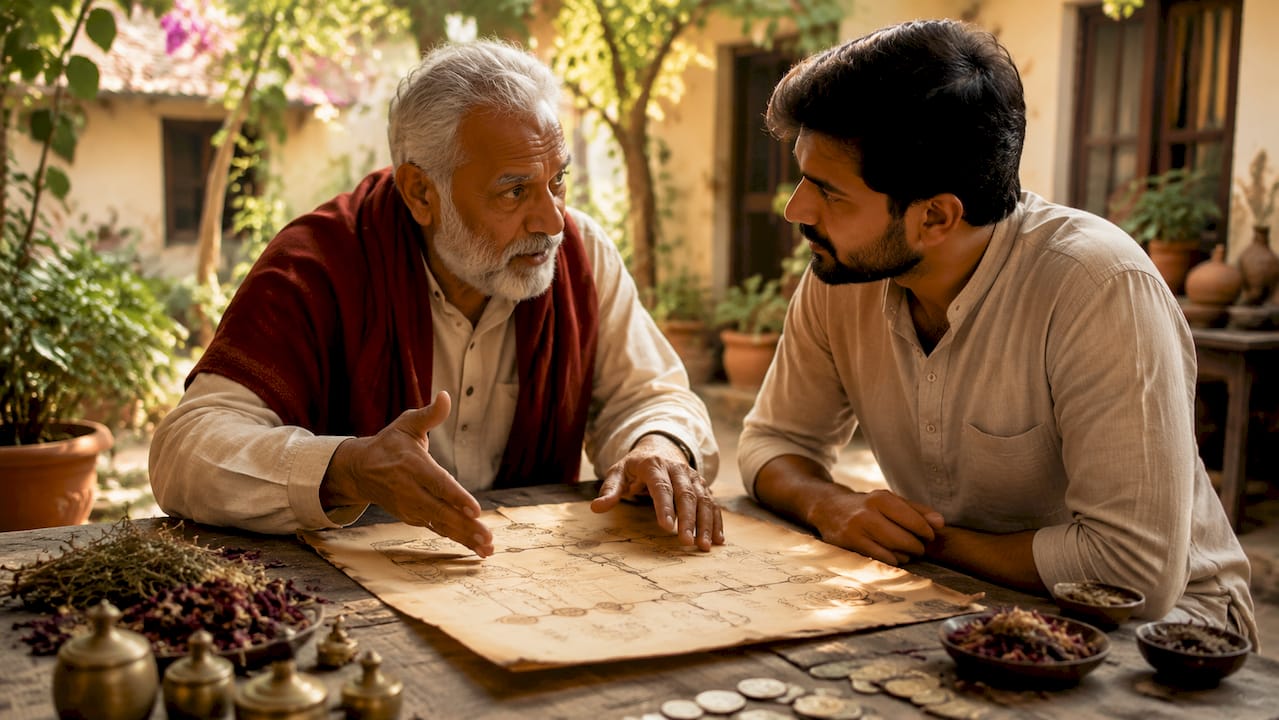
Pro Tip: Apply the 1,000-day rule by setting a calendar reminder 36 months from your launch date. Before that date, ban yourself from making any major pivot or closure decision based on revenue alone. Track learning milestones instead.
How does seven-generational planning influence strategic leadership?
The Iroquois seven-generational planning tradition reframes business goals toward 100-year viability rather than quarterly earnings. This is not metaphor. It is a forcing function that changes which decisions feel rational. When you ask “Will this choice serve my great-great-grandchildren?” you automatically filter out extractive, short-sighted strategies.
Leaders who integrate this framework into their planning process report fundamentally different priorities:
- Stakeholder definition expands. Nature becomes a stakeholder. Communities become partners. Employees become legacy assets, not cost centers.
- Risk tolerance shifts. Short-term losses become acceptable if they protect long-term positioning.
- Brand identity deepens. Businesses built on generational values attract customers who share those values, creating loyalty that advertising cannot buy.
Hawaiian Huna principles operate similarly. Leaders blending Huna ancestral principles into business report a 40% increase in client retention. That number reflects something real: when a business communicates through values that feel ancient and trustworthy, clients stay longer. They are not just buying a product. They are affiliating with a worldview.
Maori business philosophy takes this further by reframing nature as a senior relation, requiring economic activity to respect environmental limits. This resolves the sustainability paradox that plagues modern corporations. You cannot exploit what you consider family.
Pro Tip: To integrate seven-generational thinking into your corporate culture, add one standing question to every quarterly strategy meeting: “How does this decision look in 25 years?” You do not need to answer it perfectly. You need to ask it consistently.
What advantages do ancestral knowledge systems provide as strategic resources?
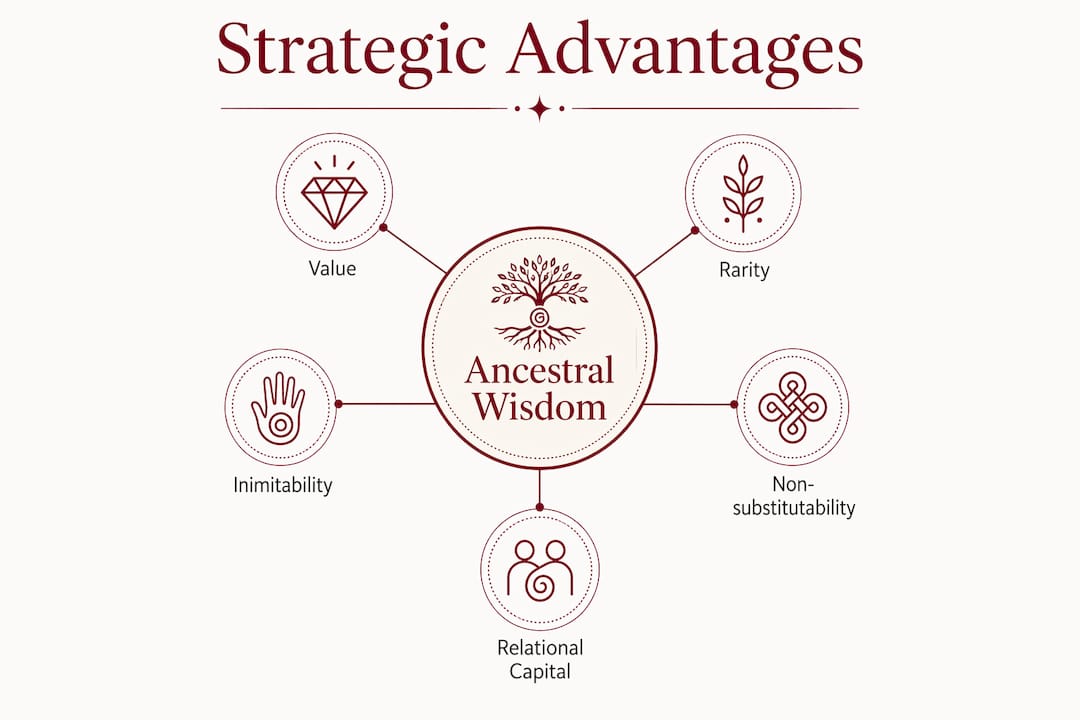
Ancestral knowledge systems act as VRIN resources for SMEs, meaning they are Valuable, Rare, Inimitable, and Non-substitutable. These are the four qualities that define a true competitive advantage in strategic management theory. Most businesses compete on resources that are easy to copy. Ancestral knowledge cannot be copied because it is embedded in specific cultural histories, relationships, and practices.
| Resource Type | Mechanism of Advantage | Business Application |
|---|---|---|
| Relational capital | Trust built through community ties | Loyal customer networks, informal credit access |
| Substitutive knowledge | Fills gaps where formal institutions fail | Dispute resolution, supplier relationships |
| Innovative knowledge | Combines old wisdom with new science | Novel products, differentiated market positioning |
| Tacit knowledge | Embedded in practice, hard to codify | Proprietary processes, craft quality |
Indigenous-operated businesses in the native bush food industry represent about 2% of a market projected to grow into the billions. That 2% figure is deceptive. It represents businesses with near-zero competition on authenticity, deep supplier relationships built over generations, and product stories that no competitor can replicate. Ancestral knowledge provides inimitable strategic resources that fill market gaps unavailable to firms relying on conventional frameworks.
The challenge is codification. Writing down tacit knowledge risks stripping it of the cultural context that makes it powerful. The solution is not to fully codify but to document enough to train the next generation while preserving the living practice alongside the written record.
How can entrepreneurs revive ancestral wisdom to drive innovation?
Restoring, reviving, and renewing traditional knowledge enables businesses to create novel products by combining old wisdom with modern science. This process is called recombinant innovation, and it follows three phases that any entrepreneur can apply.
- Restore: Recover the original traditional knowledge through oral histories, elder interviews, archival research, and community engagement. This phase is about listening, not building. Family businesses with multigenerational roots often skip this step and lose the depth that makes their heritage valuable.
- Disrupt: De-embed the knowledge from its original context and identify which principles transfer to modern markets. The Mexican mezcal industry demonstrates this precisely. Combining traditional techniques with modern science has enhanced quality, improved sustainability, and strengthened rural communities simultaneously. The traditional knowledge did not disappear. It became more powerful when paired with analytical tools.
- Reconfigure: Build new products, services, or business models that carry the ancestral insight in a form modern customers can access. Technology, including AI, now plays a real role here. AI tools can help catalog oral traditions, identify patterns across generations of practice, and surface insights that would otherwise remain invisible.
The cultural insights for success that emerge from this process are not generic. They are specific to your heritage, your community, and your market. That specificity is the advantage.
Pro Tip: The most common mistake in heritage-based innovation is aestheticizing the tradition rather than operationalizing it. Using an ancestral symbol as a logo is decoration. Using an ancestral decision-making framework as your planning process is strategy. Focus on the latter.
How does ancestral emotional wisdom inform risk management?
Traditional business wisdom advises entrepreneurs to treat fear as data and use ancestral teachings like Chanakya Niti to convert anxiety into actionable intelligence. Chanakya, the ancient Indian strategist whose work dates to roughly 300 BCE, built an entire framework for navigating uncertainty in commerce and governance. His core insight is that emotional states are not obstacles to good decisions. They are inputs.
Ancestral wisdom traditions across cultures share a consistent approach to the emotions that entrepreneurs face most often:
- Fear signals that you have identified a real risk. Investigate the source before acting. Do not suppress it or react to it impulsively.
- Impatience signals misalignment between your timeline and reality. Return to the 1,000-day framework and recalibrate expectations.
- Doubt signals incomplete information. Seek counsel from your community, your mentors, or your heritage practices before committing.
- Confidence signals momentum. Use it to act, but verify it against your long-term values before scaling.
This approach integrates naturally with modern business analytics. Data tells you what is happening. Ancestral emotional intelligence tells you what it means for your people, your community, and your legacy. The combination produces decisions that are both numerically sound and humanly wise. Exploring how cultural roots strengthen leadership is one of the most underutilized advantages available to entrepreneurs today.
Key takeaways
Ancestral wisdom guides business success by providing time-tested frameworks for endurance, ethical leadership, and community-centered strategy that modern business schools do not teach.
| Point | Details |
|---|---|
| Commit to the 1,000-day rule | Evaluate business viability only after 36 months of immersion, iteration, and compounding. |
| Plan for seven generations | Reframe strategy around 100-year viability to filter out extractive, short-sighted decisions. |
| Treat ancestral knowledge as VRIN | Heritage-based resources are inimitable and create competitive advantages no competitor can replicate. |
| Use recombinant innovation | Restore, disrupt, and reconfigure traditional knowledge to build differentiated modern products. |
| Treat fear as business data | Ancestral teachings like Chanakya Niti convert emotional signals into wiser risk management. |
Why heritage is the most underrated business asset i know
Most entrepreneurs I have worked with arrive carrying two things: a business plan and a disconnection from everything their ancestors knew about building something that lasts. The business plan gets revised constantly. The disconnection stays.
What I have observed over decades is that the entrepreneurs who build something truly durable are not the ones with the best spreadsheets. They are the ones who know where they come from. They carry a sense of obligation that extends backward and forward in time, not just to this quarter’s numbers.
The Marwari 1,000-day rule is not just a patience strategy. It is a transmission of hard-won knowledge from generations of merchants who learned that trust compounds slower than revenue but lasts longer than any single transaction. Seven-generational planning is not nostalgia. It is the most rigorous long-term strategy framework I have ever encountered, and it predates every MBA curriculum by centuries.
The uncomfortable truth is that most modern business frameworks optimize for speed and scale at the expense of depth and endurance. Ancestral wisdom optimizes for the opposite. When you blend both, you get something rare: a business that grows fast enough to survive and deep enough to last.
Heritage is not a story you tell on your website. It is a living resource you draw from when the market turns, when your team loses faith, or when you face a decision that no spreadsheet can resolve. Treat it that way, and it will serve you the way it served every generation before you.
— Psychic
Connect your business energy with ancestral abundance
Entrepreneurs who study ancestral wisdom often discover that the intellectual work is only part of the transformation. The energetic alignment matters too.
Motherodessa has spent 40+ years working with business owners, founders, and leaders who need more than strategy. They need clarity, protection, and renewed purpose. Her spiritual healing rituals are designed specifically for people navigating high-stakes decisions, generational patterns, and the kind of uncertainty that no business framework fully addresses. For entrepreneurs ready to align their inner resources with their outer strategy, Motherodessa’s money and abundance rituals offer a personalized path rooted in West African tradition. Every ritual is customized. No two are the same.
FAQ
What is ancestral wisdom in a business context?
Ancestral wisdom in business refers to inherited knowledge systems, values, and decision-making frameworks passed down through cultural traditions. These include practices like the Marwari 1,000-day rule, Iroquois seven-generational planning, and Chanakya Niti, each offering tested strategies for endurance and ethical leadership.
Can ancestral teachings actually improve profits?
Yes. Leaders integrating Hawaiian Huna ancestral principles into business report a 40% increase in client retention, which directly impacts revenue. Ancestral knowledge also creates inimitable competitive advantages that protect market position over the long term.
How does the marwari 1,000-day rule work for startups?
The 1,000-day rule requires founders to commit to three years before judging success, starting with 6–12 months of market immersion rather than profit pursuit. This prevents premature closure during the hardest and most instructive phase of building a business.
What is seven-generational planning and who uses it?
Seven-generational planning is an Iroquois tradition that reframes business strategy around 100-year viability rather than short-term financial gains. Modern entrepreneurs and sustainability-focused companies use it to align decisions with long-term legacy and ethical stewardship.
How do i start applying old-world strategies in my business?
Begin with the recombinant innovation process: restore your heritage knowledge through elder interviews and archival research, identify which principles transfer to your market, then build products or processes that carry that wisdom in a modern form. Pair this with abundance rituals for business owners to align your energy with your strategy.