
A jinx is a small, short-lived disruption. A hex is a deliberate, targeted working meant to cause sustained pressure on one person. A curse is the heaviest category: broad, long-lasting, and sometimes generational. The distinction that actually matters is severity and duration, not vocabulary, and the sections below walk through how to tell which one you’re facing and what to do about it.
TL;DR:
- Jinxes are impulsive, short-lived disruptions that typically resolve within days through simple cleansing, while hexes require targeted reversal over weeks or months.
- Curses affect multiple life areas, can last years or generations, and often need complex, staged removal with professional diagnostic work.
- Identifying whether you face a jinx, hex, or curse involves mapping the problem’s scope, timeline, and potential caster motive before choosing a removal method.
- Simple home cleanses work for jinxes, but heavier workings like curses need tailored rituals and follow-up protection to prevent reattachment.
- Professional diagnosis is recommended when issues persist across years and family lines, as this ensures appropriate, effective removal and minimizes energetic backlash.
Table of Contents
- Hex vs Curse: What Each Term Actually Means
- How Do Jinxes, Hexes, and Curses Actually Compare?
- How Do You Know Which One You’re Dealing With?
- Where Do Hex and Curse Come From?
- How to Remove a Jinx, Lift a Hex, or Break a Curse
- Why Proportionality and Containment Matter
- How a Practitioner Actually Triages a Case
- The Real Problem With How This Gets Taught
- When Professional Diagnostic Work Makes Sense
- Sources
- FAQ
Hex vs Curse: What Each Term Actually Means
Practitioners rarely agree on every fine point of terminology, but a working hierarchy has emerged across most contemporary craft traditions: jinx sits at the light end, hex in the middle, curse at the heavy end. Here’s how each one breaks down in practice.
A jinx is usually a minor, often impulsive disruption. It can come from an offhand curse word muttered in anger, a passing evil-eye glance, or low-grade negative energy that clings without real intent behind it. Jinxes tend to be short in duration, mild in material requirements (such as a pinch of salt or a quick word), and highly reversible. Most resolve on their own relatively quickly if left alone, and faster with a simple cleanse.
A hex is different. It requires a caster with actual intent, usually aimed at one specific person, and it’s built to hold. Hexes get “fed,” meaning the caster or the working itself sustains the pressure over time rather than firing once and fading. Common examples include a targeted working meant to sabotage a relationship, stall someone’s finances, or cause a run of bad luck that keeps circling back to the same area of life. Because a hex has deliberate intent behind it, removing one takes more than a bath and a candle.
A curse is the broadest and most serious category. Scope matters here more than intensity: a curse can touch multiple areas of a person’s life at once (health, money, relationships, luck) and can run for years. Some curses are generational, passed down a family line through inherited patterns rather than a single casting event. That’s why recurring family tragedy often signals a curse rather than a coincidence of bad luck. Curse work is reserved for serious situations precisely because of that scope, and because undoing one usually means addressing root causes, not just symptoms.
Two clarifications come up constantly:
- Binding vs. curse: a binding spell restrains or stops an action (a person from causing harm, a habit from repeating). It doesn’t inflict consequences the way a curse does, and most practitioners consider it lower risk.
- Evil eye vs. jinx: the evil eye is typically unintentional, cast through envy or admiration rather than malice, and functions more like a mild jinx than a targeted working.
How Do Jinxes, Hexes, and Curses Actually Compare?
Once you understand the definitions, the practical question becomes: how do you compare them on the ground? Six factors do most of the work.
- Intent: jinxes often lack deliberate intent; hexes and curses require it.
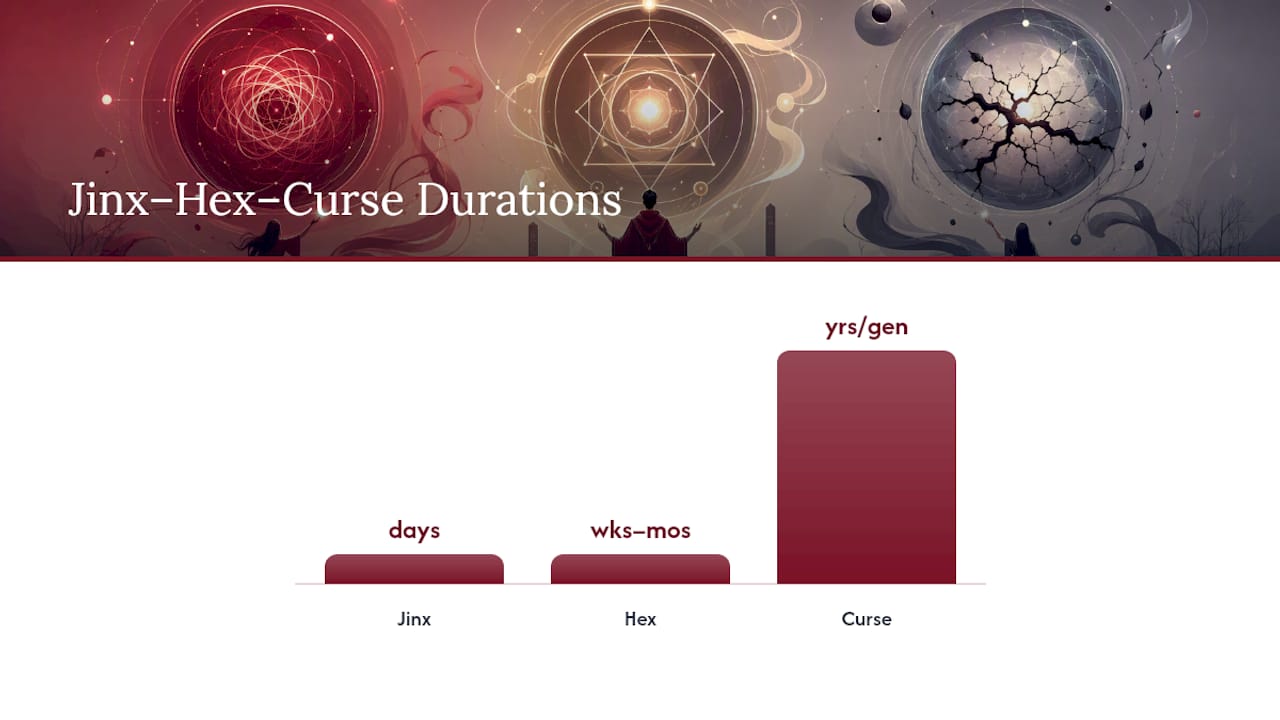
- Duration: jinxes fade in days; hexes run weeks to months; curses can persist for years or generations, according to comparative guides like DefinePagan’s breakdown of curse, hex, and jinx timelines.
- Scope: jinxes hit one small incident; hexes target one person’s specific life area; curses can spread across multiple domains at once.
- Reversibility: jinxes are usually easy to lift; hexes need targeted reversal work; curses often require extended, staged removal.
- Risk to the caster: light jinxing carries minimal blowback; hexing carries moderate risk; cursing carries the highest risk of energetic backlash if done without containment.
- Typical materials: salt and quick candle work for jinxes, uncrossing oils and name-based reversal for hexes, ancestral work and multi-session ceremonies for curses.
A few scenarios make this concrete. Someone snaps “I hope your car breaks down” at a driver who cut them off, and the car actually breaks down that week. That’s a jinx: impulsive, unintended, low-stakes. A jealous coworker who deliberately works against your promotion for months, and your career stalls in ways that track suspiciously with their behavior, points toward a hex. A family where every generation loses a marriage to infidelity, every business fails within three years, and health problems repeat down the line suggests something with far more scope than a single hex, which is where curse work and generational curse breaking enter the conversation.
The simple rule of thumb: if it’s an isolated incident, treat it as a jinx first. If a specific person had motive and it’s hitting one area repeatedly, treat it as a hex. If it’s spread across multiple life areas over years or repeats down a family line, that’s curse territory.
How Do You Know Which One You’re Dealing With?
Run through this before you commit to a full removal ritual. Guessing wrong wastes time and, in the case of curse work, unnecessary exposure.
- Map the scope. Is the problem confined to one area (a single relationship, one job) or is it bleeding across multiple parts of your life at once?
- Check the timeline. Did trouble start suddenly after a specific conflict, or has it built gradually over months or years?
- Look for a plausible caster. Does someone have both motive and a believable means to have worked against you? Learn Religions recommends this exact check before assuming magical causation, since ordinary bad luck gets misattributed to curses constantly.
- Test with a small intervention. Run a basic salt bath or a short cleanse and watch for change over a week. Jinxes respond fast. If nothing shifts, you’re likely dealing with something heavier.
- Watch for generational patterns. If the same misfortune has repeated across your parents’ and grandparents’ lives, that’s a strong signal you’re looking at entrenched, ancestral-level work rather than a recent hex.
Pro Tip: Keep a simple log for a week before you act. Note dates, what happened, and who was around. Patterns that look random day to day often reveal a clear shape once you see them written down.
Where Do Hex and Curse Come From?
The word “hex” traces back to the German hexen, meaning “to practice witchcraft,” and it entered American English largely through Pennsylvania German folk traditions, where hex signs and protective symbolism were common. Curses have a much older paper trail. Mesopotamian curse tablets and Roman defixiones, thin sheets of lead inscribed with the caster’s demands and buried or thrown into wells, date back thousands of years and show that curse work as a documented practice long predates modern witchcraft. “Jinx” has murkier linguistic roots, possibly tied to the jynx (the wryneck bird used in ancient Greek love magic), though its casual, superstitious modern usage is a much later development.
Different traditions carve up baneful work differently, and none of them is “more correct” than the others:
- Hoodoo distinguishes crossing, jinxing, and cursing with specific root and conjure techniques for each.
- European folk magic leans on the evil eye and binding as its own separate categories.
- Islamic tradition addresses harmful magic through ruqyah, a practice distinct from Western hex/curse language entirely.
None of this makes the jinx/hex/curse framework universal truth. It’s a working vocabulary, useful because it helps practitioners triage and respond appropriately, not because it’s the one correct map of how baneful energy behaves.
How to Remove a Jinx, Lift a Hex, or Break a Curse
Removal scales with severity, and trying to skip straight to heavy-duty curse work for a minor jinx wastes effort. Match the tool to the actual problem, as Shadow Grimoire’s comparison of jinxes, hexes, and curses puts it.
For a jinx, start simple:
- Take a salt bath (sea salt dissolved in warm water) and soak for at least fifteen minutes.
- Clear your space with smoke from rosemary, sage, or a similar clarifying herb.
- Run cold water over your hands and wrists while stating an intention to release what’s clinging to you.
- Light a simple white candle and let it burn down completely as a closing gesture.
Full instructions for a fast home approach are laid out in this rootwork guide to removing a hex with salt, smoke, and lemon, which also works as a first-line jinx cleanse.
For a hex, you need targeted reversal, not just general clearing:
- Use an uncrossing oil applied to pulse points and doorways to interrupt the working’s hold.
- Perform name-based reversal work if you know or strongly suspect who cast it.
- Cut the energetic cord between you and the source, a technique explained in detail in this guide to safe cord-cutting methods and aftercare.
- Carry or wear a protective talisman for several weeks afterward to prevent re-attachment.
A full banishing ritual walkthrough covers this staged approach with more detail than a single cleanse can offer.
For a curse, the approach changes entirely. This is where DIY methods usually fall short, because curses frequently involve ancestral patterns that a bath and a candle can’t touch. Effective curse-breaking generally requires a proper diagnostic first (to confirm scope and origin), followed by an extended removal ceremony, and then a containment phase to prevent the pattern from reattaching. Staged aftercare matters just as much as the initial removal. A curse lifted without follow-up protection often risks returning over time.
Aftercare, regardless of severity: repeat cleanses monthly if you live or work in a high-conflict environment, keep protective charms current, and treat any sudden return of old symptoms as a signal to reassess rather than assume the first removal simply “wore off.”
Pro Tip: Never layer a new cleanse on top of an unfinished one. Finish one removal approach fully, wait a few days, and reassess before starting another. Stacking half-finished workings is a common reason people report inconsistent results.
Why Proportionality and Containment Matter
The single biggest mistake beginners make is escalating straight to curse work when a jinx or hex would have solved the problem. Heavier workings carry real risk of energetic blowback, and practitioner consensus is consistent on this point: containment and reversal protections should be in place before you cast anything with real weight behind it, not improvised afterward.
A few rules of thumb keep this proportional:
- Match the weight of your working to the actual scale of the problem. Minor or short-term issues typically don’t call for curse-level intervention.
- Consider consent and consequence before acting. Heavier workings affect more of another person’s life, which raises the ethical stakes considerably.
- Don’t mix systems carelessly. Combining Hoodoo root work with unrelated European folk techniques without understanding either fully increases the odds of a working misfiring.
- When in doubt, choose the safer alternative: a binding to stop harmful behavior, or a legal remedy and firm boundary, rather than a curse.
There’s no clean statistic on how often blowback occurs, but the pattern shows up consistently enough in practitioner accounts that experienced workers treat containment planning as mandatory, not optional, for anything above hex-level intensity. Beginners consistently underestimate this risk, which is precisely why the heavier the working, the more essential pre-existing protections become.
How a Practitioner Actually Triages a Case
A real diagnostic workflow doesn’t start with a ritual. It starts with a reading to establish what’s actually happening, followed by a check for ancestral or generational patterns, and only then a containment plan if the situation warrants heavier work.
When someone comes to me convinced they’re cursed, the first thing I look at isn’t the symptoms. It’s the pattern across their family line and the actual timeline of when things started going wrong. Most of what people call a curse is a hex that’s been left untreated long enough to spread. The real curses, the generational ones, look different from the start. They touch every area of a person’s life at once, not just the one thing that’s stressing them out today.
That’s the practical difference between recommending a home cleanse and recommending an extended curse removal ceremony. A single-area problem with a clear recent trigger usually responds to targeted hex work. A multi-area, long-running, or family-wide pattern needs a full diagnostic before any removal work begins, because treating a curse like a hex just delays the real fix.
The Real Problem With How This Gets Taught
Most explanations of jinx, hex, and curse stop at definitions and leave readers to guess what to actually do next. That’s backward. The definitions matter less than the diagnostic: what changed, when, and how far it’s spread. Get that wrong and you’ll either underreact to something entrenched or overreact to something that would have cleared on its own in a week.
The conventional advice to “just cleanse and see” is fine for jinxes and weak on everything past that. Hexes need targeted reversal aimed at a specific source, not general clearing. Curses need root cause work, often ancestral, that a bath was never going to touch. If there’s one thing worth prioritizing first, it’s the motive and probability check: before assuming you’re cursed, ask honestly whether someone had both reason and opportunity to work against you. That single question saves more people from unnecessary escalation than any ritual does.
— Psychic
When Professional Diagnostic Work Makes Sense
Home cleanses handle a real jinx well, and targeted reversal work handles most hexes. But when the pattern spans years, repeats across generations, or touches multiple areas of your life at once, guesswork gets expensive fast, both in time and in unnecessary exposure. Some practices focus on offering an honest assessment of your situation before committing to heavier work.

A typical professional package starts with a full spiritual diagnostic reading to establish scope and origin, followed by a ritual tailored to what the diagnostic actually finds, not a generic template pulled off a shelf. That distinction matters most for generational patterns, complex curses, or safety concerns where a wrong guess costs months. This approach draws on West African spiritual traditions and extensive personal practice, with each working tailored to the specific situation rather than using a one-size-fits-all script.
If you suspect something has settled in deeper than a jinx or a passing hex, start with the Generational Curse Breaking Ceremony or explore the full range of custom diagnostic and ritual services to find the right starting point for your case.
Sources
- Online Etymology Dictionary — ‘hex’
- Learn Religions — Breaking curses or hexes
- DefinePagan — Difference Between a Curse, Hex and Jinx Explained
- Shadow Grimoire — Jinx, Hex and Curse: What’s the difference?
FAQ
Is a Curse Worse Than a Hex?
Yes. A curse is broader in scope and can last years or span generations, while a hex is typically targeted at one person and one area of life, resolving in weeks to months with proper reversal work.
What Are the Three Types of Baneful Workings?
The common hierarchy used in contemporary practice is jinx, hex, and curse, ranked from lightest and shortest to broadest and longest-lasting.
How Do You Cleanse a Hex or Curse?
A hex typically responds to targeted reversal work like uncrossing oils, name-based reversal, and cord-cutting, while a genuine curse usually requires a professional diagnostic followed by extended ceremonial removal and staged aftercare.
Is Hexing Someone Illegal?
Casting a hex isn’t illegal in the United States, since spiritual workings aren’t a criminal act. Threatening or harassing someone alongside it, however, can carry legal consequences independent of any spiritual practice.
Can a Curse Actually Be Broken?
Yes, though it usually takes more than a single ritual. Effective curse-breaking typically involves a proper diagnostic, addressing root or ancestral causes, and staged aftercare, which is why services like Motherodessa’s Full Custom Ritual build in follow-up rather than a one-time fix.