
Long-term guidance is defined as a sustained, ongoing relationship between a client and a guide that deepens in trust, precision, and impact over months and years. Research across healthcare, psychology, and financial advising confirms that repeat clients who maintain continuous relationships with their guides experience measurably better outcomes than those who engage in isolated, one-off sessions. The advantages of long-term coaching are not simply about more time spent. They reflect a compounding effect where trust, shared understanding, and goal alignment build on each other with every interaction. For anyone seeking spiritual growth, this distinction matters enormously.
Why repeat clients benefit from long-term guidance through trust
Sustained relationships change the nature of guidance itself. When a client returns repeatedly, the guide accumulates a detailed picture of that person’s values, fears, patterns, and history. That knowledge cannot be replicated in a single session, no matter how skilled the practitioner. Research on long-term advice relationships confirms that clients report emotional reassurance and reduced stress specifically because their guide already understands the context behind every new challenge they bring.
This depth of understanding produces something qualitatively different from what short-term engagement offers. A guide who has worked with you through a difficult period, a major life transition, or a recurring spiritual block does not need to start from scratch each time. The relationship carries memory, and that memory becomes a resource. Clients value long-term partnerships where satisfaction, trust, and confidence build through life milestones in ways that a single consultation simply cannot replicate.
The emotional dimension of this trust is not soft or secondary. It is a functional asset. When clients feel genuinely known by their guide, they are more willing to be honest about setbacks, more open to difficult feedback, and more consistent in following through on practices between sessions. That consistency is where real transformation happens.
“Continuity helps guides understand client values, histories, and triggers in ways that make every subsequent session more targeted and more effective.”
Key benefits of sustained trust in long-term guidance include:
- Guides can identify recurring patterns that only become visible across multiple sessions
- Clients feel safe enough to share information they might withhold from a new practitioner
- Emotional reassurance compounds over time, reducing anxiety around the guidance process itself
- Personalized support becomes more precise as the guide’s understanding deepens
Pro Tip: When starting with a new spiritual guide, commit to at least six sessions before evaluating whether the relationship is working. Trust and depth take time to build, and early sessions are often the foundation rather than the full picture.
What does research say about continuity and long-term outcomes?
The evidence supporting sustained guidance relationships is not limited to anecdote. Clinical and psychological research consistently shows that continuity produces measurable improvements in adherence, mental health, and relapse prevention. These findings translate directly to the spiritual guidance context, where the same mechanisms of trust, familiarity, and goal alignment are at work.
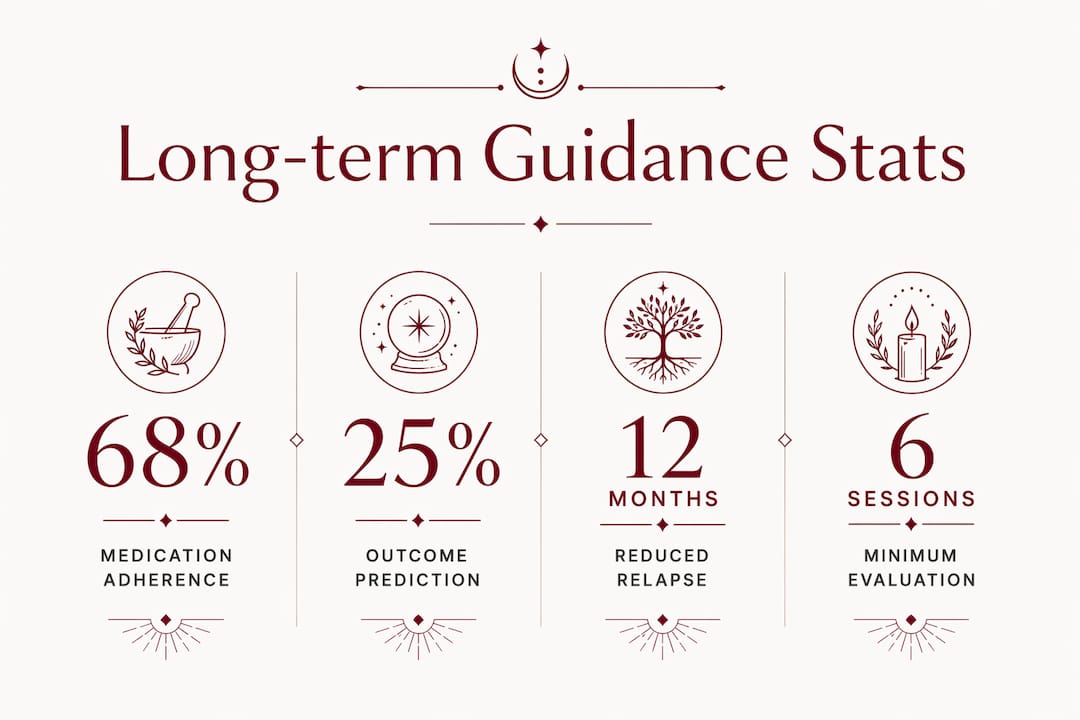
A study on coronary heart disease patients found that continuity of care improved medication adherence rates from 67.5% to 86.3% and reduced six-month cardiovascular readmission risk from 16.4% to 5.5%. That gap is not marginal. It reflects how much better people follow through on practices when they have an ongoing, trusted relationship with their guide rather than fragmented, episodic contact.
Mental health outcomes follow the same pattern. Continuity of care mechanisms reduce anxiety and depression by enabling ongoing understanding tailored to individual histories. For spiritual clients navigating grief, generational trauma, or relationship ruptures, this kind of tailored, continuous support is not a luxury. It is the condition under which lasting change becomes possible.
Research on psychodynamic psychotherapy adds another dimension. Long-term psychotherapy reduces relapse risk at 12 months by 22%, with a number needed to treat of approximately five to six people. That means for every six people who commit to long-term support, one additional person avoids a full relapse compared to shorter interventions. The implication is clear: duration is not just a preference. It is a protective factor.
The following table summarizes key research findings on continuity and long-term guidance outcomes:
| Study area | Key finding | Implication for guidance |
|---|---|---|
| Coronary heart disease continuity | Adherence improved from 67.5% to 86.3% with continuous care | Ongoing relationships drive follow-through on practices |
| Cardiovascular readmission risk | Reduced from 16.4% to 5.5% with continuity | Sustained support prevents costly setbacks |
| Psychodynamic psychotherapy | 22% lower relapse risk at 12-month follow-up | Long-term engagement protects gains made in early sessions |
| Therapeutic alliance meta-analysis | Task/goal alignment predicts outcomes at r=0.25 | Shared goals matter more than emotional rapport alone |
| Telehealth behavioral health program | Over 70% of patients who attended at least one visit established follow-up care | Structured continuity improves real-world engagement |
A meta-analysis on therapeutic alliances found that task and goal alignment between client and guide predicts outcomes at r=0.25, compared to r=0.12 for emotional bond alone. This means that feeling connected to your guide matters less than being aligned with them on what you are working toward and how. That alignment deepens naturally over time, which is another reason repeat clients consistently outperform one-time visitors.
Short-term vs. long-term guidance: why duration changes everything
The difference between a single session and a sustained relationship is not just quantitative. It is structural. Some benefits of guidance simply do not appear until behavioral patterns have had time to stabilize, which research suggests takes at least six months of consistent engagement. Expecting transformation from one or two sessions is like expecting a garden to bloom the day after planting seeds.

Long-term benefits typically materialize only after sustained behavioral pattern establishment, with positive effects appearing six months or later after continuous engagement. For spiritual clients working on breaking generational curses, healing relationship wounds, or building financial abundance, this timeline is not discouraging. It is clarifying. It tells you where to invest your energy.
Switching guides or approaches too early is one of the most common ways clients undermine their own progress. When you change direction before a pattern has had time to consolidate, you reset the clock. The new guide starts without context, the client re-explains their history, and the momentum built in earlier sessions is lost. This is why evaluating effectiveness requires follow-up windows of at least 12 months to capture relapse prevention and durable benefits beyond initial symptom reduction.
Here is a practical framework for understanding why duration matters:
- Months one to three: The guide learns your patterns, history, and goals. You learn how to use the relationship. This is foundation-building, not transformation.
- Months three to six: Behavioral patterns begin to shift. You start applying guidance between sessions. Early results appear, but they are fragile without continued support.
- Months six to twelve: Gains consolidate. The guide can now anticipate your challenges before you articulate them. Relapse risk drops significantly during this window.
- Beyond twelve months: The relationship becomes a long-term container for growth. New life challenges are met with accumulated wisdom from the shared history.
Pro Tip: If you feel like progress has stalled around month three or four, do not switch guides. That plateau is often the moment just before a significant shift. Discuss it openly with your guide instead.
How long-term guidance supports ongoing personal growth
Sustained guidance does more than prevent relapse. It actively builds the conditions for compounding growth. Each session adds a layer of self-knowledge, refined practice, and recalibrated goals that make the next session more productive. This is the core mechanism behind one-on-one spiritual counsel and why it consistently outperforms group or generic formats for clients with specific, personal transformation goals.
Goal and task alignment is the engine of this growth. Research confirms that shared task and goal agreement in guidance relationships drives better outcomes, indicating the importance of collaborative goal alignment over time. In practice, this means that long-term clients and their guides regularly revisit what they are working toward, adjust practices to reflect life changes, and build on completed goals rather than recycling the same starting point.
The practical benefits of sustained spiritual guidance for personal growth include:
- Regular sessions create accountability structures that make spiritual practices more consistent
- Guides can adapt rituals and recommendations as clients move through different life stages
- Emotional and behavioral shifts become more durable when reinforced across multiple sessions
- Clients develop a clearer personal spiritual language over time, making communication with their guide more precise
- Long-term relationships allow guides to track subtle changes that signal either progress or emerging challenges
For clients working with Motherodessa, this sustained approach means that each ritual, each consultation, and each follow-up builds on the last. The types of personalized spiritual consultations available in 2026 reflect this philosophy directly. No two clients receive the same approach, and no two sessions are identical, because the guide’s understanding of the client evolves continuously.
Key takeaways
Repeat clients benefit from long-term guidance because continuity builds trust, aligns goals, and creates the conditions for durable transformation that isolated sessions cannot produce.
| Point | Details |
|---|---|
| Trust compounds over time | Clients who return repeatedly receive more precise, personalized support as their guide’s understanding deepens. |
| Research supports duration | Continuity improves adherence from 67.5% to 86.3% and reduces relapse risk by 22% at 12 months. |
| Six months is the threshold | Meaningful behavioral change typically requires at least six months of consistent engagement to stabilize. |
| Goal alignment drives outcomes | Task and goal agreement between client and guide predicts outcomes more strongly than emotional rapport alone. |
| Switching early resets progress | Changing guides before patterns consolidate eliminates accumulated context and delays transformation. |
What 40 years of working with returning clients has taught me
The most profound transformations I have witnessed have never come from a single session, no matter how powerful that session was. They have come from clients who returned, who trusted the process enough to stay through the plateaus, and who allowed the relationship to deepen past the surface of their presenting problem.
What I have learned is that the first few sessions reveal what a client thinks they need. The sessions after that reveal what they actually need. Those are rarely the same thing. A client who comes seeking help with a relationship may be carrying a generational wound that has nothing to do with their current partner. A client seeking financial abundance may be unconsciously honoring a family belief that wealth is dangerous. These layers only become visible over time, and they only become workable when the client trusts you enough to go there.
Patience is not passive in this work. It is a discipline. Staying consistent with a client through a difficult stretch, when they are frustrated or doubtful, is often the most important thing a guide can do. That consistency communicates something that no single ritual can: that their growth is worth sustained attention. That message, received over months and years, changes people at a level that one-off sessions simply cannot reach.
The science confirms what practice has always shown. Continuity is not a preference. It is the mechanism.
— Psychic
Begin your long-term spiritual transformation with Motherodessa
Motherodessa’s approach to spiritual healing is built on exactly the principles this article describes: personalized, sustained, and rooted in 40 years of experience with clients navigating love, abundance, protection, and generational healing. Every ritual is customized to your specific situation, and no two clients receive the same guidance. That customization deepens with every session, which is why so many clients return and why their results compound over time.
Whether you are seeking clarity, financial abundance, or protection from negative influences, Motherodessa’s spiritual healing services offer a structured path to lasting transformation. For clients focused on prosperity, the money and abundance rituals provide targeted support that evolves with your goals. Start your long-term journey today.
FAQ
Why do repeat clients get better results than first-time clients?
Repeat clients benefit from accumulated context. Their guide understands their history, patterns, and goals, which makes every session more targeted and every recommendation more precise than what a first-time interaction can offer.
How long does it take to see real results from long-term guidance?
Research shows that meaningful behavioral change typically requires at least six months of consistent engagement to stabilize. Benefits including relapse prevention become measurable at the 12-month mark.
What makes goal alignment so important in a guidance relationship?
Studies find that task and goal alignment between client and guide predicts outcomes at r=0.25, which is more than twice the predictive power of emotional bond alone. Shared direction is the engine of progress.
Is it harmful to switch spiritual guides frequently?
Yes. Switching guides before behavioral patterns have consolidated resets the accumulated context and delays transformation. The first months of any guidance relationship are foundation-building, and leaving during that phase means starting over rather than building forward.
How does long-term spiritual guidance prevent relapse into old patterns?
Long-term guidance creates ongoing accountability and allows guides to recognize early warning signs before a full relapse occurs. Psychodynamic research shows a 22% lower relapse risk at 12 months for clients who maintain sustained therapeutic relationships compared to those who do not.