
Your business isn’t dying. It’s plateaued. And there’s a critical difference between those two realities. Understanding what does breaking business stagnation mean is the first step toward doing something about it. Stagnation shows up as flat revenue, slowing sales, and a team that feels stuck in neutral. Most entrepreneurs read those signals as failure. They’re not. They are your business sending a loud, clear message that your current systems have hit their ceiling and need a fundamental redesign.
Table of Contents
- Key Takeaways
- What causes business stagnation and how to spot it
- How to run a friction audit
- Strategies for breaking free from stagnation
- Maintaining momentum after the breakthrough
- My honest take on what breaking stagnation actually requires
- Ready to clear the path forward
- FAQ
Key Takeaways
| Point | Details |
|---|---|
| Stagnation signals change, not failure | A growth plateau means your current systems have reached their limit, not that your business is finished. |
| Internal friction is the real culprit | Redundant processes, approval chains, and founder dependency slow growth more than market conditions. |
| Friction audits reveal hidden bottlenecks | Mapping workflows and applying the Pareto Principle helps you find and fix the 20% of problems causing 80% of delays. |
| Systems beat hustle at scale | Replacing founder-driven effort with documented, delegatable processes is what actually breaks the plateau. |
| Track outcomes, not just activity | Regular performance audits and clear metrics tied to results keep you from sliding back into stagnation. |
What causes business stagnation and how to spot it
Business stagnation is what happens when a company stops growing in revenue, team capacity, or market reach, despite continued effort. It is not a market death sentence. Stagnation is a natural alert signaling that the strategies and structures that got you here are no longer capable of taking you further.
The causes are almost always internal. 70% of business transformation efforts fail due to internal complexity, not external market factors. That means the competition, the economy, and the algorithm are rarely the primary problem. The real culprits tend to be closer to home.
Common causes include:
- Leadership bottlenecks. When every significant decision runs through the founder, the business scales at the speed of one person.
- Outdated systems. Manual processes that worked at 10 clients collapse under the weight of 100.
- Team burnout. Burnout and motivation deficits are measurable contributors to stagnation, not just morale problems.
- Misaligned incentives. When your team’s effort isn’t connected to meaningful outcomes, output drops.
- Internal complexity. Redundant approval layers, duplicated communication, and unclear ownership create friction at every turn.
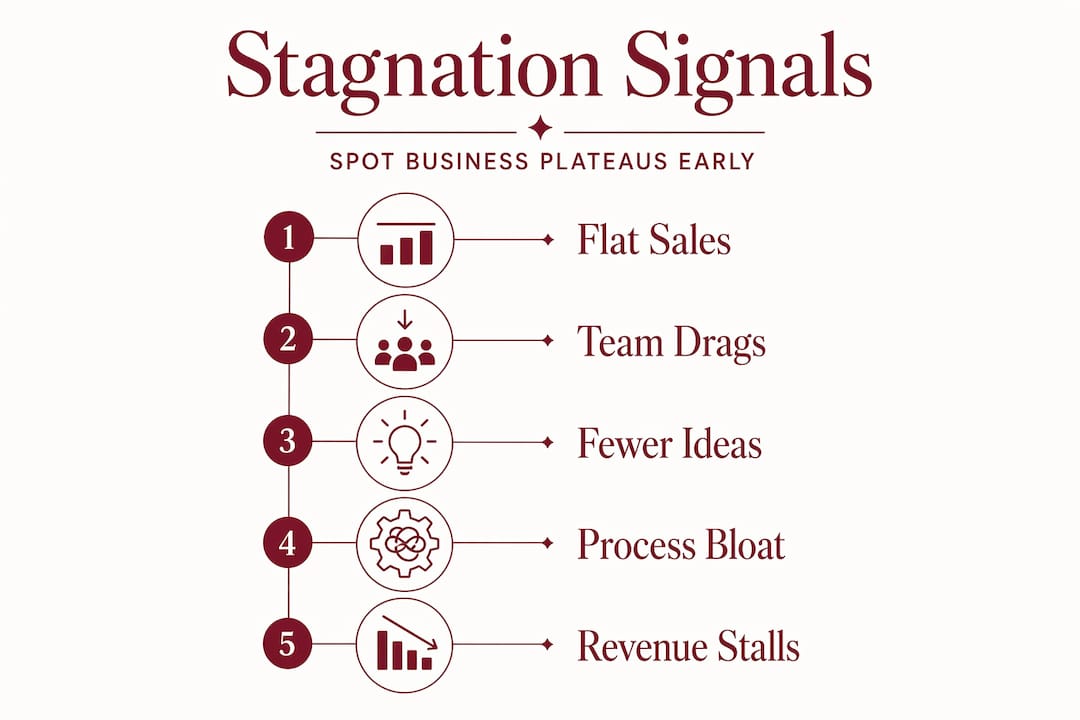
The signs are usually visible before the revenue numbers confirm them. Watch for flat sales that don’t respond to increased marketing spend. Look at declining innovation inside the team. When was the last time someone brought you a genuinely new idea? Notice whether your best people are disengaged or quietly leaving. These are early warning signs that your business has hit a structural wall, not a market one.
The most dangerous misconception is treating stagnation as a signal to push harder. More hustle into a broken system just accelerates burnout without moving the needle.
How to run a friction audit
Before you can fix what’s broken, you need to know exactly where the friction lives. A friction audit is a structured process of mapping your internal operations to find where time, energy, and money are leaking. Internal friction often hides in boring processes like approval chains and redundant reporting. Those are the places most business owners never look.
Here is how to run one:
- Map every core workflow. Document the step-by-step process for your five most critical business functions: sales, onboarding, delivery, reporting, and internal communication. Write out every handoff, every approval, and every tool involved.
- Gather team input. Ask your team one direct question: “What slows you down the most?” They know where the friction is. Most founders are surprised by the answers.
- Measure time and error rates. For each workflow, estimate how long it takes and how often something goes wrong or stalls. Even rough estimates reveal patterns.
- Apply the Pareto Principle. Identify the 20% of process breakdowns causing 80% of your delays and dropped balls. These are your high-impact targets.
- Prioritize by effort and impact. Rank each friction point by how difficult it is to fix versus how much relief it would provide. Quick wins that free up significant capacity should move to the top of the list.
Common high-impact friction points entrepreneurs discover during audits include: managers who approve tasks that don’t require their sign-off, weekly reports that no one reads but everyone spends time creating, onboarding processes with 15 steps that could be reduced to six, and client communication scattered across four different platforms.
Pro Tip: Focus your first month of changes exclusively on the friction points that affect daily operations. Fixing a bottleneck your team hits every single day creates compounding relief fast, which builds the momentum you need to tackle bigger structural changes.
Strategies for breaking free from stagnation
Breaking free from stagnation is not about working harder. It requires redesigning the system your effort flows through. Scaling beyond early success requires replacing founder-driven hustle with documented, scalable systems and processes. That shift feels uncomfortable for most founders. It requires trust, delegation, and a willingness to let go of control that once felt like an advantage.
Here are the core business stagnation strategies that actually move the needle:
- Build documented systems. Every repeatable process should have a written standard operating procedure. This reduces dependency on any one person, including you.
- Train and promote from within. Founder dependency is a critical bottleneck. Invest in developing the people already on your team so they can own decisions without your input.
- Automate manual tasks. Implementing better project management software and automating invoicing creates real capacity for growth. These are not nice-to-haves. They are growth infrastructure.
- Realign incentives. Connect compensation and recognition to outcomes that matter to the business. When team members see a direct link between their work and results, motivation follows.
The leadership evolution piece deserves extra attention. As Intel’s Andy Grove understood, success breeds complacency, and overcoming stagnation requires leaders to embrace innovation instead of minimizing risk. The founders who break through plateaus are the ones who transition from doing the work to designing the system that does the work.
| Approach | Hustle-based | Systems-based |
|---|---|---|
| Decision-making | Centralized with founder | Distributed across trained team |
| Process documentation | In founder’s head | Written SOPs accessible to all |
| Bottleneck location | Single person | Identifiable process steps |
| Scalability | Hits ceiling quickly | Grows with team capacity |
| Burnout risk | High | Significantly reduced |

Pro Tip: Pick one manual process this week and document it in writing. You don’t need a perfect system on day one. You need a starting point that someone other than you can follow.
Small incremental changes build momentum more sustainably than forced heroic efforts. The breakthrough rarely comes from a single dramatic move. It comes from ten small fixes that compound over 90 days.
Maintaining momentum after the breakthrough
Breaking stagnation is one thing. Staying out of it is another. Most businesses that successfully push through a plateau slide back within 18 months because they fixed the symptoms without embedding a culture of ongoing improvement.
The single most reliable tool for maintaining momentum is regular performance data review. Companies that audit performance data regularly are 2.4 times more likely to break growth plateaus, and the same habit keeps them from returning. Weekly or bi-weekly reviews of your key metrics are not bureaucracy. They are your early warning system.
| Metric category | What to track | Why it matters |
|---|---|---|
| Revenue performance | Week-over-week and month-over-month growth | Catches early signs of renewed stagnation |
| Team productivity | Tasks completed per person against output goals | Surfaces emerging bottlenecks before they compound |
| Process efficiency | Average time per workflow cycle | Shows whether system improvements are holding |
| Innovation activity | New ideas tested per quarter | Measures whether culture is staying dynamic |
Track outcomes, not just activity. Hours worked is an activity metric. Revenue per client or delivery cycle time is an outcome metric. The second category tells you whether your systems are actually working.
Frequent performance audits and momentum mapping turn stagnation from a guessing game into a structured process. When you see a metric moving in the wrong direction, you know exactly where to look. That is the difference between a business that grows and one that cycles through plateaus indefinitely.
Build psychological safety into your leadership approach. Teams that feel safe flagging problems early give you the information you need before small issues become expensive ones. That culture does not happen automatically. It requires leaders to visibly reward honesty over comfort.
My honest take on what breaking stagnation actually requires
I’ve worked with enough people stuck at growth ceilings to know the pattern well. The problem is almost never what it looks like on the surface. Owners come in convinced they need a new marketing strategy or a different product line. What they actually need is to stop being the bottleneck in their own business.
In my experience, the biggest barrier to breaking free from stagnation is the emotional attachment founders have to control. They built the thing. They know it best. Letting someone else own a piece of it feels like risk. But that attachment is the friction. It is the reason the business cannot grow past a certain point no matter how hard the founder pushes.
What I’ve seen work, time and again, is the shift from being the operator to being the architect. Stop doing the work. Design the system that does it. That transition is not just strategic. It is deeply personal. It requires you to redefine your value inside your own company. That shift can trigger fear, doubt, and a kind of identity crisis that no one talks about in business articles.
The good news is that once you make it, everything changes. The business breathes. The team steps up. Revenue moves again. Stagnation was never the ceiling. You were standing on it.
— Psychic
Ready to clear the path forward
Sometimes the blocks holding your business back are not just operational. They are energetic. You can redesign every system and delegate every task, and still feel like something unseen is working against your momentum and financial flow.

Motherodessa has spent 40+ years helping people clear the hidden obstacles that no spreadsheet can identify. Whether you are dealing with cycles of financial stagnation or need clarity and focus to lead your next growth phase, her personalized rituals offer a complementary path to the work you are already doing. Explore her spiritual healing services for renewed clarity and direction, or look into her money and abundance rituals if financial flow has felt consistently blocked. No two sessions are the same. Every approach is built around your specific situation.
FAQ
What does breaking business stagnation mean?
Breaking business stagnation means identifying and removing the internal friction, leadership bottlenecks, and outdated systems that have stopped your business from growing. It is a deliberate redesign of how your business operates, not just increased effort.
What are the most common signs of business stagnation?
The most recognizable signs include flat or declining revenue, reduced team motivation, a lack of new ideas, and processes that consistently cause delays. These signals indicate your current systems have hit their structural ceiling.
What causes business stagnation in growing companies?
Research points to internal complexity as the leading cause, with 70% of transformation failures linked to internal factors rather than market conditions. Founder dependency, outdated workflows, and misaligned incentives are the most common culprits.
How long does it take to break business stagnation?
There is no fixed timeline, but businesses that commit to regular performance audits and incremental system fixes typically see meaningful improvement within 60 to 90 days. Consistency matters far more than speed.
Can spiritual practices support breaking business stagnation?
Many entrepreneurs find that clearing energetic and emotional blocks complements the operational changes they make. Practices focused on financial abundance and personal clarity can help restore the motivation and focus needed to lead through a growth transition.