
A house cleansing ritual resets stagnant energy in your home by pairing a real physical clean with an intentional practice like smoke, salt, sound, or prayer. Start now: tidy one room, open a window, and name what you want the space to feel like when you’re done. Everything else in this guide—smoke, salt, sound, water, crystals, prayer—builds on that first move.
TL;DR:
- Physical cleaning and decluttering are essential before any ritual to remove stagnant energy and create a clean foundation.
- Most homes hold their energetic reset for two to four weeks, but frequent conflicts or recent traumas may require monthly full cleansings.
- Combining methods like smudging, salt, sound, and floor washes enhances effectiveness, especially if tailored to your space and household sensitivities.
- Timing with lunar phases is optional; waning moons are traditionally used for banishing, while new moons suit intentions for new beginnings.
- Consulting a professional is recommended for persistent issues that DIY methods cannot resolve or when patterns seem unrelated to physical causes.
Table of Contents
- What Is a House Cleansing Ritual, Exactly?
- Your Step-by-Step House Cleansing Checklist
- How Do You Smudge, Salt, and Sound-Clear a Room?
- Can You Cleanse a Home Through Prayer Instead?
- When Should You Call a Professional Like Mother Odessa?
- How Do You Keep a Home Clear After the Ritual?
- Does the Moon Actually Matter for Timing a Cleansing?
- Where Do House Cleansing Rituals Actually Come From?
- What About Kids and Pets During the Ritual?
- What Mistakes Ruin a House Cleansing Ritual?
- A Practitioner’s Note on Doing This With Intention
- How Motherodessa Can Support Your Home’s Reset
- Sources
What Is a House Cleansing Ritual, Exactly?
“House cleansing ritual” is the phrase most people search, but practitioners across traditions usually call it a house clearing, a space clearing, or a home blessing. All three describe the same core act: removing stuck or unwanted energy from a physical space and replacing it with something calmer or more protective. The vocabulary shifts depending on whether you’re working from a magical, secular, or faith-based framework, but the mechanics rhyme.
You’ll know a home needs one when the signs are hard to explain with logic alone. A room that stays cold no matter what the thermostat says. A corner of the house everyone avoids without quite knowing why. An argument that seems to erupt in the same spot every time. A run of bad luck, broken appliances, missed opportunities, restless sleep, that started right after a move, a breakup, an illness, or a fight under your roof. None of these prove anything supernatural is happening. But they’re the reasons people reach for a ritual instead of just repainting the walls.
The starting point is never incense or salt. It’s a thorough physical clean, decluttering, dusting, vacuuming, opening windows, because stagnant energy tends to collect wherever stagnant stuff collects. Skip that step and you’re waving smoke around a mess. Do it first, and the ritual actually has something clean to work with.
Your Step-by-Step House Cleansing Checklist
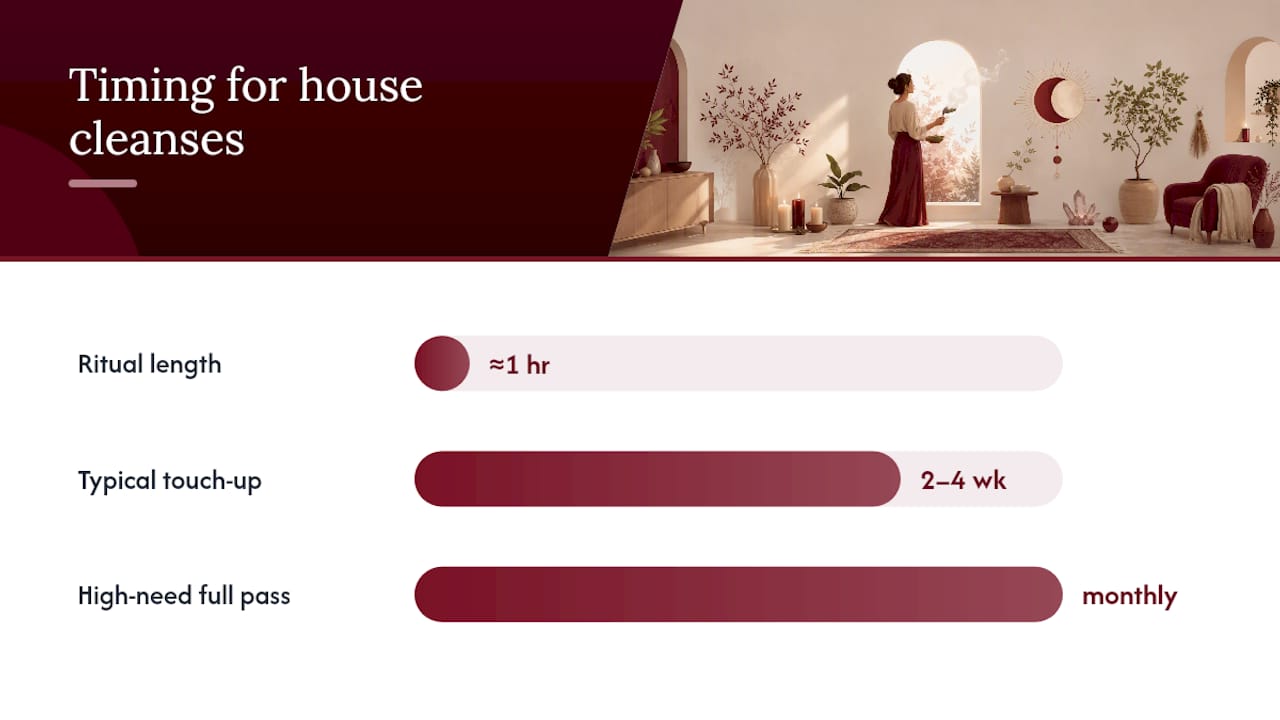
Run this in order, in one sitting if you can. Most homes take about an hour or so to complete a house cleansing ritual.
- Pick your time and gather supplies. Choose a day you won’t be rushed, morning light works well for most people, and set out whatever you’re using: a broom, salt, a bell or bowl, water, oil, or a bundle of dried herbs.
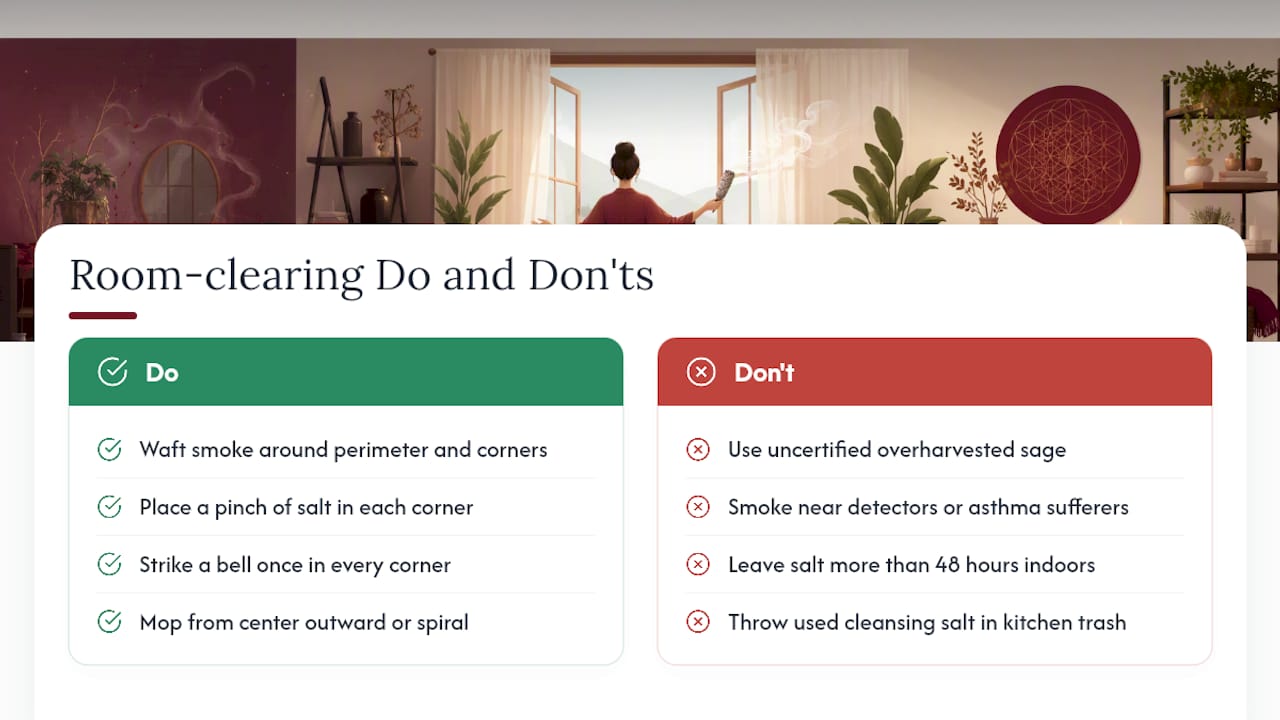
- Check safety basics first. Disable smoke detectors near the area you’re smudging (never disconnect the whole system), keep pets in a separate room during the smoke or sound phase, and crack a window for airflow before you strike a match.
- Deep clean the physical space. Declutter surfaces, vacuum corners, wipe down doorframes and windowsills. This isn’t prep work you rush through, it’s half the ritual.
- Open every window you can, even briefly. You’re creating a literal exit route for whatever you’re about to move out.
- Walk the home slowly and “listen.” Stand in each room for a few seconds. Notice temperature shifts, sounds, or a room that just feels heavier. Mark those spots mentally, you’ll spend extra time there.
- Do your banishing pass. Move through the home counterclockwise, widdershins, carrying smoke, a bell, or salt water, and pay extra attention to the corners and closets you marked. This pass is about removal, not invitation.
- Do your blessing pass. Reverse direction, clockwise, deosil, and repeat the walk, this time speaking or thinking your intention for the space: peace, protection, warmth, whatever you named at the start.
- Anoint or seal entry points. Touch a drop of oil, water, or salt to the main door threshold and any windows that stayed shut during the ritual.
- Dispose of ritual remnants properly. Burned herb ash goes outside, ideally buried or scattered away from the house. Used salt gets swept outdoors, not into your kitchen trash. Nothing from a banishing pass should linger inside overnight.
- Log the date and how the home feels. A one-line note in your phone is enough. You’ll want it later to track whether the effect holds.
The directional detail matters more than it looks. Widdershins for banishing and deosil for blessing is a convention many traditions share, keep the two passes distinct so you’re not accidentally blessing what you’re trying to remove.
Pro Tip: If a room keeps feeling “off” after the full ritual, don’t repeat the whole process there. Do a two-minute mini-cleanse instead, one bell strike, one sweep of smoke or spray, and check again in a few days before escalating.
Most homes hold their reset for two to four weeks before needing a touch-up. High-conflict households, homes with frequent visitors, or spaces recovering from a specific bad event (illness, breakup, burglary) tend to need monthly full passes rather than seasonal ones.
How Do You Smudge, Salt, and Sound-Clear a Room?
Each method below stands on its own. Pick one that fits your space, your budget, and your comfort with smoke, or combine two or three for a fuller ritual.
Smudging and sacred smoke. Buy dried bundles from a source that discloses where the plant was harvested. Overharvested white sage has become a real sustainability problem, so look for suppliers who grow their own or source from land they have permission to harvest. Light the tip until it catches flame, then blow it out so it smolders and smokes rather than burns. Waft the smoke with a feather or your hand as you walk the perimeter, spending extra time in corners and closets. If you live in an apartment with sensitive detectors, or you or a family member has asthma, swap smoke for a spray, a Florida water mist, or a diffuser blend, the ritual intention carries through even without visible smoke.
Salt. Place a small pinch of plain salt in each room’s corners, this is the traditional absorption method for pulling negative energy out of a space. For a stronger pass, mix a salt-water spray: one tablespoon of sea salt dissolved in a cup of warm water, cooled, then transferred to a spray bottle for doorframes and windowsills. Leave placed salt for 24 to 48 hours before sweeping it up, then take it directly outside. Salt that’s absorbed negative energy doesn’t belong in your kitchen trash can.
Sound clearing. Bells, singing bowls, and tuning forks break up stagnant energy in a way smoke and salt can’t quite match, sound moves through a room instantly and reaches spots you’d otherwise miss. Strike a bell once in each corner of every room, then again near closets and under stairs, spots where air rarely circulates. There’s no need to chase a specific frequency; a clear, resonant tone you can hear fade out naturally is enough.
Floor wash. Steep a handful of cleansing herbs, rosemary, bay leaf, or mint are common choices, in hot water for ten minutes, strain, then stir in a tablespoon of salt once the water cools. Mop from the center of the home outward toward the front door, or in a spiral pattern if your tradition favors that, driving old energy toward the exit rather than trapping it in a corner.
Crystals. Selenite is the go-to stone for clearing, place a wand or tower near your front door or in a room that felt heavy during your walk-through. Black tourmaline does the opposite job, it grounds and absorbs rather than clears, so pair it near electronics or in bedrooms where you want stability instead of movement. Clean crystals under running water monthly and set them in sunlight or moonlight for a few hours to recharge.
Aromatherapy for maintenance. Between full rituals, a diffuser running lemon, lavender, or eucalyptus keeps the reset feeling fresh without repeating the whole process. Run it for 20 to 30 minutes a few times a week, especially in rooms that see the most foot traffic.
Pro Tip: Never mix a heavy smudge session with a full salt floor wash on the same day if you’re new to this. Layering too many methods at once makes it hard to tell which one actually shifted the room, and it can leave the space feeling overworked rather than cleared.
Can You Cleanse a Home Through Prayer Instead?
Faith-based house cleansing works from a different premise than the secular or magical versions above. Instead of clearing generic “negative energy,” Christian and other faith traditions frame the goal as reclaiming a space for God, or removing objects and influences tied to practices the household no longer wants a connection to.
The steps look different from a smudge-and-salt ritual, but they’re just as practical:
- Walk through the home and identify objects tied to occult practices, curses, or a past owner’s rituals, then remove or destroy them rather than storing them elsewhere in the house.
- Anoint doorframes and windowsills with blessed or plain olive oil, a gesture used across denominations to mark a threshold as protected.
- Speak a direct prayer or declaration in each room, something as simple as “This home belongs to peace, and I ask that anything unwelcome leave now.”
- Burn only what’s safe to burn. Paper items or dried herbs are fine in a fireproof dish outdoors; anything with plastic, electronics, or unclear origin should be discarded in the trash or buried instead.
- Invite a pastor, priest, or elder to walk through with you if the home has a history you’re not confident handling alone, a past occupant’s practice, a violent event, or a family pattern that feels bigger than a weekend project.
The difference in language matters here. Where a secular ritual “clears,” a faith-based one “reclaims” or “consecrates.” Both aim at the same felt result, a home that feels lighter and safer, they just get there through different vocabulary and different sources of authority.
When Should You Call a Professional Like Mother Odessa?
DIY works for most everyday resets: a new apartment, post-argument tension, a general seasonal refresh. What it doesn’t do well is diagnose why a heavy pattern keeps returning, three failed relationships in the same house, a business that won’t stop losing money, a curse you suspect but can’t confirm. That’s where a practitioner with decades of hands-on diagnostic experience earns her fee.
A practitioner with decades of experience rooted in West African tradition builds custom rituals rather than one-size-fits-all scripts. Two services map directly onto what this guide covers: the House Blessing & Consecration Ceremony for a full-home reset and warding, and the Spiritual Cleansing Bath Ritual for readers whose own energy needs clearing alongside their home’s.
Before hiring a practitioner, ask a few pointed questions:
- Where do their ritual materials come from, and do they disclose sourcing?
- Will the ritual be customized to your specific situation, or is it a fixed script?
- What does follow-up look like after the initial session?
- How do they handle confidentiality around what you share?
A professional session usually includes a diagnostic conversation, materials suited to your specific case rather than a generic kit, and a follow-up window to check whether the work held.
How Do You Keep a Home Clear After the Ritual?
A cleansing isn’t a one-time fix, it’s the start of a maintenance rhythm. Treat it like cleaning a house: satisfying once, useless if you never do it again.
Weekly: Open a window for ten minutes, run a diffuser blend for five, and speak a one-line blessing at your front door as you leave or arrive.
Monthly: Do a light smudge or a floor wash in high-traffic rooms, check that your crystals haven’t gathered dust or moved out of place, and refresh any salt or wards you set during the last full ritual.
When something feels off again: Rule out the mundane first. Mold, a pest problem, a noisy neighbor, or bad sleep hygiene can all mimic “bad energy” convincingly. If the physical causes check out clean and the feeling persists, run a mini-cleanse focused on the specific room. If it still won’t budge after that, that’s the signal to bring in outside help, a practitioner, a pastor, or both, rather than repeating the same ritual for the fourth time.
Pro Tip: Keep a simple log, one line per entry, noting the date of each cleanse and how the home felt a week later. Patterns show up fast: if the same room keeps relapsing, the fix probably isn’t another ritual, it’s whatever’s physically happening in that room.
Does the Moon Actually Matter for Timing a Cleansing?
Timing isn’t required for a house cleansing to work, but plenty of practitioners sync their rituals to lunar phases on purpose. A waning moon, the two weeks between full and new moon, is the traditional window for banishing work, since the shrinking light is thought to mirror the energy you’re trying to reduce. A new moon itself is a popular reset point for starting fresh intentions right after a cleanse.
Full moons lean the opposite direction. They’re associated with charging, amplifying, and blessing rather than removing, so many practitioners save the blessing pass, or a crystal recharge, for the day of or just after a full moon. If you’re combining a floor wash with lunar timing, aligning the ritual with the waning moon is a common approach in modern practice.
Astrological timing adds another layer for readers who track it: some practitioners avoid ritual work during a Mercury retrograde, arguing that communication and intention tend to get muddled during that window, and prefer a Sunday or Thursday for blessing work tied to solar and expansive energy.
None of this is a requirement. A home in crisis doesn’t need to wait three weeks for the right moon phase, cleanse it now, and adjust timing on your next round if the calendar cooperates.
Where Do House Cleansing Rituals Actually Come From?
Nearly every culture with a fixed dwelling developed some version of this practice, which is part of why the instructions above overlap so much across traditions. Smudging with sacred plants traces to Indigenous North American practices, where specific herbs carried specific ceremonial roles long before the technique spread into broader use. Salt as a purifier shows up independently in European folk magic, in Japanese Shinto practice (where it’s scattered at thresholds and used in sumo rings), and in Jewish and Christian traditions tied to covenant and preservation.
Floor washing with herbal infusions has deep roots in Caribbean and West African spiritual practice, where specific plant combinations are chosen for specific outcomes, protection, love, prosperity, rather than a generic “cleanse everything” approach, as explained in Horror | Mark Watson Books. Bell and gong use for clearing stagnant energy is central to Buddhist and Hindu temple practice before it became a staple of secular sound-healing kits.
What ties all of it together isn’t the ingredient, it’s the underlying logic: a home absorbs whatever happens inside it, and every culture that’s lived in fixed structures for long enough has built a method to periodically reset that absorption. The specific herb or gesture changes. The reason people reach for one doesn’t.
What About Kids and Pets During the Ritual?
Smoke, sound, and unfamiliar scents can startle pets and small children faster than adults expect, so plan around them rather than working through the interruption.
Move pets to a room you’re not actively cleansing, with the door shut, during the smudging or bell phase. Cats and dogs both have far more sensitive hearing and smell than we do, a bell that sounds pleasant to you can be genuinely stressful at close range. Bring them back into the space once the smoke has cleared and the room has aired out.
For kids old enough to understand, frame the ritual as tidying and “making the house feel happy” rather than anything that implies danger was present, young children can absorb anxiety from language faster than from the ritual itself. Younger kids do best watching from another room or helping with the physical cleaning phase, vacuuming, wiping counters, since that part carries zero safety risk and gives them a sense of participation.
If anyone in the household has asthma, allergies, or a strong sensitivity to scent, that’s your cue to lean on smoke-free alternatives, sprays, sound, or salt, for the whole household’s sake rather than isolating one person in another room every time.
What Mistakes Ruin a House Cleansing Ritual?
The single most common mistake is skipping the physical clean and going straight to smoke or salt. Treating the deep clean as optional treats the canvas as already prepared when it isn’t, and a ritual performed over clutter and dust rarely holds.
A close second: rushing the banishing pass and skipping the blessing pass entirely. Removing negative energy without inviting something to take its place leaves a vacuum, and vacuums tend to get refilled with whatever’s easiest, often the same pattern you just cleared.
Other frequent errors worth naming directly:
- Burning unsafe materials indoors. Plastic-wrapped bundles, damp herbs, or anything near curtains or bedding is a fire risk, not a spiritual shortcut.
- Leaving used salt or ash inside the house. Both are meant to carry the removed energy out with them; leaving them in an indoor trash can defeats the point.
- Doing the ritual while angry or rushed. Intention shapes the outcome more than the tools do, a hurried, distracted pass rarely produces the calm you’re after.
- Ignoring a mundane explanation. Mold, poor ventilation, or a genuinely toxic relationship in the house won’t respond to salt and smoke, address the physical cause first.
- Repeating the same method obsessively without results. If a full ritual hasn’t shifted a room after two attempts, switch methods or bring in outside help rather than doing pass three of the same one.
A Practitioner’s Note on Doing This With Intention
The tools matter less than most guides let on. Sage, salt, a bell, holy water, they’re vehicles for intention, not the source of the effect. A rushed ritual performed with the right ingredients accomplishes less than a slow, focused one using nothing but a swept floor and an open window.
Sourcing deserves more attention than it usually gets. Sacred smoke materials in particular carry weight beyond their scent, and buying from a supplier who can’t tell you where the plant came from strips the ritual of the respect it’s supposed to embody.
If a pattern in your home keeps returning no matter what you try, that’s not a failure on your part. It’s a signal the work might need a second set of eyes.
— Psychic
How Motherodessa Can Support Your Home’s Reset
A professional practitioner is the option for readers who’ve run the DIY steps above and still feel a pattern won’t budge, offering custom ritual work built from decades of practice in West African spiritual tradition, not a generic script applied to every client.

Two services line up directly with what this guide covers. The House Blessing & Consecration Ceremony handles a full-home reset and warding when you want a practitioner to diagnose and design the ritual rather than guessing at which method fits. The Spiritual Cleansing Bath Ritual pairs well with a home cleansing when the energy that needs clearing is personal as much as it’s tied to the space itself. For patterns that feel more like an active threat than lingering stagnation, the Protection & Banishing collection covers focused work built around exactly that.
Every session ideally includes a custom ritual plan built around your specific situation, confidential handling of what you share, and follow-up to check whether the work held. Browse the full Spiritual Healing & Clarity collection to see which service fits your situation, and start with whichever one addresses what your walk-through actually turned up.
Sources
- A House Cleansing Ritual: Spiritually Protecting Your Space | John Beckett
- How to Cleanse a House: Physical & Spiritual Guide – EcoCraftyLiving
- A Cleansing & Protection Ritual For Interesting Times - Postmugglism
- 18 Easy Rituals to Reset Your Home’s Energy This Spring | Goop