
The Fiery Wall of Protection is a hoodoo and conjure working that surrounds a person or home with an aggressive spiritual barrier meant to repel active harassment, hostility, or psychic attack, not just deflect vague bad luck. It’s used when someone is already targeting you, whether through gossip, legal threats, workplace sabotage, or something harder to name. Treat it as a serious spiritual tool, not a substitute for calling police, a lawyer, or a doctor when the threat is physical or immediate.
TL;DR:
- The Fiery Wall of Protection is designed to actively repel targeted harm, not just ward off general bad luck, and works best against known threats.
- Invoking a Helper such as an angel, ancestor, or deity enhances the working’s effectiveness, emphasizing relationship and trust over mere ritual mechanics.
- Practical application includes dressing candles, floor washes, sachet powders, and carrying mojo bags, with scale and materials adjusted to the severity of the threat.
- A basic ritual requires only a white protectee candle, a black threat candle, a few guardian candles, and a protective oil, performed with specific lighting and spoken intent.
- Rituals do not replace urgent safety measures, legal action, or medical aid and should be tailored carefully to avoid mis-targeting or causing unintended harm.
Table of Contents
- What Is the Fiery Wall of Protection, Exactly?
- Fiery Wall Products and Ingredients, and How to Use Each
- How to Perform a Basic Fiery Wall Ritual
- Variations, Scale, and Common Adaptations
- Safety, Ethics, and the Limits of This Work
- How Mother Odessa Approaches a Fiery Wall Working
- An Honest Take on Fiery Wall Work
- Protection and Banishing Support From Mother Odessa
- Sources
What Is the Fiery Wall of Protection, Exactly?
Most protection rituals build a shield. The Fiery Wall of Protection builds a fence with a current running through it. That distinction shapes everything about how the ritual works and when practitioners reach for it.
A passive protection charm, like carrying a St. Christopher medal or sprinkling salt across a doorstep, tends to ward off generic misfortune. The Fiery Wall is different by design. It’s meant to actively repel someone who is already sending harm your way, whether that’s a jealous coworker, a vindictive ex, or an entity the client can’t quite name but feels pressing in. Practitioner and retail write-ups describe it as one of the most requested formulas in New Orleans style hoodoo because it handles active conflict rather than background bad luck.
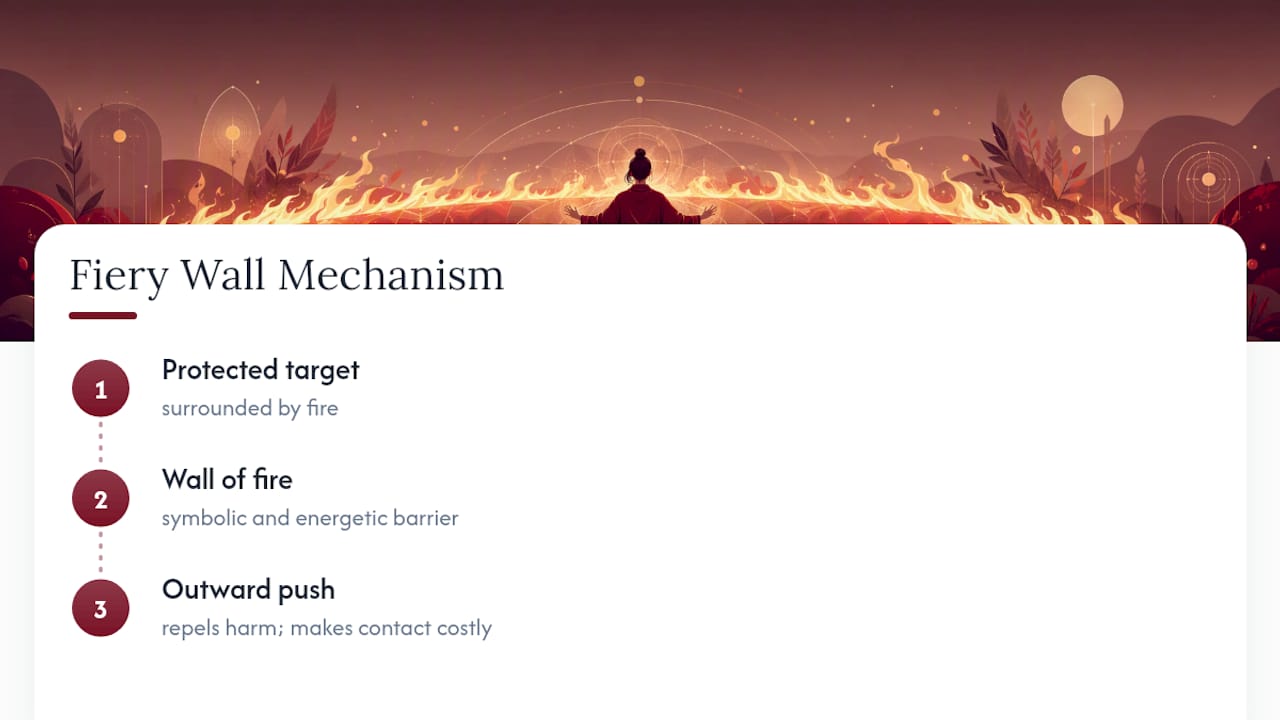
The mechanism, as practitioners describe it, works in two layers. First, a wall of protective fire surrounds the target, symbolically and energetically. Second, that fire pushes outward against anyone trying to breach it. One breakdown of the working frames it less as a shield and more as an electric fence: it doesn’t just block contact, it makes contact costly for whoever initiates it.
The Helper concept
Almost every version of this ritual calls on a Helper, a spiritual ally invoked to stand at the wall and enforce it. Who you call depends on your own tradition and comfort level:
- Archangel Michael appears constantly in Christian-influenced hoodoo practice, invoked as a warrior spirit who guards boundaries.
- A named ancestor works well when the threat is personal or familial, since ancestors are assumed to already be invested in your safety.
- A patron deity or spirit fits practitioners working within specific West African or diaspora traditions, where a particular spirit governs protection and justice.
- A general “guardian” or higher power works for anyone uncomfortable naming a specific figure, since the ritual’s structure matters more than the exact name spoken.
Church of Jesus Christ’s general conference teaching on spiritual protection makes a parallel point from a different tradition entirely: protection is tied to relationship and covenant, not just the mechanics of a ritual. Whatever Helper you call, the working assumes a relationship, not a vending machine. You’re asking for backup, not pushing a button.
Fiery Wall Products and Ingredients, and How to Use Each
Walk into any hoodoo supply shop, physical or online, and the Fiery Wall section usually has five or six product types sitting side by side. Each does a slightly different job, and knowing which one fits your situation saves you money and mess.
Dressing oil is the workhorse. It’s a blend, commonly built around rue, basil, angelica root, frankincense, and dragon’s blood, each herb carrying its own job in the formula. Formula breakdowns from practitioner blogs note that rue handles the defensive, hex-breaking end of things, while dragon’s blood adds raw power and heat to the mix, and frankincense lends a cleansing, elevating quality. You anoint candles with it, dab a little on doorframes, or wear a drop on pulse points when you need protection on the move.
Sachet powder is the same herbal logic in dry form. Sprinkle it across a threshold, dust it into shoes, or add a pinch to a floor wash. It’s less messy than oil for regular home maintenance work.
Incense carries the working through the air, which matters if your goal is clearing a whole room or home rather than dressing one object. Burn it during the ritual itself or afterward as upkeep.
Salts and crystals get dissolved into floor washes or bath water. Product pages built around this formula describe mixing mineral salts into a bucket of mop water for the whole house, or into bath water for a personal working. The bath version is worth calling out on its own since it’s the most physically immediate way to use the formula.
Candles anchor the ritual visually and symbolically. A dedicated Fiery Wall candle, often red or a striped red and black design, gets dressed with the oil and burned as the centerpiece of the working.
Mojo packets are the portable, long-term version. A small flannel bag holds a mix of herbs, a personal item, and sometimes a small charged object, carried on the body for ongoing protection rather than a one-time ritual.
Here’s how the application actually breaks down in practice:
- Dressing a candle: rub oil from the middle outward to both ends, never end to end in one stroke, then roll the candle in the matching powder if you have it.
- Anointing yourself: a drop on the wrists, back of the neck, and center of the forehead before you leave the house on a hard day.
- Floor wash: dissolve a tablespoon of salts or a pinch of powder in warm mop water and wash from the back of the house toward the front door, pushing negativity out.
- Protective bath: dissolve crystals or a handful of herbs in bath water, soak for at least ten minutes, and let the water go down the drain rather than rinsing it off your skin afterward.
- Carrying a mojo packet: keep it close to your body, in a pocket or on a cord, and refresh it with a drop of the matching oil every week or two.
Pro Tip: If you can’t find a pre-made Fiery Wall blend locally, you can build a rough substitute from rue, dried basil, and a pinch of cayenne or paprika for heat. It won’t match a practitioner-formulated oil exactly, but the core defensive and fiery elements are there, and something imperfect beats nothing when you’re dealing with an active problem.
One caution worth repeating here since it applies to every form: dragon’s blood resin and some rue preparations can irritate skin or, in the case of rue, cause real harm if ingested or handled carelessly during pregnancy. Treat these as ritual materials, not kitchen spices.
How to Perform a Basic Fiery Wall Ritual
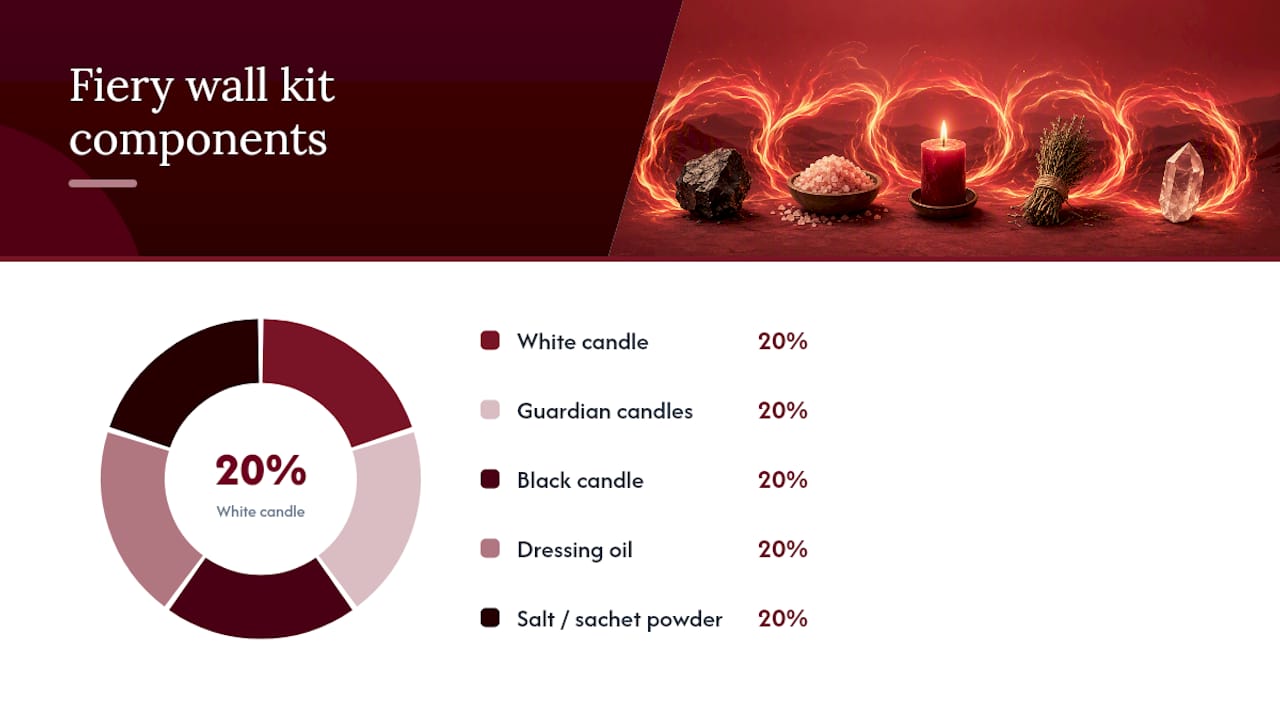
You don’t need a fully stocked apothecary to run this working. A stripped-down version with five materials covers the essentials, and simplified spell recipes from practitioner sources confirm the minimal-kit approach is both common and effective for personal use.
What you need:
- One white candle to represent yourself or the person being protected.
- Two to four smaller candles in purple, blue, or gold to represent your Helper or guardian spirits.
- One black candle to represent the person or force causing trouble.
- Fiery Wall dressing oil, or a homemade rue and dragon’s blood substitute.
- A pinch of protective salt or sachet powder.
Step by step:
- Clean your ritual space and wash your hands. This is basic practice, not superstition. You want a clear head and a clear surface.
- Set the white candle in the center of your working surface. This represents you or the person you’re protecting.
- Dress the white candle with oil, rubbing from the middle out to each end, then set it down.
- Arrange the guardian candles in a rough circle around the white candle, leaving a gap facing outward. These represent the Helpers you’re calling in.
- Place the black candle outside that circle, several inches away, facing the gap. This is the threat, kept at a clear distance.
- Sprinkle a ring of salt or sachet powder connecting the guardian candles, closing the circle around the white candle.
- Light the white candle first and speak a short statement of intent asking for a wall of protective fire to surround you, that no harm may pass through.
- Light each guardian candle in turn, naming your Helper aloud. A simple line works: “Archangel Michael, stand at my wall,” or the name of the ancestor or spirit you’re calling.
- Light the black candle last, and speak directly to the threat: “You may come no closer. This fire turns you back.”
- Let the candles burn down completely if you can safely supervise them, or extinguish and relight them at the same time each day until they’re gone.
One recurring detail across shop and blog write-ups worth flagging: the order matters more than the exact wording. Light protectee, then guardians, then the antagonist candle last, so the wall exists before you formally acknowledge what it’s standing against.
Pro Tip: Never leave a burning candle unattended, especially the black candle, which some practitioners let burn out fully away from the home, such as at a crossroads or in an outdoor fire pit, as a symbolic act of pushing the threat away from your space.
Once the candles are spent, wrap the leftover wax and any burned herb residue in paper and dispose of it away from your home, ideally at a crossroads or running water if that fits your practice. Save a portion of the ash or wax to add to a mojo packet if you want an ongoing, portable version of the protection.
Variations, Scale, and Common Adaptations
The basic ritual above scales up or down depending on what’s actually happening in your life. A single stressful coworker calls for something much smaller than protecting an entire household from a sustained pattern of harassment.
- A quick personal working uses just the white candle, one guardian candle, and a single anointing before a hard meeting or court date. It’s meant to last hours or days, not weeks.
- An extended family or home working adds candles for each household member and often runs over multiple nights, paired with a floor wash through the whole house and fresh sachets placed at every entrance.
- Moving out a perpetrator is one of the more specific and sensitive adaptations. Rather than a violent framing, most practitioners approach this as encouraging someone to lose interest in staying, to find reasons to leave a shared space or relationship voluntarily. This is meaningfully different from a banishing worked in anger, and it’s worth being honest with yourself about which one you’re actually doing.
- Regional substitutions matter if you can’t source rue or dragon’s blood locally. Basil and cayenne cover a rough approximation of the heat and clearing qualities, and a strong black tea or coffee wash can stand in for some of the grounding elements in a floor wash.
- A longer ceremony makes sense when the threat is ongoing rather than a single incident, such as a prolonged legal dispute, sustained workplace bullying, or a family pattern that’s clearly repeating across years.
The through line across every variation: match the scale of the ritual to the scale of the actual problem. A nine-day working for a single rude email is overkill. A single-candle working for a genuinely dangerous stalking situation is undersized, and that’s a case where pairing ritual work with real-world protective steps, documented in daily psychic protection routines, matters more than the candle count.
Safety, Ethics, and the Limits of This Work
Ritual work has a real place in handling fear, targeted hostility, and the feeling of being spiritually exposed. It does not replace the systems built to handle physical danger, legal disputes, or medical emergencies, and no serious practitioner will tell you otherwise.
- If you are in physical danger, call emergency services or the police first. A Fiery Wall candle burning on your altar does not stop someone from breaking into your home.
- If the conflict involves contracts, custody, harassment, or anything with legal weight, talk to a lawyer. Ritual work can run alongside legal action; it cannot substitute for it.
- If you’re dealing with a medical crisis, whether physical or a mental health emergency, get medical care. This applies to you and to anyone the ritual concerns.
- Confirm who you’re actually targeting before you burn a black candle naming someone. Misdirected ritual work aimed at the wrong person, based on a guess or gossip, causes real relational damage and doesn’t solve the actual problem.
- Avoid framing this as revenge work. A wall that repels harm is different in both intent and structure from a working built to hurt someone back, and most practitioners draw that line deliberately.
- Never leave open flame unattended, and keep candles on a heatproof dish, away from curtains, papers, or anything flammable. This sounds obvious until it’s midnight and you’re exhausted.
There’s a psychological dimension worth naming too. Ritual work aimed at a specific person, even protective ritual, can deepen anxiety if you’re constantly re-litigating the conflict every time you light a candle. Background material on the limits of hoodoo protection work consistently frames these workings as preventive and complementary rather than curative, which matters if you’re using ritual as your only coping mechanism for an ongoing crisis.
Pro Tip: If a situation feels too big to handle with a home altar and five candles, that’s usually a sign to bring in outside help, spiritual, legal, or medical, rather than escalating the ritual on your own.
How Mother Odessa Approaches a Fiery Wall Working
Forty-plus years of practice teaches you that no two Fiery Wall cases look the same, even when the candles and oils on the shopping list are identical. Mother Odessa’s approach starts with the actual situation, not a fixed script.
A commissioned working typically starts with a case assessment: who’s involved, what’s actually happening, and whether the threat is a single bad actor, a pattern of harassment, or something harder to define, like a persistent feeling of being spiritually targeted without a clear source. That intake and customization process shapes which Helper gets called, how the candles are arranged, and whether the working closes in one session or needs to run longer.
What a client typically receives:
- A working built around their specific case rather than a generic template pulled off a shelf.
- Selection of a Helper that fits the client’s own background and comfort, rather than a one-size figure applied to everyone.
- A mojo packet or ongoing material component when the situation calls for lasting protection, not just a single ritual moment.
- Follow-up guidance on what to expect and how to maintain the working afterward.
- Privacy throughout, since these situations are often deeply personal and sometimes involve people the client still has to see regularly.
So when does hiring a practitioner make more sense than the DIY version above? A single stressful week at work, handled with a quick personal candle working, doesn’t need a commissioned ritual. A sustained pattern, someone who’s clearly and repeatedly targeting you, a family situation with real history behind it, or a case where you genuinely can’t tell who’s responsible for what you’re feeling, is where an experienced assessment earns its cost. You can always start with the DIY steps and escalate to a bespoke working if the problem doesn’t resolve.
An Honest Take on Fiery Wall Work
Most articles on this topic treat the Fiery Wall like a fixed recipe: light these candles in this order, and the problem goes away. That’s not how it actually works, and it undersells the ritual’s real strength. The working succeeds or fails based on whether you correctly identified the actual threat, not on whether you burned the exact right shade of purple candle.
Conventional advice skips right past the hardest part: sitting down and being honest about who or what is actually causing harm before you name a target. Skip that step and you get a technically correct ritual aimed at the wrong problem. That’s wasted effort at best and a new conflict at worst.
If you take one thing from this guide, prioritize accurate targeting over ritual precision. A simple, correctly aimed working with three candles and a homemade oil outperforms an elaborate nine-day ceremony pointed at a guess.
— Psychic
Protection and Banishing Support From Mother Odessa
Sourcing the right herbs and getting the candle order right is only half the job. The harder part, figuring out exactly who or what you’re dealing with and which Helper actually fits your case, is where a self-guided ritual usually runs into trouble. That’s the gap Motherodessa’s Protection & Banishing services close.

The collection covers targeted defensive workings built around your specific situation, including approaches modeled on the Fiery Wall concept for active harassment or psychic intrusion, plus dedicated Psychic Attack Defense work for cases where the source of trouble is harder to pin down. Orders typically start with details about the situation so the ritual can be built around what’s actually happening, not a generic template. Reports are delivered privately, and turnaround expectations are provided before ordering so there’s no guessing.
If you’re not sure which service fits, start with the Protection & Banishing collection and look for the option closest to your situation, whether that’s a single aggressor, a household concern, or a pattern you can’t quite explain. Ethical practice means confirming who’s actually targeted before any work begins, the same principle covered earlier in this guide. Browse the Protection & Banishing collection to see current options and request a consultation.
Sources
The Fiery Wall of Protection draws on decades of documented hoodoo practice, and a few sources stand out for readers who want to go deeper. Lucky Mojo’s Fiery Wall of Protection page remains the most detailed retail and practitioner breakdown of materials and procedure. Grove and Grotto’s write-up offers a clean, simplified version of the ritual for readers building a minimal kit. For a broader framework on spiritual protection tied to faith and covenant, the Church of Jesus Christ’s general conference address offers a useful contrast from outside hoodoo tradition. Readers interested in complementary protective jewelry can also review GothMarket’s piece on occult jewelry for context on wearable protective items.
- The key to spiritual protection — General Conference (Church of Jesus Christ)
- Fiery Wall of Protection — Lucky Mojo
- The Fiery Wall of Protection — Grove and Grotto